

This is Naked Capitalism fundraising week. 719 donors have already invested in our efforts to combat corruption and predatory conduct, particularly in the financial realm. Please join us and participate via our donation page, which shows how to give via check, credit card, debit card, PayPal. Clover, or Wise. Read about why we’re doing this fundraiser, what we’ve accomplished in the last year,, and our current goal, continuing expanded daily Links.
Conor here: Korybko tries to come up with some workable terms, but perhaps the biggest problem with his idea is what he says midway through the piece: “All of this is sensible.”
Exactly, which is why it would never fly in a Europe where too many people in power have taken leave of their of their senses. We only have to look to the recent meeting between Foreign Minister Sergey Lavrov and Germany’s Federal Minister of Foreign Affairs Johann Wadephul for a reminder:
Lavrov on his conversation with German official Wadephul:
When we met, I invited him to lay out the purpose of his visit. He took out his notes and read a text that was a verbatim repetition of what German leaders state officially and publicly on a daily basis.
That is… pic.twitter.com/93RPMIIL4p
— Victor vicktop55 commentary (@vick55top) September 26, 2026
Just more narrative control games from the European side:
The difficulty is that Lavrov says Wadephul talked at him rather than with him. Diplomacy traditionally requires at least two participants. https://t.co/j5bKolem6q
— Brian McDonald (@BrianMcDonaldIE) September 26, 2026
It’s really hard to see why the Russians would agree to such a proposal, and as Lavrov stated plainly just the other day, they will not pause their operations in Ukraine for talks in any format.
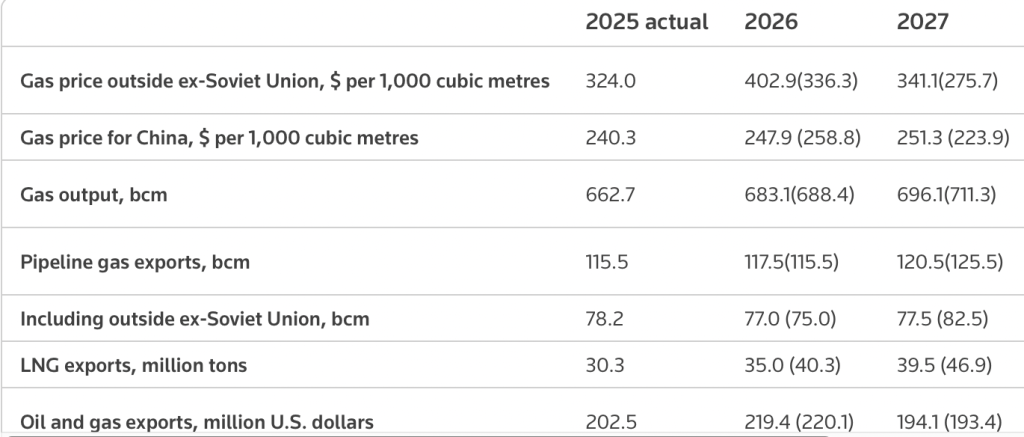
Meanwhile, in other Russia energy news. Talks with Beijing over the Power of Siberia 2 pipeline continue to drag on with the two sides reportedly still far apart on prices. Overall, Russia is doing just fine even without pipeline gas heading to Europe, and forecasts are steady despite the EU’s plan to stop all purchases of Russian gas come New Year’s Day 2027:
Source.
By Andrew Korybko, a Moscow-based American political analyst who specializes in the global systemic transition to multipolarity in the New Cold War. He has a PhD from MGIMO, which is under the umbrella of the Russian Foreign Ministry. Originally published at his website.
Restoring some of their pre-2022 complex mutual interdependence through US mediation, even if only for the wintertime, could facilitate a series of pragmatic diplomatic-military compromises aimed at resolving the Ukrainian Conflict and jointly building the new continental security architecture.
Zelensky recently proposed a partial truce with Russia that would include, among other things, eschewing attacks on each other’s energy infrastructure. The strategic context concerns Russia’s ramped-up systematic strike campaign against Ukrainian power plants, gas stations, ports, and most recently, locomotives, all of which aims to cripple its military logistics by winter for achieving a Russian breakthrough. The Kremlin therefore doesn’t have any interest in accepting this lopsided arrangement.
That could change, however, if Russia makes at least the energy dimension of Zelensky’s proposal conditional on resuming its pipeline exports to Europe. It’s not just Ukraine that’s poised to experience its must difficult winter in years but the EU as a whole too according to the European Commissioner for Energy and Housing in a recent interview with the Financial Times. This is due to the global fuel crisis brought about by the Third Gulf War and Ukraine’s spree of attacks against Russian refineries this year.
Ukraine desperately needs relief from Russia’s systematic strikes against its energy infrastructure this winter, the EU desperately needs more energy amidst the global fuel crisis during the same season, and Russia is unlikely to turn down the influx of revenue even if the windfall is only for several months. A deal could take the form of resuming gas exports to Germany via the one undamaged Nord Stream pipeline possibly together with oil and gas exports to Poland (and beyond) via the Druzhba and Yamal pipelines.
The resumption of Russian pipeline exports to Europe, even if only for the winter, would restore some of their pre-2022 complex mutual interdependence for raising the odds that the energy truce is respected. The EU will still survive the winter even without Russian pipeline imports, and Russia can continue funding its military operations even without pipeline exports to Europe, but Ukraine might not survive without relief from Russia’s systematic strikes against its energy infrastructure.
Accordingly, the EU could sever its imports from Russia if Russia violates the energy truce, while Russia could sever its exports to the EU if Ukraine does so instead. While skeptics might suspect that Russia has more to gain from violating the energy truce due to Ukraine’s increasingly desperate military-strategic situation, Russia has a greater interest in jointly building the new continental security architecture with European NATO (E-NATO), which it can’t do without a relative normalization of ties. All of this is sensible.
If an energy truce is agreed to on the condition of Russia resuming at least its Nord Stream exports to Europe, then the “snowdrop diplomacy” formula proposed here could be advanced, which might see the mutual drawdown of E-NATO forces from the Baltic States in parallel with Russian ones from Belarus. The US might then purchase Nord Stream from Russia as has been floated, and perhaps also the Belarusian parts of Druzhba and/or Yamal, for upholding this new order and facilitating a grand deal over Ukraine.
The resultant security architecture could have partial buffers in the Baltic States, Belarus, and Ukraine, while the western flank of the “cordon sanitaire” would have a US-backed Polish-led Intermarium counterbalance a German-dominated militarized EU. Poland would also still be the US’ LNG hub in Europe since the US would probably raise the price of the Russian pipeline gas under its control to keep its own gas competitive. This balance of interests is realistic and should thus be seriously considered.
