

The media landscape continues to shift as Netflix purges its executive class while Larry Ellison borrows big dollars to backstop his son’s Skydance media empire.
Let’s start with Netflix.
Netflix Cuts 1,000 Jobs, Including Key Executives
Puck had the scoop before the layoffs happened, reporting on October 9 that Netflix was planning to cut about 5% of staff. Puck explained the likely reasoning:
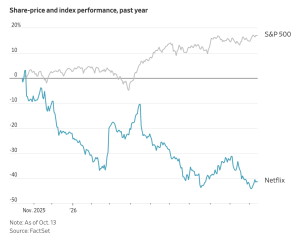
Netflix does restructurings periodically, though its last big public layoff was in 2022, amid the Great Netflix Correction and a period of slowing growth, and that reduction hit only about 150 employees, or about 2 percent of the workforce. The company’s share price has been under pressure since last year’s failed bid for Warner Bros. and amid slowing engagement growth on the platform.
On the 14th, The Wall Street Journal reported that “the bulk of the cuts would be in the streaming giant’s product, tech, legal and human-resources teams:”
Netflix, confronting flagging engagement, has tried a number of ways to get subscribers to spend more time on its platform, including adding live channels of programming, as well as bundling with other streaming services. It has added video podcasts and YouTube creators’ shows to its service, as well as live sports and events.
While its rate of customer defections is by far the best in the industry at just over 2% in the U.S., according to Antenna, shares have fallen more than 40% over the past 12 months.
Netflix isn’t alone among tech and entertainment companies making cuts. Disney and Amazon.com have both significantly reduced head count in the past several months.
CNBC reported that “Netflix’s biggest threat has been YouTube, but looming on the horizon is Skydance. The combined entity of Paramount and Warner Bros. Discovery has plans to integrate the two companies’ streaming platforms, Paramount+ and HBO Max.”
The September 10 Nielsen US TV viewership numbers, which cover July, show why Netflix was feeling stressed, with YouTube way out in front and a combined Paramount/WBD poised to jump ahead, leaving Netflix in fifth place:
Some Very Big Names on the Chopping Block
The biggest casualty of the layoffs was Chief Content Officer Bela Bajaria. Variety obviously spoke to some sources kindly disposed to Bajaria:
One word that came up in nearly a dozen conversations with industry players this afternoon about Bajaria’s pink-slipping: “scapegoat.”
Netflix is obviously against the ropes again, after slowing user engagement on the service rattled Wall Street investors and layoffs came this week as a sacrifice to the share price. But Bajaria’s dismissal makes it clear, according to the numerous sources we spoke with, that content is once again going to take it on the chin.
“People always blame the content,” said the source, “but you don’t lay off 1,000 people unless there’s a big problem with the business model.”
Bajaria’s exit echoes similarly shocking removals in Netflix history — notably that of Cindy Holland, the company’s first content queen who oversaw flagship hits like “House of Cards,” “Stranger Things” and “The Crown.” Holland was ousted in 2020, when Sarandos combined English-language and international content under Bajaria (elevating the latter to the largest autonomous content job in the streamer’s history).
Holland, one insider with knowledge of Netflix observed to Variety, built a business of boutique hits. Bajaria’s foresight was sharper, investing in local language productions and building up Netflix’s global presence (almost two dozen international offices were opened during Bajaria’s reign). She is also credited internally with pushing the streamer into live entertainment. Bajaria was on the “ground floor” of licensing deals with WWE and the NFL, which have proven significant draws for the ad-supported tier of Netflix subscribers, per the source. Her talent relations were on par with others at her level (Bajaria was ubiquitous at premieres and launches in film and TV, most recently at Sarandos’ side at the L.A. premiere of Ben Affleck’s “Animals”).
“The problem isn’t engagement,” said yet another person with knowledge of Netflix. “It’s that the only lever to pull for revenue growth is raising the subscriber price. How’s that Bela’s problem? Where’s the CFO and the CEO?”
Page Six has a more gossipy take:
In a twist worthy of a Netflix drama, ousted chief content officer Bela Bajaria only learned of her firing at 5p.m. on Wednesday before a VIP screening of “Nobody Wants This” — after the streamer had repeatedly reassured her that her job was secure…
“She got f–ked — she got blindsided,” says a source with knowledge of the tick tock surrounding Bajaria’s ouster and the layoffs. The source said that, “she knew there were rumors,” she’d be let go, but was told in recent weeks that her job was safe.
…
“What was extra s–ty is that they made her go to these Town Halls and meetings of team leaders to be like, ‘This is a hard day,’ and to be all supportive and calm,” said one insider. “It’s like, just tell her to her face. They could have just fired her.”
…
“I’m a little perplexed,” said a top Hollywood agent. “Netflix is definitely looking for their next hit. They don’t have anything to replace ‘Stranger Things.’ They don’t have that big show that’s on deck. But how the f–k do you blame that on Bela? Other people have greenlight authority [too]. Bella was grabbing NFL rights and wrestling. I think Netflix is one of those weird new age digital corporations that’s like, ‘change is good.’ They are losing subscribers and the stock is down.”
…
“It’s like the last days of Babylon over here,” said a Netflix employee when asked about the mood inside the streamer’s Hollywood offices. “People are losing their minds over this. They’re either popping champagne or cowering in their offices.”
During Bajaria’s four year run as its top programmer, Netflix effectively won the streaming wars. But more recently subscriber engagement on the platform plunged, and Netflix has been largely shut out of the awards race while the stock is down after its failed bid to acquire Warners.
Some also questioned the purchase of Ben Affleck’s AI company for nearly $600 million.
Bajaria came up through CBS and then Universal TV before landing at Netflix in 2016, and had a reputation for embracing more mass market content. She famously described her programming strategy as a “gourmet cheeseburger” in a New Yorker profile, and it was on her watch that Netflix expanded into live events, videocasting and game shows — genres Netflix co-founders Sarandos and Reed Hastings vowed they would never get into.
Another high-profile casualty was Netflix Film Chairman Dan Lin. Deadline has the deets:
Many were shocked when the ax swung last week and it missed Lin’s head, landing on his lieutenant co-head of film Doug Belgrad. It was seen that Belgrad was an extra layer at the top of Netflix’s film brass that could easily be let go, dollar-wise. Lin was expected to be safe until Rice took over officially on October 26. It was at that point in time the exec planned to assess the situation.
What is all boils down to is this question: Netflix, what is it you exactly want? All of streaming has turned into basic cable as we get farther away from Covid, and Netflix looked to Lin in April 2024 post-Scott Stuber to ratchet down the quantity of features and at a lower cost. He arrived after being a producer at his own hub, Rideback. From 2008-2024, Lin produced movies that minted $6 billion at the global box office.
Lin did exactly what Netflix asked, steering away from overpriced $200 million-plus, non-downstream features like Red Notice, The Irishman and The Electric State.
However, he had a no-nonsense approach to filmmakers, and hand no problem reportedly pushing back on prestige content creators like Greta Gerwig and Ben Affleck. During the Lin regime, one source told us that relationships with filmmakers were fraying. Recently, The Further Mis-Adventures of Cliff Booth filmmaker David Fincher opted not to renew his longtime exclusive contract with the streamer. That said, we’re also hearing there was never any bad blood between Fincher and Lin.
During Lin’s run, Netflix saw its most viewed movie of all-time, Sony’s KPop Demon Hunters (325.1M global views). However, that was greenlit under the Stuber administration. For Lin and Belgrad, their bragging rights include War Machine ($80M production cost, 147M views), the animated movie Swapped (144.9M views, which broke into the streamer’s top 10 all-time list), The Rip ($100M production cost, 136M views), Happy Gilmore 2 (135.1M), Apex (129M), Thrash (100M views) and People We Meet on Vacation ($14M production cost, 77.1M). Still there wasn’t a consistent reseeding of the Top 10 Most Popular list like there was during the Stuber era.
Also during the Lin regime, he acquired two-time Oscar winner Emila Pérez in addition to the streamer’s current awards contender, Cannes winner La Bola Negra.
Again, Page Six has the fun stuff:
Ben Affleck may have played a role in Dan Lin being shown the door at Netflix, sources say.
…
We’d previously reported that Affleck had soured on Lin, an executive said to be making $12 million a year, over the release of the star’s latest film, “Animals” — and that Lin didn’t introduce the film at its premiere, and was only spotted on the red carpet.
But sources say the issues were also over Netflix’s purchase of Affleck’s AI company, InterPositive.
We hear that Lin, known for his penny-pinching, questioned the deal that Netflix made to buy Affleck’s outfit for $587 million.
Then again, Lin wasn’t the only one inside Netflix who was skeptical of the eye-popping price — and many staffers there remain unsure if the tech is worth the bill.
“Part of Dan’s appeal when he was hired was his dispassionate approach to budgets and cutting output, which is what [co-CEO Ted Sarandos] wanted at the time and liked about him. But that same dispassionate personality ultimately cost him his job,” says an exec at a production company with business at Netflix.
The Hollywood Reporter headlined its piece “Dan Lin Was Fired for Being Dan Lin” and subtitled it, “Netflix wanted a blunt communicator who could rightsize budgets. Until it didn’t.”
It was a fitting anecdote given that Dan Lin — the Harvard Business School grad turned studio executive turned movie producer behind hits like The Lego Movie and $1 billion grosser Aladdin who is known for his calculating and budget-conscious acumen — was hired to be Dan Lin. And he was Dan Lin all the way until Netflix made the decision that it no longer wanted a Dan Lin-esque figure running its movie division.
…
When Bajaria hired him in the spring of 2024, his mandate was to rein in spending (no more $300 million Russo brothers movies) and improve the quality of the slate.
“Dan was very frank in feedback. Blunt, even,” says one Netflix insider. “Some talent was used to being handled with velvet gloves.”
…
Sources say that in spite of the talk of chafing talent, he was able to secure big names to work with Netflix. He landed projects that are still unannounced with Keanu Reeves, Ben Stiller and the famously streaming-averse Jason Statham, according to sources. And filmmaker Guillermo del Toro, who earned Oscar nominations for his adaptation of Frankenstein and won a best animated film Oscar for his take on Pinocchio, re-upped his film deal while under Lin.
As for the movies, Lin’s slate was just starting to get in front of audiences this year. Alan Ritchson’s sci-fi movie War Machine and the splashy book adaptation Remarkably Bright Creatures were two of Lin’s early greenlights, and came out in February and May, respectively. Both generated huge viewership numbers. When he arrived in 2024, he worked to fill holes in the 2025 slate, greenlighting Nonas, Happy Gilmore 2, My Oxford Year, The Thursday Murder Club, and House of Dynamite — and buying Oscar contender Train Dreams.
The other major exec to get whacked was VP of Film Doug Belgrad. Deadline has the scoop:
When Belgrad arrived at Netflix, there was the challenge to make movies at a lower cost. Lin and Belgrad built a slate of titles through 2028. Belgrad focused much of his time on shepherding filmmakers through post-production.
Former top Sony executive Belgrad also tended to Sony’s output deal at Netflix. In addition to the $7B Pay-1 agreement with Netflix for indie studio’s theatrical films, the pact also called for Sony to funnel a number of direct-to-streaming movies to Netflix (the Culver City lot was responsible for the streamer’s most watched movie ever Kpop Demon Hunters, which also doubled as Netflix’s first movie to open at No. 1 at the weekend box office in late August 2025). Belgrad worked with Sony leadership of Tom Rothman, Sanford Panitch and Elizabeth Gabler, to identify which pictures would fill direct-to-Netflix slots. These movies included People We Meet on Vacation, Voicemails from Isabelle (51M views in 11 days), and 72 Hours starring Kevin Hart. Other direct Sony-to-Netflix movies in the pipeline are Grown Ups 3 (Belgrad was the exec on the first two movies at Sony), Matter of Time with Ben Stiller, and Yeti starring Chris Pine.
During his Netflix run, Belgrad was instrumental in packaging such movies as Extraction 3, Protecting Jared (starring Jason Momoa and Andy Samberg), War Machine (147M views), The Rip (136M views), Happy Gilmore 2, The Serpent and the Snake, Unabomber (starring Russell Crowe), 13 Going on 30, Jennifer Lopez and Brett Goldstein’s Office Romance (58M views), Remarkably Bright Christmas, 2034 (AI cautionary tale directed and written by Joseph Gordon Levitt and starring Rachel McAdams), Whisper Man and an untitled David O. Russell movie (both starring Robert De Niro), Ugly Kitten and Double Bind (starring Will Smith).
Belgrad also worked with top filmmakers at Netflix including but to limited to Greta Gerwig, Guillermo del Toro, Peter Berg, Rian Johnson, Christopher McQuarrie, Eva Longoria, Antoine Fuqua, Cameron Crowe and Amy Sherman Palladino.
Deadline also reported on rumors that Co-CEO Ted Sarandos had recently lunched with former Warner Bros Studio heads Michael De Luca and Pam Abdy, but that doesn’t appear to be the direction the streamer is going in.
Meet the New Boss
Variety reports that Peter Rice, the former president of 21st Century Fox and former chairman of Walt Disney Television will be taking Bajaria’s place as Netflix’s Chief Content Officer and adds this big picture commentary:
…what we once called a movie executive might now be called a content officer, and there’s a larger change as well. Where film executives used to have to follow the numbers, now they follow the algorithms. And here’s the difference: Numbers are something you’re in charge of, while algorithms have a way of taking charge of you.
…
(Rice’s) roots are in the world of old-school movie-executive passion. In his new position, he’ll oversee both movies and television, which is a perfect role for him, since he has worked on the small-screen side ever since he was promoted to chairman and CEO of the Fox Networks Group back in 2012. But when he was president of Fox Searchlight, from 2000 to 2009, Rice was one of the most revered movie executives of his time, overseeing titles like “Slumdog Millionaire,” “Juno,” “Little Miss Sunshine” and “Sideways,” to name just a few. His only competition as the consummate movie-executive maven might be Tom Rothman, the original head of Fox Searchlight. These two sustained the single best model for how to expand the independent film revolution as a mainstream movement beyond the Harvey Weinstein model.
…
Ted Sarandos, the Netflix co-CEO, having now given the ax to Bela Bajaria (there’s speculation that she was let go as a scapegoat for the company’s current growth squeeze), made an incredibly smart move in hiring Rice to be his chief content officer. Recently, there had been rumors that Rice was going to be offered a major position within Skydance. His ascension into the Netflix brain trust is every bit as significant, and given his historical tendency to rise in a company (without, somehow, making enemies), one could see that happening over the next five years at Netflix. Being the chief content officer at Netflix is like being in charge of hamburgers and fries at McDonald’s. In his new role, Rice will help to shape the company’s spirit and aesthetic. The question is, how?
Deadline has some quotes from Sarandos in praise of his new hire:
“I’ve got to tell you, the outpouring of excitement for him about him coming to Netflix from across the industry, and from the creative community, has been nothing short of overwhelming,” the exec raved. “He’s one of the really rare people in the industry who’s led TV networks, movie studios, streaming services. His creative instinct and his business acumen are remarkable. He’s really an at-scale quality and volume operator, and he does it across every imaginable form of entertainment – network, prestige cable, streaming, theatrical and TV films, and live sports.”
While Sarandos took time to praise Bajaria during the call, he also threw a bit of shade by going on to say, “Most importantly, Peter Rice understands talent relations. In a competitive market, creative talent have choices of where they want to work, and we want Netflix to always be the place that they love to do the best work of their life. Peter is the exact right person to lead those efforts in the U.S. and around the world.”
Meanwhile some news broke that indicates why Netflix was unable to close its deal to acquire WBD.
Trump Administration Said No Way to Netflix-WBD Deal
That’s per Liberty Media boss John Malone, per Deadline:
Media mogul John Malone says that the Trump administration informed Netflix that their proposed acquisition of Warner Bros. Discovery would be blocked, with the streaming giant then dropping out of the bidding and clearing the way for Paramount’s purchase.
At the Paley Center for Media’s International Council Summit on Wednesday, Malone said, “They were right on the verge of pressing on, and were told by the administration that they had no chance of getting regulatory approval from the U.S. I think that that was really the spike that got him.”
…
Netflix’s Ted Sarandos went to the White House to meet with administration officials in late February, and the company abandoned its bid later that day. Sarandos later told Bloomberg that Donald Trump was “completely neutral” on the transaction, and said that the reason Netflix dropped out was that the WBD deemed Paramount’s offer as superior. He also said that the White House meeting was “nothing out of the ordinary.”
Malone also had some speculation about the alliance between Larry Ellison, Oracle co-founder and father of Skydance/Paramount/WBD CEO David Ellison, and Elon Musk, via Deadline:
Elon Musk will put up to $10 billion into Skydance to help the media giant pay down debt while also giving SpaceX satellite subsidiary Starlink a foothold in the entertainment business.
That was the eye-opening prediction offered Wednesday by John Malone, the billionaire media mogul who has earned a reputation as a sage for his ability to anticipate the future. Musk had already been reported to be a potential investor in Skydance, but Malone highlighted his corporate portfolio as well as the relationship with Skydance backer Larry Ellison, father of CEO David Ellison
“These guys are very intertwined,” Malone said in a conversation with Liberty Global CEO Mike Fries at the Paley Center for Media’s International Council Summit. “Who helped Elon finance Twitter when he bought it [for $44 billion in 2022]? Larry Ellison. Okay. How did Larry Ellison come up with some of the money to put into the creation of Skydance? Tesla stock. And I would not doubt for a minute that before very long you’re gonna see an announcement. I predict – big prediction – that you’ll see a global output deal for Skydance with SpaceX, and an investment by SpaceX into Skydance, to de-lever Skydance and take a little bit of the burden off [Skydance CEO] David Ellison’s shoulders, because he’s taking on a pretty big pile of debt.”
Ellison Already Helping Musk, Or Maybe Not
One piece of Larry Ellison’s empire that has not been handed over to his son David is Oracle’s reported $2 billion stake in TikTok USDS, which owns the American version of TikTok.
And for a few days it appeared that TikTok USDS was going above and beyond to help out its friend Elon Musk, per Variety:
TikTok temporarily suspended the “Musk” advertisement account on Friday ahead of the documentary’s wide release, Variety can confirm. The ad account’s ability to advertise on the platform was then restored on Sunday “after an error,” per a spokesperson for the company.
Directed by Alex Gibney, “Musk” seeks to make sense of Elon Musk, the world’s richest man, and the outsized influence he has on the world, diving deep into his shift to MAGA supporter, controversies surrounding his Occupy Mars mission and Tesla’s self-driving cars and his contentious relationships with several of the mothers of his 14 children.
Even beyond the film’s account suspension on TikTok, the 3-hour-and-45-minute has already faced it’s fair share of controversy ahead of its release. In an interview with The New York Times, Gibney confirmed that Universal Pictures wavered in planning the doc’s overseas release. When questioned about what happened, Gibney responded: “Were they concerned that in this political environment, a film about the world’s richest man was problematic? Maybe, but you have to ask them.” (Legal threats from the SpaceX founder initially raised audience concerns about an international release.)
But fortunately that was all just a wacky mix-up and the “Musk” film has had its TikTok account restored.
But there’s no mix-up about Larry Ellison’s borrowing to back his son David’s Skydance play.
Buy Borrow Die, Larry
The Wall Street Journal has an exclusive on Ellison’s use of a favored billionaire financial strategy:
This summer, Larry Ellison was going to sell a big chunk of his stock in Oracle, the company he founded five decades ago. He wanted cash to help pay for his son David’s takeover of Warner Bros. Discovery.
Instead, in the run-up to the merger’s completion, Ellison added to a multibillion-dollar borrowing spree. He put up shares in Oracle, Tesla, SpaceX and Paramount as collateral, and increased his lending from five banks: Citigroup, HSBC, JPMorgan, UBS and BNP Paribas. In September, Oracle said Ellison scrapped a plan to sell roughly $7.5 billion worth of stock.
The borrowing let Ellison keep his stock and avoid locking in taxable gains, and highlighted how billionaires often employ a strategy called “buy, borrow and die” to retain their wealth without selling assets. Regulatory filings in California, the details of which haven’t previously been reported, shed light on the number of shares Ellison leveraged for lines of credit, and the banks that offered it to him.
Ellison is one of the biggest single borrowers in the world. Oracle in September separately said Ellison has 413 million shares worth around $58 billion pledged to back his personal indebtedness, without giving specifics. The stock he has pledged for borrowing rose from 346 million shares the last time Oracle disclosed it a year earlier. Forbes puts his total wealth at around $169 billion, largely based on his total 40% share of Oracle, the bulk of which isn’t linked to his borrowing.
The California filings, made by banks taking liens over stock collateral, offer a glimpse at part of the increased borrowing as Ellison committed to backstop billions to get the Warner deal over the finish line.
The banks that disclosed the amount of Oracle stock they had security over reported 87 million shares, up from around 30 million a year ago, according to the filings. It wasn’t clear exactly how much cash Ellison borrowed, but market researchers and private bankers said that loans backed by a very liquid stock such as Oracle would typically be for around half the market value at the time of the loan. That means 87 million shares, at their current price, could equal $5.7 billion to spend.
The X account Marla Seraphine had some interesting commentary (plus a cool graphic):
The Ellison family’s financial position now connects several businesses that would otherwise have quite different economic characteristics.
Suppose Oracle’s stock suffers a substantial decline. Like if the AI bubble bursts.
That could reduce the value of Ellison’s pledged collateral, potentially prompting lenders to demand additional collateral or loan repayment, depending on the agreements.
Meanwhile, Skydance could be experiencing its own operational difficulties and require additional capital.
In that scenario, the financial backer expected to support the entertainment company could be facing pressure on his own borrowing arrangements at precisely the wrong moment.
A financial safety net is most valuable when its resources remain available during a crisis. If the safety net depends heavily on a concentrated equity position that can fluctuate dramatically, its capacity is less predictable than the headline net-worth figure implies. And Oracle has its own enormous capital commitments associated with AI infrastructure. Recent reporting has raised concerns about the company’s borrowing and cash-flow demands.
The businesses aren’t legally one balance sheet. But they are connected through Ellison’s personal finances and the market’s expectations of his willingness to provide support.
I’ve previously invoked Kirk Kerkorian and MGM. Kerkorian understood that the value of a Hollywood studio could extend far beyond the films it produced. Libraries, real estate, brand names and corporate transactions could be financially valuable even when the underlying production business was troubled.
The Ellison transaction has a different structure and very different ambitions. David Ellison has committed to producing more films, not abandoning production.
But the financial question is similar:
Can the economic value extracted from owning a Hollywood institution justify the capital required to acquire and maintain it?
And there’s a more immediate question. Larry Ellison originally intended to sell Oracle stock to help finance the acquisition. Instead, he chose to borrow against it, preserving his holdings while assuming additional obligations.
That is a decision premised, at least in part, on the continued value and liquidity of his investment portfolio.
For a transaction of this magnitude, the distinction is significant. The Warner Bros. acquisition is not simply a bet on Hollywood’s future. It is also, indirectly, a bet on the continuing financial strength of Larry Ellison’s other investments.
Ellison has concentrated so much media power, debt, and reliance on the AI data center boom that they all now lean against one another like a house of cards.
Follow and support my work at NatWilsonTurner.com.
