

Just 32% of public bachelor’s degree-granting colleges were affordable for low- and moderate-income students in the 2023-24 academic year, according to the National College Attainment Network’s 2026 Affordability Gap analysis.
Community colleges, often pitched as the cheaper path to a degree, fared only slightly better at 42%. The average shortfall reached $1,801 at public four-year schools and $1,228 at community colleges, and NCAN says gaps widened in both sectors.
NCAN counts a school as affordable only when its total in-state price, plus $300 for emergencies, is covered by grant aid, federal student loans, Federal Work-Study, an estimated family contribution similar to the Student Aid Index, and three months of minimum-wage summer earnings.
Why It Matters
The affordability gap has grown even as tuition plateaued and the maximum Pell Grant rose a historic $500 to $7,395 for 2023-24. NCAN blames inflation: living expenses made up a larger share of the cost of attendance than tuition and fees that year, on average.
The authors wrote that “investments in public higher education programs have struggled to keep pace, eroding the purchasing power of available aid.“
This data is also two years old. The Pell maximum has stayed at $7,395 ever since, so a flat award has lost ground every year that housing and food prices kept climbing. That puts more weight on state and institutional aid programs to fill the hole.
This data also comes at a time when some analyses have posted massive declines in the college wage premium and a record-low percentage of Americans see the value in higher ed. So much of this ties back to affordability.
Understanding The College Affordability Gap
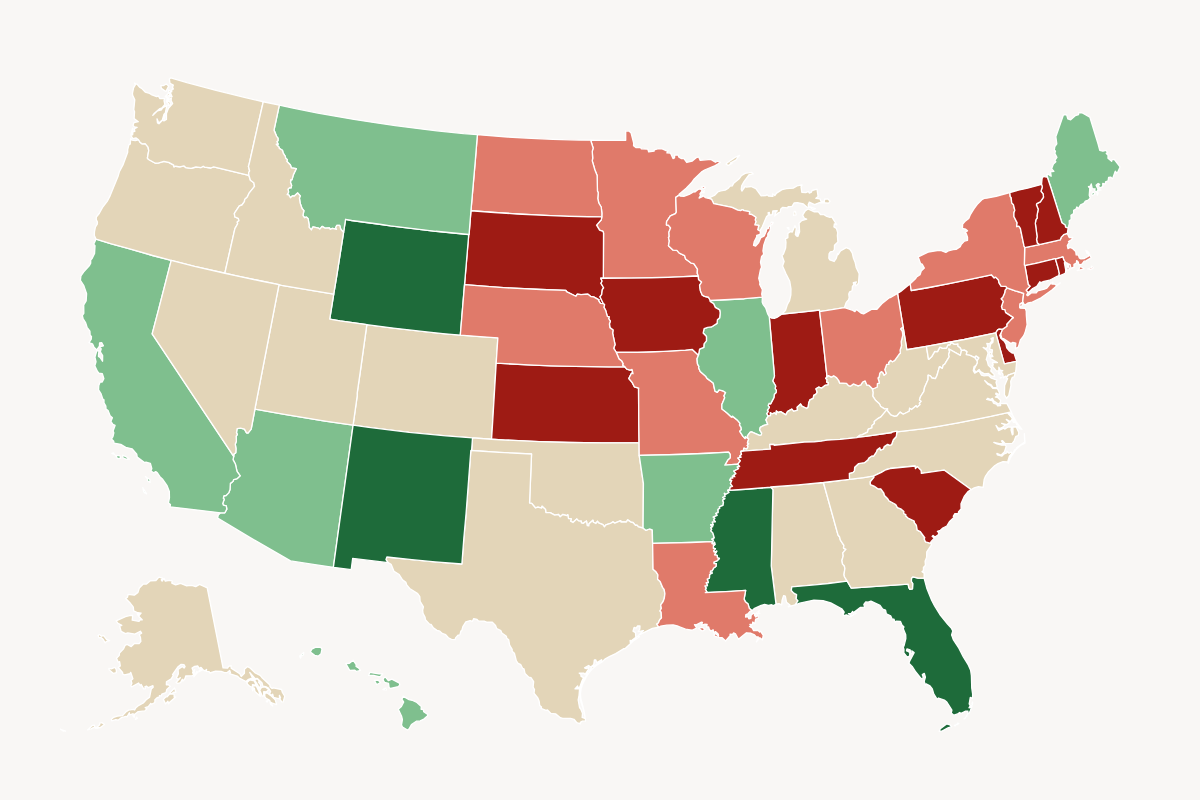
- Twelve states had no affordable public four-year college: Connecticut, Delaware, Indiana, Iowa, Kansas, New Hampshire, Pennsylvania, Rhode Island, South Carolina, South Dakota, Tennessee and Vermont.
- Community colleges were completely unaffordable in seven states: Connecticut, Idaho, Indiana, New Hampshire, Rhode Island, Utah and Vermont.
- New Hampshire had no affordable public college at all, with average gaps of $11,731 at community colleges and $7,632 at four-year schools.
- Tennessee students could afford 63% of community colleges but none of the state’s public four-year schools.
- Only Arizona, Mississippi, Montana and New Mexico had an average institution that met NCAN’s bar in both sectors.
How Affordable Is College In Your State?
How Affordable Are Public Colleges In Your State? Hover Or Tap A State
Share of public colleges where grants, federal student loans, Federal Work-Study, expected family contribution and a summer job cover the full in-state price (plus $300 for emergencies) for low- and moderate-income students, 2023-24.
Four-Year Colleges
Community Colleges
View All States As A Table
The map shades each state by the share of its public colleges that met NCAN’s affordability test in 2023-24, from red (none) through tan to green (75% or more). Use the toggle to switch between four-year colleges and community colleges, then hover over or tap a state to see its average gap, the amount a typical low- or moderate-income student came up short after grants, federal loans and work-study. A positive number is a surplus (21 states had a surplus in at least one area).
Illinois students faced an average gap of $2,171 at community colleges but had a $774 surplus at four-year schools, while Kentucky flipped that pattern with a $3,168 community college surplus and a $2,263 four-year gap. These figures are averages across each state’s public colleges, so a family’s own result depends on its Student Aid Index and the school.
NCAN didn’t report community college figures for Alaska, Delaware, Florida, Nevada or Washington.
How This Connects
College affordability has been a driving force in the news. Families are feeling that college is more unaffordable than ever. The student loan borrowing crisis is exacerbated by higher college costs and more borrowing. And the one big beautiful bill act is significantly changing the borrowing rules for families that need to fill any gaps.
Families who covered gaps with parent borrowing now face tighter rules, since new Parent PLUS limits took effect July 1, 2026 as part of the broader federal student loan overhaul.
What’s Next
NCAN is urging Congress to increase Pell funding and asking state leaders to protect need-based aid as budgets absorb federal cuts to SNAP and Medicaid. Watch the next appropriations cycle for the Pell maximum, which has a history of budget shortfall warnings, and NCAN’s interactive dashboard for more detail.
Robert Farrington is the founder of The College Investor and is widely recognized as one of the nation’s leading voices on student loan debt and saving for college. He holds an MBA from UC San Diego Rady School of Management and has spent over 15 years researching, writing, and advising on student loans, 529 plans, financial aid programs, and saving and investing for young professionals.
Robert has been featured in the The New York Times, The Wall Street Journal, The Washington Post, NBC News, and Forbes, where he has been a regular personal finance contributor for over a decade. His work combines both professional expertise and personal experience – he successfully navigated his own student loan repayment journey and has helped thousands of readers do the same.
He is committed to making the intersection of personal finance and education transparent and accessible. You can learn more about Robert on the About Page or on his personal site RobertFarrington.com.
