

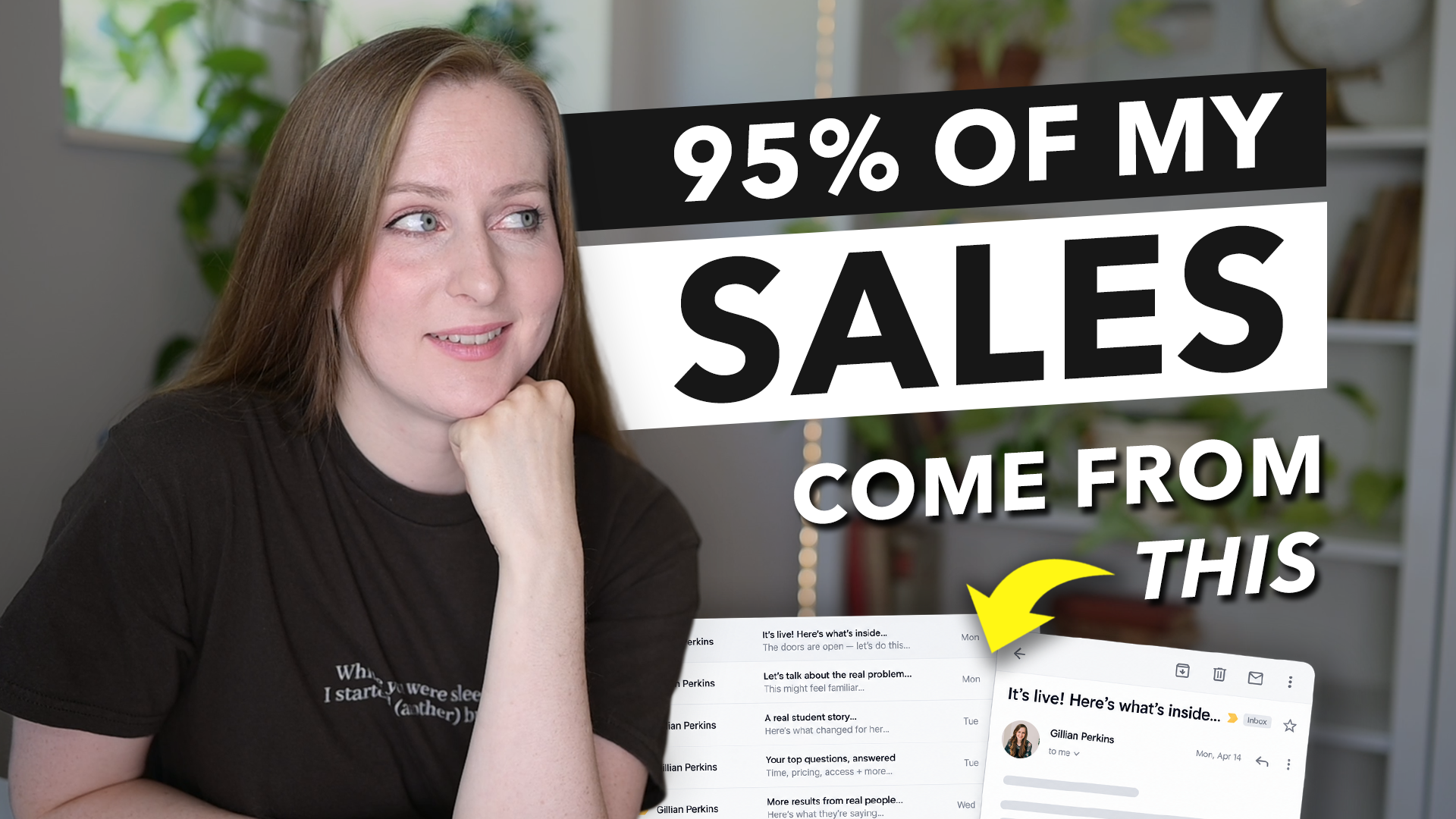
If you’re sending this after a webinar, open with a quick recap. Something like: “I just wrapped up today’s live workshop and it was incredible. We spent a solid 60 minutes covering [the 3 things], and at the end of class I shared our limited-time offer, available for the next 72 hours.”
If you’re not doing a webinar, you can go straight to the announcement: “It’s the moment we’ve all been waiting for. Enrollment is officially open. If you’re ready to [get the result], now is the time to take action.”
Either way, this email exists to say: heads up, this is what we’re talking about. The real selling happens next.
Notice what this email is not doing. It’s not trying to close the sale. It’s not stacking up bonuses or building a case. It’s just telling your list, clearly, that the doors are open and what’s on the other side of them. Save the convincing for email #2.
Want the actual swipe copy, not just the breakdown? I turned this whole sequence (plus a detailed guide for writing your own version!) into a free download. Grab your copy here: https://www.gillianperkins.com/free-launch-email-sequence-sign-up
Email 2: Diagnose the problem
This one’s counterintuitive. When you’re selling something, it feels natural to talk about the product: the features, the benefits, how great it is. But roughly two-thirds of your launch copy should actually be about your customer and the problem they’re facing right now. That’s the real reason anyone buys.
Think about a doctor’s appointment. You fill out a questionnaire, a nurse asks more questions, and then the doctor asks some of the same questions again. It can feel slow. But it’s also exactly why you trust the diagnosis at the end of it. Now imagine the doctor skipped all of that, handed you a bottle of pills, and said “these are great, take one a day, that’ll be $50.” You wouldn’t trust it. You’d have no confidence those pills were for your specific problem.
That’s what happens when we sell online by only talking about how great the product is. We skip the part where we prove we understand the problem, and we jump straight to price and how to buy. The second email in this sequence is where you avoid that. You describe the problem back to your reader in language they actually use (which means you need to have talked to real customers before you write this), so they feel like you get it before you ever pitch the solution.
This is also the email where you can afford to tell a real story, including your own. If you’ve ever struggled with the exact problem your product solves, this is the place to say so, in detail, with the specific frustrating parts included. People don’t trust a solution from someone who’s never felt the problem. They trust it from someone who’s been there and found a way out.
