

Yves here. I have been tearing my hair at how many YouTube commentators and to a lesser degree, Twitter accounts I follow, have been hyperventilating about supposed US Treasury bond market and dollar meltdowns. We’ve addressed how neither is happening in extended discussions in two recent Iran war posts. I am very grateful, as I hope readers are, for Rob Urie tacking one of these two bogus yet suddenly very popular messages frontally.
As we pointed out, the dollar was much lower in the post-crisis era and stayed there for quite a few years. 5% is not a high interest rate by historical standards and even less so relative to current and expected inflation is concerned. The US government can always meet dollar obligations, so there is no risk of an involuntary default.1
In addition, the short-lived Bessent suppression of interest rates took place in conjunction with a Treasury auction. Not getting paid what investors had deemed to be sufficiently high interest rates should have killed demand. While the bids were lower than in recent auctions, they were still within normal ranges. If the Treasury market were suffering from a buyer revolt, the auction would have been sloppy and that also would have been widely reported.
Mind you, the odds of a bad, potentially devastating crisis are high and rising. But the rising longer-dated Treasury interest rates are a symptom, and not the cause. The cause is inflation, as is showing up in rising government bond yields in most major and many smaller economies. Inflation lowers financial asset prices. The prototypical pattern is risky bonds get hit first, and along with that, the ability of higher-risk companies and projects to get funding. Liquidity dries up in this part of the market first.
Historically, stock prices needed more persuasion to register the growing investor risk aversion registering in the weaker credit part of the bond market. The typical lag was 4 to 5 months. But with AI debt funding and stock price potential so closely linked, we could instead see a broad-based AI selloff that would then spread to other financial assets.
And that is before getting to the real economy damage from higher energy prices, higher food prices, and shortages in key commodities like sulphur.
Keep in mind that the real downside is mot simply that we have a global depression. It is that the entire paradigm of heavy reliance on financial markets and credit as drivers of growth is mortally wounded. Much of our economic order would need to be rebuilt. Our current leadership and soi-disant experts are not even remotely up to the task.
Also a tiny clarification: Rob refers to Bessent trying to implement QE. Only the Fed can do that. The Treasury lacks the firepower. And there is no evidence that the central bank is on board. Recent statement indicate the Fed’s bias is somewhat hawkish. And unlike the runup to the 2008 crisis, there is no sign that the Fed chair, the New York Fed president, and the Treasury Secretary are actively communicating and coordinating strategies.
By Robert Urie, author of Zen Economics, artist, and musician who publishes The Journal of Belligerent Pontification on Substack
Like clockwork, every few years the US loses its mind. The problem for the rest of us is that what are imagined to be plausible explanations accompany each of these episodes of clinical insanity. Who remembers the devil-worshiping pedophiles running every nursery school in the US until the story was revealed to be a paranoid fantasy? Who remembers Iraqi WMDs or the assertion that $75K in Facebook ads spent mostly after the 2016 election determined the outcome of the election? Americans love crazy bullshit. The crazier the better.
And so, reports have the US is in the midst of a world-historic bond market rout. Yields are exploding higher? One might expect that evidence to support these headlines exists. In contrast, as of now bond yields are at or below where they would be expected to be (graphs below) given similar economic backdrops in the past. What is actually taking place is a propaganda blitz to support US Secretary of the Treasury Scott Bessent’s effort to raise financial asset prices using QE (Quantitative Easing). This is about the midterm elections, not bond yields.
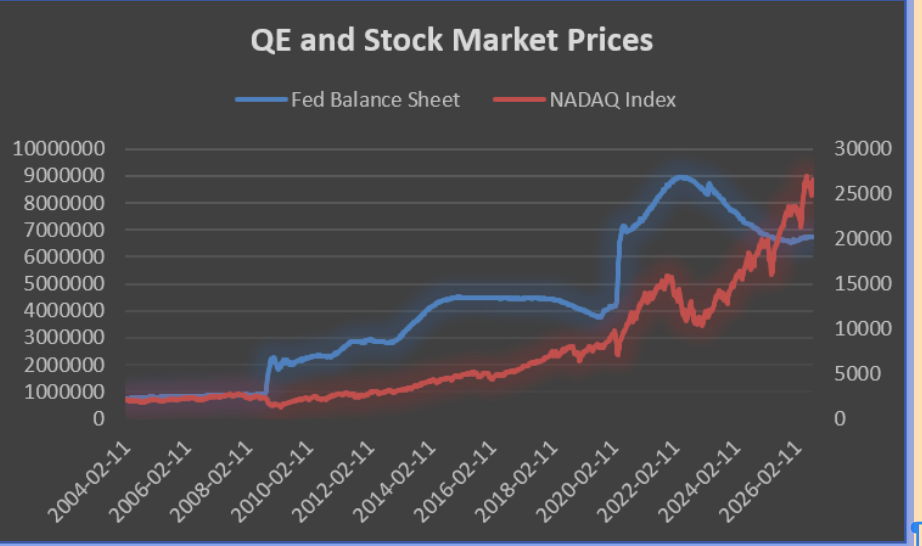
Graph: 2009 – today the Federal Reserve has used QE to raise financial asset prices. The economic insight is that buying intermediate and long-term treasury notes and bonds lowers interest rates, making financial leverage cheaper. In other words, it is a way of rigging financial markets to always go up. The danger is that the farther that prices get from fundamentals like corporate profits (earnings), the larger the prospective decline when prices are allowed to fall. Sources: St. Louis Federal Reserve.
As one who has been warning about inflated financial asset prices for quite a while, there is no suggestion here that unattended (by the Federal Reserve) markets represent good value. I will be surprised if prices aren’t half or less of their current values within the next few years. But this is different from claiming a ‘crisis in the bond market’ today. From the graphs below, the evidence does not support the contention of crisis. If anything, treasury bond prices appear to be relatively stable given the geopolitical and inflationary backdrops.
As of late August 2026, both nominal and real bond yields are below the averages represented in the graphs below. What this means is that both represent relative value to comparable circumstances in the past. For technical reasons (non-stationary mean) nominal bond yield averages must be interpreted carefully. This is why adjusting nominal bond yields to the rate of inflation ‘grounds’ them. The Taylor Rule used to estimate the fair value of the Fed Funds rate explicitly uses interest rates to create a grounded decomposition of bond yields.
Graph: worry over rising bond yields would seemingly be tied to evidence of rising bond yields. In fact, the yield on the benchmark US 10 Year Treasury is below its average over the last forty years in both nominal and real (inflation adjusted) terms. The graph above illustrates the monthly change in nominal bond yields. A similar look at daily price changes provides the same conclusion. There is no panic reflected in bond yields at present. Source: St. Louis Federal Reserve.
Graph: for all of the drama in the press, the Real Yield on the US 10 Year Treasury is still below its historical average for this data series. While Real Yields have risen recently, this has been accompanied by a rapid rise in CPI inflation. Until the Western press went full brain dead, inflation was understood to drive bond yields through driving bond prices. The political impact of the drama has been to give the Trump administration cover to restart (former Fed Chair) Bernanke’s QE. Source: St. Louis Federal Reserve.
With US Treasury Secretary Scott Bessent once again using QE (Quantitative Easing) to manage yield levels, the current crisis mongering over the bond market has a political goal. QE is understood to have raised financial asset values 2009 – today. Donald Trump’s constituency is a few dozen rich people whose fortunes come from asset values (stock market) inflated by QE. Trump sees the stock market as a broad indicator of economic wellbeing. In fact, stock prices are indicators of financial conditions, not economic conditions.
QE is but a variation on the Federal Reserve’s open market operations. Open market operations are used to manage interest rates for the benefit of banks. Banks borrow the reserves used to scale their lending at the rate set by the Federal Reserve. QE is an open market operation carried out on the long-end of the US yield curve. The Fed’s economic goal is to lower borrowing rates on auto loans. student loans and home mortgages. This makes cars and homes more affordable (sort of— prices eventually adjust higher to reflect reduced borrowing costs). So, raising financial asset prices while lowering borrowing costs is Bessent’s objective.
Why is this counterproductive? In terms of valuation levels, US stock markets are almost exactly where they were in 2000 when the Dotcom bubble burst. No one at that time argued that US stock prices weren’t in a conspicuous financial bubble. The Shiller CAPE (cyclically adjusted price – earnings ratio) at 44 represented the highest bubble reading in US stock market history. The CAPE today is 42.5. The average for the pre-bubble era was about 12. House prices today are 10% higher in inflation-adjusted terms than they were at the peak of the housing bubble of the 2010s. This means the US is currently in the largest housing bubble in US history.
Graph: for readers who like 10 Year Treasury Bond Yields unadjusted for inflation, the current nominal yield is also below the average for this longer data series. While the series has a conspicuously non-stationary average, grounding it using CPI inflation gives the series economic meaning. Bond ‘investors’ are buying real, inflation adjusted, yields to the extent that they can. With inflation currently at high levels relative to the recent historical average, bond yields would be expected to rise to a level that produces positive real yields. Source: St. Louis Federal Reserve.
Graph: rapidly rising and then moderating CPI inflation can be seen on the right side of the graph. The current level is still above recent levels. Mechanically, treasury bond yields must rise to maintain a positive Real Rate. That those worried about bond yields rising aren’t mentioning inflation is strange. It is as if they have a political agenda to promote and have forgotten what they learned in introductory economics in order to move their political agendas forward. Source: St. Louis Federal Reserve.
The challenge here is bond yields look quite normal given the level of inflation. Given how manipulated all financial returns have been since 1987 (stock market crash), it is hard to know what normal looks like. But what is clear at present is that there are no signs of panic in the US bond market. There are plenty of reasons for financial panic. But with the Fed using QE to ease financial market conditions, a floor is being put under prices until the QE is ended.
So again. All of the reasons for a financial panic appear to be in place except for the Federal Reserve raising interest rates. Of my predictive quant models, the best interest rate predictor is Fed policy. The intent of Fed policy under Bessent is to raise financial asset prices. To an extent, the relationship is mechanical. In decades of watching markets, I’ve never seen a serious stock market decline begin while the Fed is lowering rates. This doesn’t mean that it couldn’t happen. What it does mean is that the forces that determine financial asset prices are aligned with rising stock prices and falling bond yields.
What I can’t get past is how many crisis mongers didn’t bother to see if their claims match the evidence. They do not. This took less than fifteen seconds to ascertain (St. Louis Fed — GS10).
___
1 But as Keynes warned:
Practical men who believe themselves to be quite exempt from any intellectual influence, are usually the slaves of some defunct economist. Madmen in authority, who hear voices in the air, are distilling their frenzy from some academic scribbler of a few years back.
Again, that means Team Trump, captured by the mainstreams fables about fiscal orthodoxy, could very well make matters worse by overreacting and relying on the wrong medicine.
