


Speaking one week ago European Commission President Ursula von der Leyen caused a stir when she said that if the EU fails to expand, neighbouring countries could fall under Russian or Chinese influence. Nothing out of the ordinary there; Von der Leyen and others have been making similar statements for years. What made this instance notable, however, was that she added Türkiye to the list of nefarious influencers who would make it “difficult for us”.
The Commission backtracked by issuing a statement describing Türkiye as an “important partner” and a candidate to join the bloc, but the comments are providing a fresh source for EU infighting with Charles Michel, the former European Council president, publicly criticizing von der Leyen. Cypriot President Nikos Christodoulides, who hosted EU leaders Thursday and Friday (Turkish president Recep Tayyip Erdoğan wasn’t invited despite Türkiye still officially a candidate country) knocked Michel. NATO Secretary-General Mark Rutte then heaped praise on Türkiye on a trip to the country.
Ankara, for its part, has ignored the comment.
Some have mistaken the whole kerfuffle as a sign Türkiye is decamping for the BRICS (whatever that group is anymore). Politico, on the other hand, calls Von der Leyen’s comment just a “gaffe,” but it comes at an interesting time as the war against Iran is belly up, the old US order in the Middle East collapses, and the Israeli Zionists are ratcheting up the rhetoric against Türkiye. Beneath all the noise, however, Türkiye is more integrated than ever in the Western Zionist fold. Von der Leyen’s comment, taken with all these factors in mind, was likely more than just a gaffe.
Let’s first look at how Türkiye has been playing the Iran war and how it fits with Ankara’s ambitions before turning to the friction with a segment of the Zionists.
Türkiye has avoided taking an openly hostile stance towards Tehran and has instead opted for the role of ‘good cop’. Ankara continues to assist the US-Israel while publicly placing the blame for the war on Israel alone while absolving the US of any responsibility as it seeks to remain in Washington’s good graces. Why?
Much of it has to do with the economic sea change in Türkiye over the past few years, and Ankara now has little choice but to remain in Washington’s good graces.
Türkiye has been forced to offload nearly $60 billion from reserves to limit currency fluctuations since the start of the Iran war. Like much of the world, Türkiye is facing major stagflation risks with inflation ticking back up while the economy slows.
The Central Bank of the Republic of Türkiye kept its policy rate steady at 37% at a meeting last week, but it emphasized the following in its statement:
“In case of a significant and persistent deterioration in the inflation outlook… monetary policy stance will be tightened.”
That’s a major shift from policy only a few years ago when Erdogan was a leading proponent of rate cuts to stimulate the economy. Yet, after the 2023 elections, Erdogan appointed neoliberal champion Mehmet Simsek to Minister of Treasury and Finance. He immediately began jacking up rates and renewing efforts to attract western capital into Türkiye, which of course requires good relations with the US and Europe.
What this means is that “the West” has reasserted control over Türkiye, according to political economist Umit Akcay:
Between 2021 and 2023, Ankara pursued a unorthodox monetary experiment that cut interest rates despite soaring inflation and was backed by parts of business groups. The policy bought short-term growth and helped the government win elections. But like Argentina, Türkiye’s experiment collapsed under the weight of inflation and depleted reserves. Since 2023, Ankara has returned to orthodoxy under Finance Minister Mehmet Şimşek.
Both Argentina and Türkiye show how class coalitions can briefly expand policy space, but without structural transformation these tactical gains evaporate. In both cases, dependency on volatile capital flows and the dollar system has forced governments back into orthodoxy and deeper external subordination. Looking into Argentina’s mirror, Türkiye and the wider Global South can see their own reflection. Stability under dependent financialization is never permanent. It is at best the postponement of the next crisis, achieved at the cost of deeper social hardship and renewed dependency.
Together, the US and Europe account for roughly 82 percent of foreign direct investment in Türkiye. Ankara continues to plead for relief from the “Countering America’s Adversaries Through Sanctions Act” which was applied to Türkiye after it purchased the Russian S-400 system back in 2019. The sanctions slow particular imports like semiconductors and microchips, hurting the country’s defense industry ambitions, which include its own air defense project and domestically-produced fighter jets. The S-400s have never been activated and Washington and Ankara have been working towards a solution that will see the sanctions lifted.
Meanwhile, Erdogan continues to try to make Türkiye indispensable economically, and moreso, militarily to US-NATO.
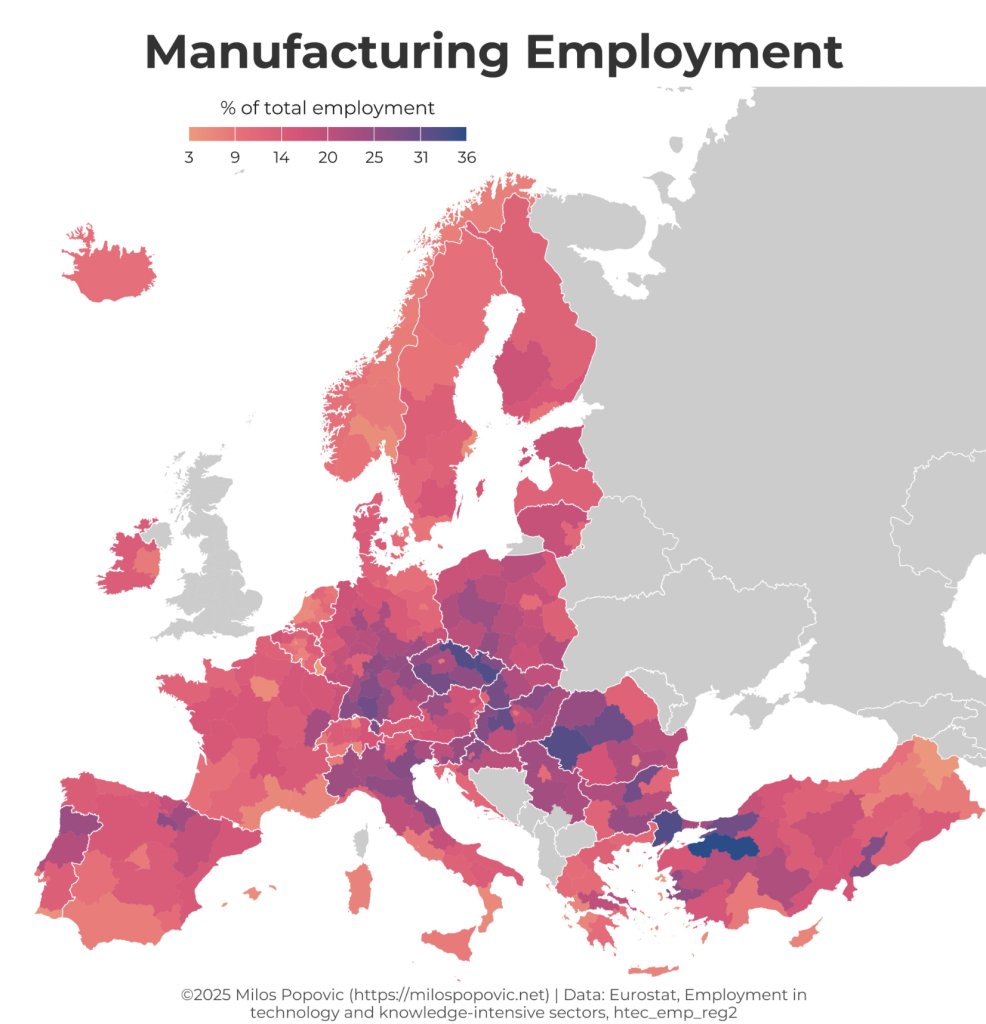
Türkiye has long had a heavy manufacturing presence geared toward the European market thanks to its customs union agreement with the EU.
That is increasingly turning toward defense manufacturing as the bloc embarks on its great rearmament to take on the Russian menace, and Ankara is naturally looking for access to the EU’s new $170 billion defense fund. Some EU officials are also talking about how they need Türkiye’s help to “rearm.” (Ironically, Türkiye’s manufacturing is largely enabled by Russian gas of which it meets more than 40 percent of its needs, and Ukraine allegedly keeps trying to blow up the TurkStream pipeline that carries it across the Black Sea).
There was already the joint venture between Turkish drone maker Baykar and Italian defense contractor Leonardo and other Turkish involvement in the NATO defense sector, but it looks set to grow exponentially.
Rutte wasn’t just in Türkiye last week to smooth over Von der Leyen’s statements; he was there championing a lead Turkish role in NATO’s layered defense strategy.
He did so in a visit to ASELSAN,Türkiye’s leading defence company and Europe’s fifth most valuable defence firm, which NATO is positioning alongside U.S. systems within its emerging layered air and missile defense architecture.
Aselsan bills itself as critical to support NATO’s logistical security and a reliable production hub as it increasingly embeds itself within the alliance’s landscape. Everything ASELSAN produces is integrated with NATO’s common data links and command-and-control systems.
Aselsan and the Turkish government continue to bend over backwards trying to make the country into a NATO manufacturing center. And Türkiye is further integrating itself in other ways, as well. Last month the Turkish defence ministry announced that NATO will establish a multinational corps in Türkiye. It will be located in Adana, the site of Incirlik Air Base, which holds US nukes.
If there’s anymore doubt about Türkiye being firmly in the clutches of Western capital, well, here’s this:
Earlier this month, Erdogan hosted 40 global CEOs in Istanbul at a meeting organised by the World Economic Forum (WEF). Erdogan has in fact not attended the WEF’s Davos summit since 2009, when he publicly clashed with then-Israeli President Shimon Peres over the killing of Palestinians in Gaza.
Larry Fink, chair of the WEF’s board of trustees and CEO at BlackRock, the world’s largest asset manager, helped make the Istanbul meeting happen.
Türkiye analyst Ceren Kenar told Middle East Eye (MEE) that the WEF was seeking to break the ice between Erdogan and Davos by arranging the event.
Türkiye, Israel, Iran, and Competing Visions for the Middle East
As we noted at the start of the US-Israel war of aggression, Türkiye’s role as peacemaker is a mirage. Here is the view of conflict resolution from Ankara:
“A new leadership structure may reshape Iran’s decision-making and create an opportunity to stop the war,” [Fidan] told a live broadcast on TRT Haber news channel. “The new leadership in Iran may show greater flexibility at this stage…This could be a window of opportunity, if used wisely.”
Setting aside the absurdity that the side being attacked and having school children blown up must show greater flexibility, what is Fidan talking about?
There is talk between Saudi Arabia, Pakistan, Turkiye, and Egypt over a possible “Muslim” replacement for the US-led Gulf security architecture. From The Cradle:
A quadripartite meeting on the sidelines of the Antalya Diplomacy Forum, held from 17–19 April in Turkiye, reportedly focused on lowering tensions and building a new regional security structure. Sources speaking to The Cradle say there is now broad support for an “internal security apparatus” rooted in economic integration and defense coordination.
Ankara has proposed what it describes as an “organized regional security platform” built around the idea that regional states, not outside powers, should be responsible for defending West Asia.
I’m not entirely sure that’s accurate. As we see above, Türkiye (and other trio of this Muslim security team to varying extents) is following an economic strategy that has it largely dependent on western capital and military integration. So how independent would this new alliance really be?
Nevertheless, the hope on the Turkish side is that Iran would be absorbed into this group and neutered in a more polite fashion than what the Israelis favor. These competing visions are likely behind a lot of the increase (there are also benefits to both sides on the domestic political front) in vitriol directed at Türkiye from Israel.
Many assume that this means Türkiye will be next in Israel’s line of fire. Someday, perhaps. But it’s unlikely that it’s anytime soon.
As noted above, there are key differences between Türkiye and other countries Israel has targeted. Türkiye is too important to the US designs from the Black Sea through the Caspian. Indeed, Türkiye is set to play a key role in expanding Turkish/American influence into Central Asia.
I hate to agree with US envoy Tom Barrack, but think he’s right when he describes it as just “rhetoric.” Barrack is being criticized by the neocon Zionists for his stance, but his stance demonstrates Türkiye’s role for imperial designs. More:
“Everything comes from Türkiye. It’s fiber optics. We’re talking about Azerbaijan and Armenia, which is flowing oil, gas, information, data and materials. Where does it go? How does it go?” he said.
“So Israel aligned with Türkiye, like Israel aligned with Abu Dhabi. Saudi Arabia could be aligned with Israel and, for the prosperity of the Israeli people, to me that’s the answer.”
And beneath the rhetoric they have been aligned!
There’s the obvious delivery of oil and other critical minerals from Türkiye to Israel that help fuel Israel’s genocide.
Let’s not forget that Türkiye has also enabled Israel’s ethnic cleansing in Lebanon by helping to destroy the Syrian counterweight. The jihadists that Erdogan’s government helped fund, arm, and train barely defended themselves against Israel, but instead targeted Hezbollah.
While Türkiye and Israel have faced off a bit in Syria, what happened there is also illustrative of their cooperation. At a January Paris meeting that threw the Kurds under the bus, the US, Israel, and Türkiye came to an agreement. From The Cradle:
Turkish Foreign Minister Hakan Fidan was present in Paris and played an active role in the negotiations. Its demands were clear: US support for the SDF must end, and the so-called “David Corridor” must be blocked. In exchange, Turkiye would not obstruct Israeli operations in southern Syria.
It was a transactional alignment – and it worked.
Of course all this backroom wheeling and dealing works while the winning streak is on, but with none of the three sides being agreement capable, how’s it going to work out now that it’s desperation time in Iran? With Ukraine and Iran, all the West is between a rock and a hard place. Trump has no good options. Europe has no good options.
Erdogan is in a similar boat. Forced to play ball with the West out of economic necessity, the demands might be increasing. If Türkiye is part of a good cop-bad cop routine on Iran, well, what goes around…
And this leads us back to the “gaffe.” What Ursula’s comments and other threats from Zionists could signify are threats that if Türkiye doesn’t step up, there could be economic repercussions.
And Türkiye is being pulled in various directions. Von der Leyen as head of the Russophobic element in the EU likely want something to do with Russia. The hardcore Zionists are likely out for Turkish blood. The other hardcore Zionists probably want (more) assistance against Iran.
And Barrack and others bearing gifts, the question is what exactly do they want?
Here is why I think, by the way, Israel is causing the West to start publicly hating on Türkiye now:
It is not about Türkiye (which they hate, discount and patronize), it is about Iran. They want Türkiye to allow something to be done against Iran, and Türkiye is not accommodating…
— Alon Mizrahi (@alon_mizrahi) April 21, 2026
Poor old Erdogan just wants to make a buck. Him and his family have made plenty over the years, but balancing acts always run out of rope.


