

POTUS Trump’s war council met at Camp David on Friday as Iran flexed new missile capabilities, the Saudis bombed Sanaa and Ansar Allah claimed a strike on Riyadh.
Team Trump’s ‘Highly Unusual’ Meeting at Camp David
Team Trump met at Camp David in an unannounced meeting Axios called “highly unusual,” adding, “the last time a similar meeting took place was in June 2025, just days before Israel went to war against Iran.”
The meeting was chaired by Vice President Vance and included Sec. of State Marco Rubio, Secretary of Defense War Pete Hegseth, Treasury Sec. Scott Bessent, CIA Director John Ratcliffe, Joint Chiefs of Staff Chair Gen. Dain Caine, and Special Envoy Steve Witkoff.
Trump told reporters who asked about the meeting, “If I told you, you would have a major story,” he said. “But you will see. It is working out very well. Iran is not doing well.”
Trump took some incoming fire in the form of media criticism from CNN, which “fact-checked” his Truth Social attempt to rewrite history such that his claims the war would last “four weeks” merely referred to how long it would take to wipe out Iran’s nuclear program (readers will remember the White House claimed to have “obliterated” same in one night of strikes in mid-2025).
Meanwhile, on the NYT Op-Ed page Nicholas Kristof warns that “Iran Could Choose to Escalate the War” after compiling a damning litany of Trump and company’s failures in prosecuting said war:
Diesel prices at a few places in California have hit $9.99 a gallon, the maximum price those pumps can display. The United States has already spent more than $43 billion on the war, by a lowball Pentagon estimate — more than enough to provide free college education for a year to every American family earning less than $125,000 annually. Higher prices caused by the war have cost the typical American family about $1,000, according to the economist Mark Zandi. More broadly, we’ve depleted our arsenal, cost American and Iranian lives, possibly committed war crimes, exposed American vulnerabilities, effectively lost access to some bases and weakened American military credibility as far away as East Asia.
Notably, Kristof fails to mention Israel entirely, despite their role in starting the war, agrees with Trump about the need to prevent Iran from getting nuclear weapons (he mentions the late Ayatollah’s fatwa against same only to argue the war has made an Iranian bomb more likely), and decries the “extremist” nature of Iran’s government.
In another story that adds to the developing MSM consensus that the US is losing the Iran War, NBC analyzed how “Trump’s strikes against Houthis foreshadowed struggles in Iran war:”
The 52-day conflict, dubbed Operation Rough Rider, foreshadowed some of the difficulties Trump now faces in the war with Iran: a weaker adversary able to use inexpensive drones and antiship missiles to expose the limits of U.S. air and sea power and threaten the global economy, according to seven former U.S. officials and regional experts.
There are striking parallels between the campaign against the Houthis and the U.S.- and Israel-led war with Iran.
In both conflicts, the U.S. aimed to deliver a swift blow from the air. But air power alone was not enough to achieve a rapid result. The Houthis and the Iranians suffered losses and damage but were both able to keep fighting, launching waves of drones and missiles at the world’s most powerful military.
In other US war news, The Guardian has a photo feature on young sailors on the aircraft carrier USS George Washington, which is currently the only carrier in CENTCOM’s area of operations, with the George H.W. Bush having been spotted in the Indian Ocean approaching the Malacca Strait.
This confirms speculation from TWZ’s roundup of US carrier locations that the Bush was headed for Thailand for a port call.
Reuters reports on a Portuguese prosecutor’s probe into the legality of US use of Lajes Air Base in the Azores during the Iran war.
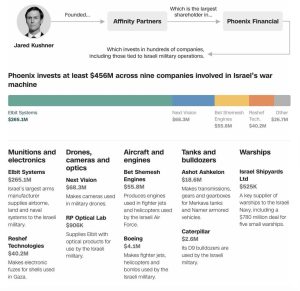
There’s also a CNN report on the 7.4% stake Trump son-in-law Jared Kushner’s Affinity Partners holds in Phoenix Financial, which has nearly a half-billion-dollar stake in firms supplying the Israeli war machine:
Why Negotiations Are Stalled
Analyst Esfandyar Batmanghelidj has a hypothesis attempting to explain the difficulty the US and Iran face in cutting a peace deal (illustrated with a nifty chart):
Here’s a model to help think through why the US and Iran are struggling to reach a deal to end the war.
Since the outset of the fighting, both sides have mainly tried to use economic pressure to push the other towards what they consider a “fair” settlement of the conflict.
But the economic pressure accumulates differently for each country. Iran must experience much higher levels of pressure to consider a diplomatic settlement with the Trump administration. But unlike for the US, there is also a point on Iran’s pressure “frontier” when a deal becomes less likely.
In short, Iran is too far along its curve. The experience of “maximum pressure” sanctions, the blockade, and the war have undermined confidence that a deal is possible.
This is why Iran is seeking an interim arrangement. They want US to walk back the pressure, allowing the two sides to return to the “deal window.”
The problem is that the Trump administration doesn’t seem to understand this model—they neither accept the diminishing returns of more economic pressure nor its counterproductive impact on the prospects for a deal.
— Esfandyar Batmanghelidj (@yarbatman) October 3, 2026
Meanwhile, Iran hasn’t been idle.
Iran’s New Missiles and Massive Mobilization
According to the United Kingdom Maritime Trade Operations (UKMTO), Iran has hit at least 8 tankers in the Hormuz Strait in the last five days with no retaliation from the US, despite its policy of “a tanker for a tanker” announced in early September. Presumably the US wishes to avoid a reprise of the brutal exchanges that followed its last strikes on Iranian tankers.
Bloomberg reported on the experience of a tanker captain who’s navigated the Strait under US escort:
The US has been quietly coordinating with shippers since early summer to plot routes and avoid Iranian mines. American forces “have assisted thousands of ships through the Strait of Hormuz in recent months by providing coordinated protection,” US Central Command said in a statement. “We remain laser-focused and will continue working with US interagency partners, regional countries, and the shipping industry to increase the maritime traffic flow.”
The captain would often be told of the military support that was keeping watch over him and could see it overhead. On one occasion he saw what he described as a jet plane flying above them, and also a helicopter.
…
These gas carriers, which are fewer in number than oil tankers, have been more cautious. But at least eight LNG ships have traversed the strait in the last two weeks with safety assurances from the US, the captain said.
Iran has its own blacklist for tankers engaged in the trade. But shipping executives estimate about a one in 20 chance of being hit while crossing Hormuz, with the ships under the watch of the US military.
The oil tanker captain’s most recent contract was a month shorter than usual because he knew the voyage “is not easy.” He still received a multiple of his usual salary to transit.
Bloomberg previously reported that one shipowner was offering its crew an extra six months of pay to shuttle through Hormuz. The amounts on offer would be significant for anyone, and much of the world’s tanker crews are from lower-income countries like the Philippines and India.
With two million barrels of oil on board, American forces had been watching over the captain’s tanker, part of a strict monitoring process that requires regular check-ins.
After he saw the blast ahead, the captain was told by the US Navy that other vessels beyond his were managing to continue on their journeys, and that he should do the same. On another occasion, the captain’s ship was the one that came under attack, but there was no damage and no injury to the crew. It was one of many near-misses.
IRGC Aerospace adviser Brig. Gen. Ali Belali told Fars about a new “Persian Gulf” missile being field-tested, designed to hit moving warships at 400–500km, with an optical camera for terminal guidance.
This follows “both IRGC spokesperson Brigadier General Hossein Mohebbi and Secretary of Iran’s Supreme National Security Council (SNSC) Major General Mohsen Rezaei (see here and here) mentioned multiple times a recent test on the USS George Washington aircraft carrier Secretary of Iran’s Supreme National Security Council (SNSC), probably referring to the attempted strike on 5th September 2026″ via Geopolitiq.
Alastair Crooke reports in his end-of-September sitrep that Iran is mobilizing one million people into battalions of 1,000, commenting that “this doesn’t seem to be to defend against some expeditionary force from the US coming landing on the far side of the Hormuz. If I was Bahrain or Kuwait, seeing Iran mobilising a million men, I would be very frightened. I’m sure they are. There have been reports in the Iranian press of Iran planning to seize Bahrain, should the Emirate support America’s assault on Iran.”
A report on Iranian IRIB TV claims that China is no longer supplying Iran with satellite images for targeting after a September WSJ report accused them of doing just that.
Now let’s turn to Saudi Arabia and its conflict with Yemen’s Ansar Allah.
Saudi Arabia and Ansar Allah Trading Shots
Crooke’s sitrep also included some analysis about the strategic situation Muhammad bin Salman (MbS) finds himself in:
The Gulf’s colonial architecture is collapsing — and Saudi Arabia is the linchpin of this structure. MbS can’t do a deal with Iran because Saudi is just too embedded in the panoply of US Tech, Intelligence and financial structures. These elements combine to – effectively – run the state on behalf of MbS. The consequences to this arrangement are profound in the context of the US war on Iran — Saudi oil sales are down significantly and the state is close to bankruptcy. Saudi has been trying to sell shares and US Treasuries that it holds, but it isn’t allowed to sell Treasuries. Even Saudi’s Gulf allies don’t want to buy Saudi asset holdings, except at a huge discount, because they’re not sure that Saudi, as we know it, will continue to exist a few months hence. So there’s a great reductance from MbS’ Gulf allies to help out MbS beyong giving rhetorical support.
Per Reuters the Saudis are planning “an offensive against Iran-backed Houthi militants in Yemen, with options being considered including a coastal push to secure the Red Sea shipping route or an assault on multiple fronts. The operation, expected to be launched in the coming weeks, will be led by Yemeni forces on the ground, which are overseen by Riyadh, and supported by Saudi air strikes.”
Also per Reuters, Pakistan has already deployed 30,000-40,000 troops to Saudi Arabia for border defense and drone/missile interception but “Islamabad hasn’t made any decision to send troops into Yemen in a fighting capacity.”
Unfortunately for MbS, Axios’ Barak Ravid reports that “the U.S. rebuffed Saudi pleas to join the operation and conduct airstrikes. But U.S. officials say that could change if the operation runs into problems.”
In the meantime, the Institute for the Study of War (ISW) has counted at least 13 Saudi or Yemeni government airstrikes on Ansar Allah’s capital Sanaa and, per the Yemeni government, 71 strikes in and around the hotly contested city of Taiz (Yemen’s 3rd largest city).
MintPress News reports that Israel is providing the Saudis with targeting information.
Ansar Allah was quick to retaliate for the strikes on Sanaa, claiming missile strikes on Aramco facilities in Riyadh after Reuters reported a large fire there; ISW assesses it was “likely” a Houthi attack.
Multiple reports claim that the Saudis are not activating civil defense alerts when their cities are hit.
Brett Erickson comments:
As I have highlighted multiple times now in the past week, it is now confirmed that Saudi Arabia’s Early Warning alerts are NOT being published by Saudi Civil Defense.
We know this due to intelligence firm Clearwater Intelligence releasing confirmation of Ansar Allah (Houthi) strikes on Yanbu in the last 72 hours, as well as Reuters imagery confirmation of Ansar Allah strikes on one of the Saudi Aramco facilities in the capital of Riyadh yesterday.
The amount of censorship across the entire Middle East is staggering, and deeply muddies the waters we are all trying to wade through around the world to get an accurate depiction of the current strategic and economic landscape.
An Ansar Allah account claimed this is footage of the most recent hit on Riyadh:
مالم تنقله قنوات العربية والحدث وقناة الجزيرة الحقيرة العبرية من الاستهداف الصاروخي اليمني المبارك اليوم على اراااامكو. نعرضه لكم لاتقصرو إعادة النشر https://t.co/HRg1DY3tQu
— بركان المسيرة (@AlnsarAllah10) October 3, 2026
Translation: “What Al Arabiya, Al Hadath and the despicable Hebrew Al Jazeera didn’t show of today’s blessed Yemeni missile strike on Arrramco. We show it to you—don’t hold back on reposting.”
Aramco in Riyadh is burning. https://t.co/jNINauv8HR
— barry with the NED (@bonzerbarry) October 3, 2026
As for the fighting around Taiz, ISW published the map below:
Barry from NED is also mapping the battles:
Ansarallah made a lot of progress in the southwest Taiz front. Al Turbah is getting pinched from both sides (only about 18km across now). They’re also only a few kilometers away from the Al-Safiya Junction to the west. AA will soon be close to reaching the last road out of Taiz at three different points.
— barry with the NED (@bonzerbarry) October 4, 2026
And About That Flydubai Incident
FORBIDDEN STUDIOS PRESENTS: WHEN PILOT IS FIGHTING, PLUMBER IS FLYING
One plane. One sword. One plumbing emergency.
The biggest Bollywood action psyop of the year has arrived. https://t.co/fnhtgPr0gE
— Forbidden HQ 🐇 (@WearForbidden) October 2, 2026
Around the Tubes
Follow and support my work at NatWilsonTurner.com.
