

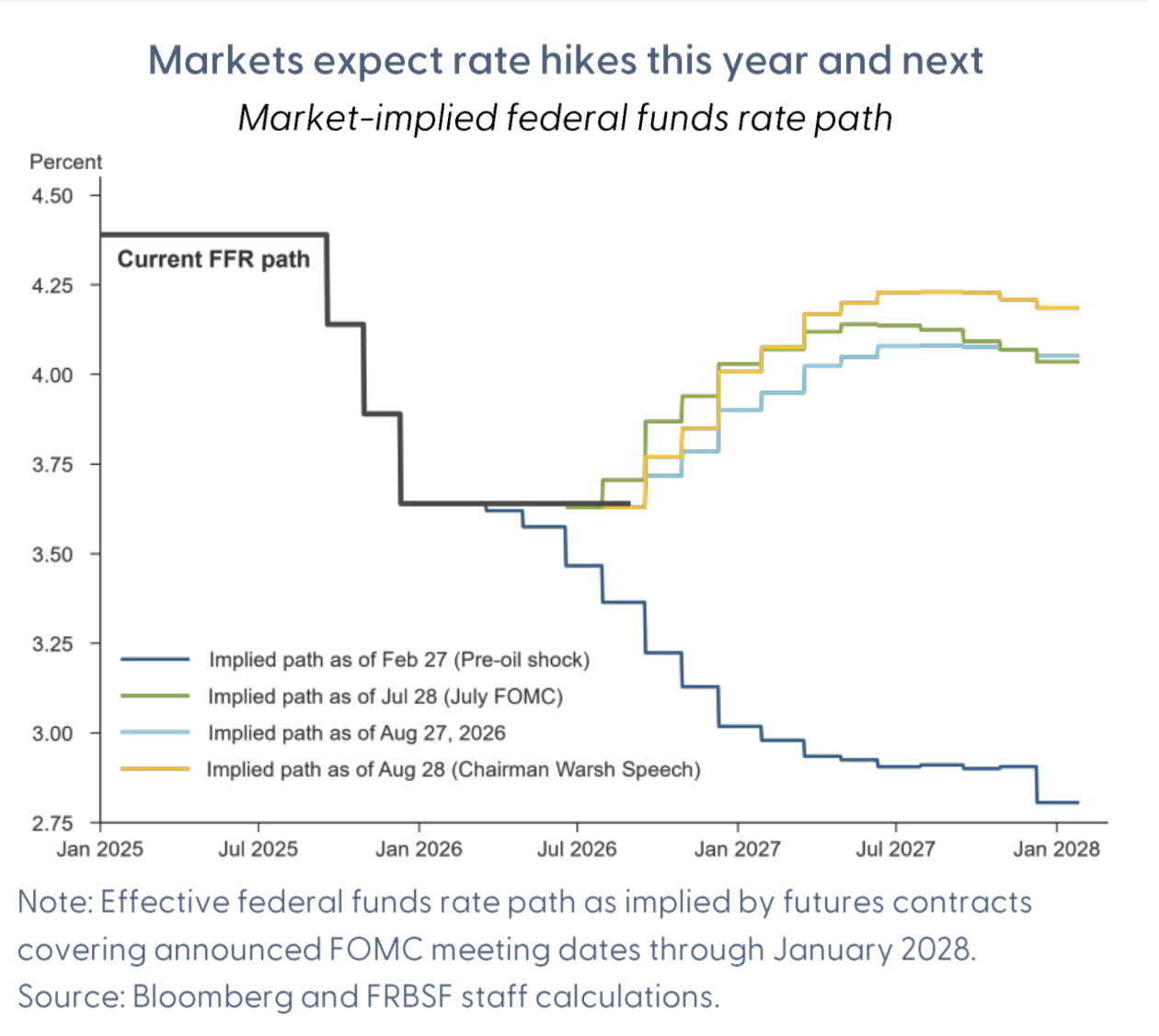
Heading out the door for the Labor Day weekend, with blue skies and 80° temperatures, I had to share a chart. It’s from the San Francisco Federal Reserve (via Torsten Slok of Apollo) and shows Wall Street expectations for Federal Reserve rate action.
It’s the perfect explainer for why forecasts tend to be so inaccurate. They are for the most part simple extrapolations of the status quo or the current trend; they also fail to include random or unanticipated events – the kind that happens all the time in the economy, markets, and geopolitics.
When you stumble across a forecast that turned out to be more or less correct, it usually means that nothing happens and that the extrapolation proved accurate.1
But most of the time, $h*t happens: Wars break out, Pandemics occur, terror attacks happen, new technology comes along and fails or succeeds, the government fails to fund their annual budget or wildly overspends their fiscal limits.
The parade of endless random events derail even the most thoughtful of predictions. A year is simply too short of a time to guarantee that the dominant secular trend asserts itself and too long a period to not have random stuff occur.
Previously:
The Folly of Forecasting (June 7, 2005)
Nobody Knows Anything (Archive)
Source:
Productivity -Driven Growth Confronts Elevated Inflation
Huiyu Li
Federal Reserve Bank of San Francisco, September 3, 2026
__________
1. Please note that I said accurate and not prescient…
