

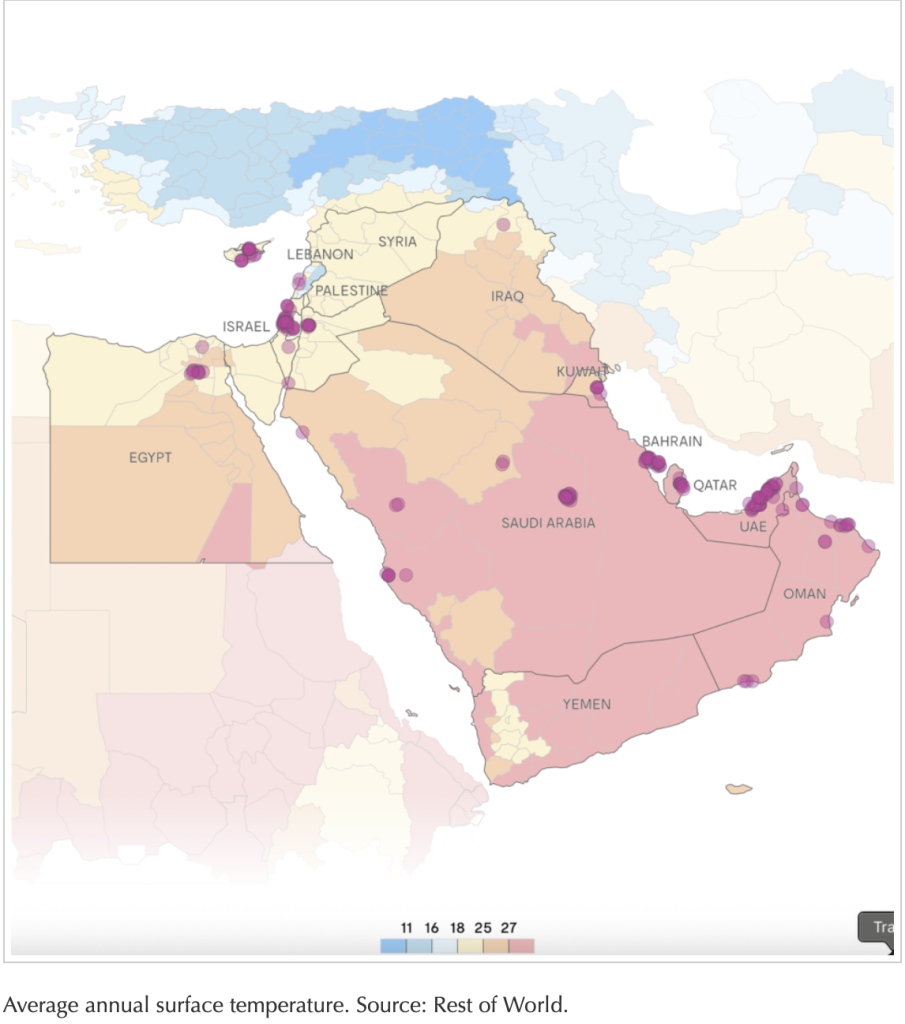
The trillion-dollar Middle East AI dream had it all. Unlimited energy to build sprawling data centers across the desert. A geopolitical masterstroke that would see US tech strengthen American presence in the energy rich region. A central hub for American digital—and dollar— supremacy. And perhaps most of all, unlimited opportunities for rampant corruption.
Well, it was fun while it lasted.
Let’s begin a few years ago when the India-Middle East-Europe Economic Corridor (IMEC) was first introduced at the September 2023 G20 Summit in New Delhi. The network of railroads, ship-to-rail, road transport routes, energy pipelines and high-speed data cables connecting South Asia, the Gulf and Europe was in theory supposed to be some sort of answer to China’s Belt and Road Initiative (BRI). It never made much sense as a logistics corridor as it involves moving cargo via ships from India to the UAE, putting them onto trains going through the UAE, Saudi Arabia, Jordan and Israel, and then back onto ships to go from Israel to Europe.
The Trump administration, however, followed Silicon Valley’s lead and shifted away from the Biden focus on a logistics corridor to more of a digital cesspit of corruption with each IMEC locale fortifying a lucrative new pole of American hegemony with Israel playing a lead role. It was an AI superiority invitation from Europe to India written in the blood of genocide, but it’s collapsing now as the Persian Gulf, which the “plan” depended on, goes up in flames.
Let’s take a look at what the Persian Gulf compute corridor was billed as and what the reality is now.
The US shared tech with Gulf countries like Saudi Arabia and the UAE in return for a guarantee that AI-enabled exports generated using American chips will be invoiced and settled in dollars—or dollar-backed stablecoins. The Persian Gulf was to provide capital, land, and loads of power for data centers and American compute power flowing outwards from the oil monarchies, as well as billions in corrupt payoffs to the Trumps, other American officials, and help keep the bubble inflated.
Prior to the war, more than 3.3 gigawatts of AI-oriented compute power was planned across the Gulf. Even if only a portion of that ended up being built, it still set the Persian Gulf monarchies up to become, in the words of Guy Laron:
…a sovereign compute corridor: a region where energy systems, capital flows, chip diplomacy, and model training capacity are boldly tied together. Indeed, the United States, for all its tech innovation, lacks the power and space to train models at planetary scale without choking its grid. The Gulf provides the chassis.
In 2025 when the US agreed to export up to 70,000 advanced Nvidia chips to the UAE and KSA the Trump administration claimed that the arrangement wold “promote continued American AI dominance and global technological leadership.”
That’s not all it would do. As the New York Times reported last year, “digital assets are one of the single biggest, if not the single biggest,” money streams for the Trump family. Eric Trump’s World Liberty Financial has a $2 billion deal with the UAE state-owned AI investment firm MGX, which has rights to the Trump stablecoin USD1. MGX uses it for billions in transactions on Binance, the exchange constantly on the wrong side of what used to be the law and whose founder, Changpeng Zhao, received a pardon from Trump in October after pleading guilty to failing to prevent money laundering in 2023.
Still, US geopolitics and blatant corruption typically go hand in hand. Sure, the scale of the Trump graft might be unprecedented but there was still some semblance of a strategy there, however harebrained. Here’s Edward Ongweso, Jr. with more on the rationale behind the compute stack imperialism:
Europe pays $0.29 per kWh, the U.S. averages $0.17, but the Gulf’s unsubsidized power costs average $0.10 per kWh. Through “centralized planning and execution” the GCC might be able to build out power infrastructure rapidly: the Kingdom plans to add 42 GW of gas capacity by 2030, outpacing the United States by 40 percent.
Second is by a geographical advantage. The Gulf sits at the crossroads of three continents and an extensive submarine cable network, meaning it can service four billion internet users within 100 millisecond latency—the threshold that lets AI interactions feel “instantaneous.” If that is not enough, the region has the world’s largest desalination infrastructure (40 percent of global desalinated water). Geographically, it’s well suited to serve the world’s inference workloads and provide more than enough water to cool power-intensive A.I. data centers as the overbuild continues along.
There’s also a financial advantage: a nearly $5 trillion sovereign wealth fund war chest that is a bit more patient than ravenous Western financiers.
It has not been a good couple of months for this “plan.”
Things Fall Apart
Not only did these Persian Gulf data centers need energy-intensive cooling:
Not only did they need energy-intensive desalination:
But they were also being built in a region where it was obvious to anyone paying attention that major conflict was on the horizon. And so it was:
March 1: Iranian Shahed drones struck two Amazon Web Services data centers in the UAE. A third data center in Bahrain was also hit.
March 11: US-Israel hit an Iranian bank’s data center. Iran’s Revolutionary Guard Corps threaten retaliation against US companies with Israeli links and which support military tech applications, which includes Google, Microsoft, Palantir, IBM, Nvidia, and Oracle.
March 31: Tehran reiterates threat against tech companies.
April 2: Iran hits an Oracle data center in Dubai.
If/when the US-Israel renews the hot conflict, OpenAI’s massive $30 billion Stargate project in the UAE is in Iran’s crosshairs along with the rest of the data centers. There are plenty easy targets:
Embedded Military Tech
While there are apparently straight-faced claims that by hitting data centers, Iran is striking “civilian” infrastructure, the reality is that these Silicon Valley companies are extensions of the Pentagon. It is not altogether clear that each of the Persian Gulf data centers were/are used by the U.S. military, but data centers frequently directly support military operations as the Pentagon reportedly uses AI to plan air attacks, formulate kill lists, and coordinate government collapse programs.
And so the data centers are kind of like embedding military weapons in civilian infrastructure. From The Conversation:
When a service member uses Claude, the computing infrastructure that powers the model and its analysis usually goes to a secure Amazon Web Services cloud that hosts secret government data and software tools.
Commercial data centers are where the cloud lives. The next time you pull up Netflix and watch your favorite shows, you are likely streaming the programming from a data center, possibly AWS. When AWS data centers go down, outages affect all sorts of entertainment, news and government functions.
With AI as a driver of economic growth, data centers are key forms of infrastructure. They ensure that AI can continue to run, as well as much of the underlying internet that governments and industry rely on. When Iran attacked the UAE’s data centers, it caused widespread disruption to the local banking system.
Commercial data centers enable most of the technology that runs the modern world, including AI systems. Disrupting them is key to disrupting a country’s military and society. Given that AWS provides and operates many of the commercial data centers where the cloud lives, it is likely that its data centers will continue to be targeted in conflict.
Seeing Nothing, Hearing Nothing
The strikes on the data centers have already caused an economic hit and the possibility of more conflict and more damage is calling into question Silicon Valley’s presence in the Persian Gulf, as well as the American “strategy” of a computer hub.
Amazon is now stuck with months of repairs as banks and others face disruptions. Those repairs and future staffing could be made more challenging by shortages of two kinds: materials and workers. Key materials needed for the AI infrastructure buildout are now hard to come by, and here’s CNBC on the labor issue:
…onsite workers are facing increased safety risks, with Pure DC offering some benefits to its Middle East staff, [CEO Gary] Wojtaszek said.
“We’re not mandating anyone be in the facility, they have to make a decision based on what’s right for them and their family…It’s a really tough situation,” he said, adding that workers who choose to remain on-site will get “additional comfort.”
Some of these perks include location flexibility for non-essential workers, who can leave the country with their families and work remotely, as well as additional welfare packs for all staff members.
The data center developer is now focusing on how to operate facilities remotely via electronic means.
Data center workers may increasingly see a “hazard pay rate” built into salaries in the future, William Self, chief workforce strategist at global workforce consulting firm Mercer, previously predicted.
How wonderful. The PMC gets to work from the relative safety of home while the blue collar worker gets a few extra bucks a month for the risk of getting blown up. Everything is like the pandemic.
Back to poor old Amazon. According to The Register, it had to waive customer charges in its Middle East cloud region for the entirety of March, which cost the company an estimated $150 million. Tech Policy Press with more on the risk facing all these American companies in the region should they too be hit by Iranian strikes:
Technology service providers typically reach for force majeure clauses, arguing that acts of war are unforeseeable events that absolve them from liability and from refunding clients.
However, regional civil law frameworks place strict boundaries on the use of force majeure during active conflicts. A landmark triad of Dubai Court judgments; Primary, Appeal, and Cassation, issued in 2017 offers definitive guidance on how regional courts allocate risk. Adjudicating a private aviation dispute over a canceled charter flight caused by the sudden closure of Saudi airspace during the 2015 Yemen War, the courts ruled decisively against the service provider.
The courts clarified that providing a contracted service is an “obligation to achieve a result,” not merely an “obligation to exercise care.” Because the operator failed to deliver the result, they were in breach. Crucially, the courts dismantled the force majeure defense based on foreseeability: entering a contract during an active regional war means that military disruptions are expected operational risks.
The Dubai Court of Cassation anchored its decision on the absolute doctrine of impossibility and automatic rescission. When sovereign military intervention renders execution impossible, the contract is dissolved, and the burden of risk falls entirely on the “debtor of the obligation,” the service provider.
Applied to the 2026 Iran War, this jurisprudence is a stark warning. If a cloud facility is disabled by a strike, regional courts are likely to view the event as a foreseeable risk of operating in a conflict zone. Without bespoke, explicitly drafted military disruption clauses that shift the financial risk onto the client, tech providers will be legally required to absorb upstream sunk costs and refund their clients entirely.
Does all this mean that Silicon Valley and Washington might be rethinking the whole Persian Gulf compute strategy? Not a chance. For now, like the AI bubble, the tech world is holding reality at bay.
What the Iran War reveals is that it’s no longer possible to be in bed with Washington and Tel Aviv and operate safely within striking distance of Iran. Expect that trend to continue in other conflicts started by the US-Israel.
Yet much like the UAE that these tech accelerationists hold up as a model example for how to organize society, they too are following the same illogical path with talk about smaller facilities more widely distributed and acquiring their own anti-drone and air defense systems. One would think if their artificial intelligence machines were so smart, they’d be able to tell them that’s a bad idea.
