

Let’s start with a little quiz: if one reads the following excerpts from an Encyclopedia Britannica entry, is it talking about the US today or Russia in the 90s?
This marriage of wealth and power that defined them as oligarchs was not unlike the sugar barons, coffee planters, and bankers who once held sway in Latin America.
…daring young men, from outside the power structure, unencumbered by old ways of thinking, seized the moment…
Enormous imbalances in prices, property, and trade could be used to mint unbelievable profits.
…the wealth was increasingly falling into the hands of a few…
Lying, stealing, and cheating were part of daily business; violence, brutality, and coercion were often tools of the trade. The oligarchs moved about in a world lacking the legal constraints or the moral compass … but, nonetheless, they became billionaires.
They knew well they were unpopular among the…people, who suffered great dislocation…[many were impoverished], others were unable to adapt to the dizzying pace of change. They looked critically at the tycoons with their flashy limos, mega-yachts, luxurious retreats, and overseas bank accounts.
Answer: it is Russia. Yet the similarities with the US today are obvious.
For many working class communities in the US, life in many ways has for some time resembled Russia in the disastrous post-USSR decade known as the “wild 90s.” Those years were full of economic devastation, deaths of despair, real wages and life expectancy plummeting, and abandonment by the state. Many Russians were forced to sell their own flesh through “commercial sex” or the black market transplantology economy.
American capitalists shook their heads, and said that’s what communism does. And yet here we are in 2026 when Americans take out ‘buy now, pay later’ loans for essentials like electricity and rent, social media oligarchs enable the sexual exploitation of children, you can gamble on just about everything, and the wealthiest are legally unaccountable.
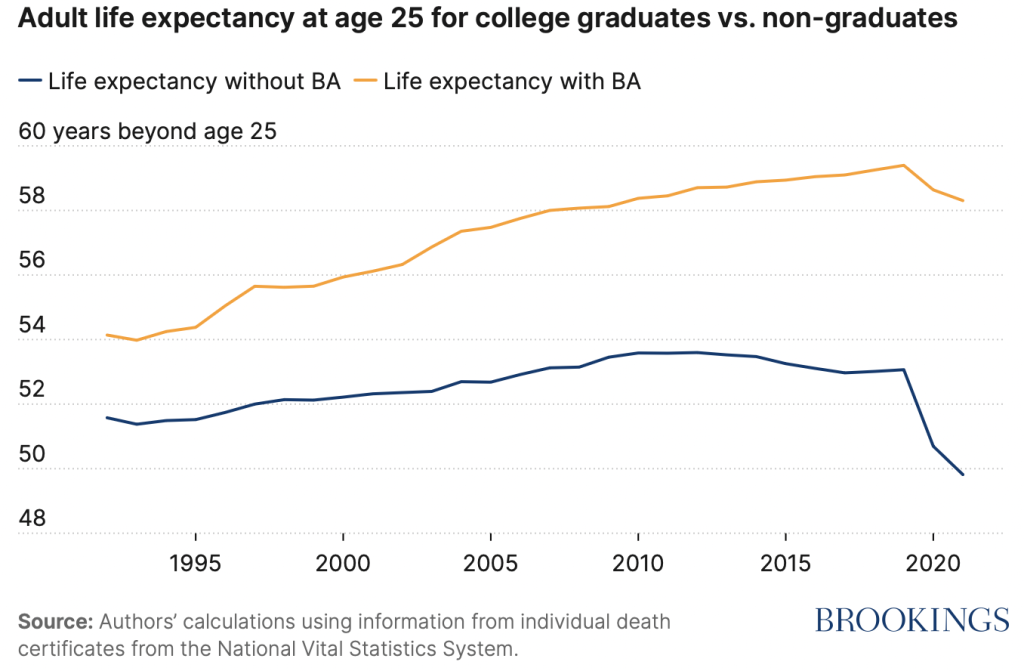
When Anne Case and Angus Deaton updated their “deaths of despair” research in 2023 they found that US social policy was only serving to widen the lifespan gap between poor and wealthier Americans. They use college graduation status, which is a stand-in for class since those with a BA earn about 60 percent more.
Here is a look at Russia in the 1990s:
Yves early on likened the Trump administration’s DOGE bust out to the Shock Therapy administered to Russia in the 90s, an unfortunately prescient observation. Coincidentally, both are the result of the US’ “best and brightest” vampires sucking the lifeblood out of anything with a pulse.
Just as Russia privatized the state’s crown jewels in industry and natural resources, the US too continues to dismantle what’s left of a once-strong secular state.
And so we see unelected wealthy increasingly running the outfits that steer day-to-day life. Media, healthcare, education, natural resources, transportation, security and prisons, surveillance, finance, space exploration, water and electricity, waste management, defense, and more.
The DOGE Boys and the administration’s destruction of housing and food aid while simultaneously helping to drive up the cost of everything through imperial wars, along with the ongoing effort to turn over government services to AI, is only accelerating the pace at which more wealth is pushed upwards while millions more struggle to survive.
While Russia experienced its shock therapy and rise of oligarchs over a short time period, in the US it’s been an ongoing process for decades which is reaching new heights under Trump 2.0. From Nathan Meyers at the University of Massachusetts Amherst Labor Center:
The government’s shift away from production largely stems from mainstreamed austerity politics – a “starve the beast” approach to government – and backlash against the New Deal’s expansion of federal economic involvement. In 1971, the controversial “Powell Memo,” written by future Supreme Court Justice Lewis Powell, mobilized business leaders around the goal of expanding private sector power over public policy. This fueled the rise of conservative think tanks, including the Heritage Foundation, the eventual architect of the Project 2025 privatization agenda.
While government production shrank, government contracting expanded on promises of cost savings and efficiency. These contracting decisions are usually made by local administrators managing budgets under fiscal stress and interest group pressure, including from businesses and public sector unions.
Yet research shows that contracting frequently fails to reduce costs, while risking monopolies, weakening accountability and public input, and sometimes locking governments into rigid contracts.
As always, Trump acts as an accelerant for trends already present, not some unique new evil.
And so predictably we’re now witnessing the rapid breakdown of the American secular state—in which the state’s ability to deliver positive life outcomes to citizens becomes almost nonexistent while bad behavior by private actors in society skyrockets. As Ganesh Sitaraman, director of the Vanderbilt Policy Accelerator for Political Economy and Regulation who has also advised Senator Elizabeth Warren, writes in The Secular Decline of the American State:
The Trump Administration’s assault on the administrative state has received significant attention. But it is a mistake to interpret the weakening of the administrative state during the first or second Trump Administration as exceptional, or as a cyclical, asymmetric phenomenon that characterizes Republican administrations. Rather, we are in the midst of a period of secular decline of the American state, albeit one that has become more acute in the second Trump Administration. This Article outlines fifteen dynamics in American politics, law, policy, and society that all push in the direction of secular decline. Some of these dynamics have been at play for decades, contributing to the already comparatively weak American state. Others are recently emergent or systemic features of decline. The consequences of decline are significant: a rise in harms to consumers, increased economic instability, less innovation, weakened resilience in crises, weakening global power and the rise of the power of adversaries, and social fracturing within society.
A Few Differences and a Potential Preview
As NC commenter ISL points out that as the state breaks down in the US the results are likely to be much worse than they were in the dark days of 90s Russia:
I expect a downside difference with the Soviet experience (note life in the US becomes more kayka-esque every day – try getting insurance approval for a medical procedure) as the US has largely eviscerated its safety net, and people cannot keep working (rent/mortgage) when paid, they must find a job that pays or homeless and keeping a job is very hard when living in a car (increasingly illegal) or under a bridge.
Bus drivers kept driving their routes even though they were unpaid, thanks to free housing / other services courtesy of the state, based on the hope of getting paid in the future. In the US, the bus wouldn’t be driven; preventing people whose job still pays from getting to work, etc., and the same applies to everything in the US. Even doctors already ignore their Hippocratic oath to maximize profits for health care corporations.
So I expect the fall to be much harder, and the fragmentation (independence for kleptocratic former states) to be much worse, likely followed by internal wars for a people who have been at war for almost every year of 250 years.
Another key difference between Russia’s wild 90s and the US today is that violent crime is at historic lows in the US while it exploded in Russia along with shock therapy.
One caveat to these statistics, however. While standard measurements of violent crime in the US are low, one could argue that the stats don’t capture the full picture. They do not take into account the widespread social murder that occurs regularly across the country.
Marissa Jackson Sow, a professor of law at the University of Richmond, defines social murder as “the elimination of groups of people via atrocious events for which the State bears indirect or partial responsibility, through calculated abandonment instead of specific intent.”
Writing that “social murder is a necessary outcome of market capitalism” she offers examples such as abandonment after natural disasters, the Twin Parks North West apartment complex in the Bronx, and, of course, COVID-19:
The COVID-19 pandemic pulled back the veil on governmental policymaking that expressly accepted the sacrifice of the lives of some for the benefit of the economy.
If these measures were to be included in the violent crime rate, the picture begins to look very different. This violence may also help explain why America’s wealthiest are increasingly worried about an uptick in violence that targets them. From Fortune:
Companies are layering in additional home security, personal security, and cybersecurity protections for CEOs and high-profile executives and board members. Goldman Sachs Ayco, the financial planning and wealth management affiliate of the bank, found the most common personal security measures are at least one bodyguard when an executive travels for business or is at a public engagement with a controversial figure in attendance or other unusual risks, and an armed chauffeur for commuting and travel. Mandatory private jet travel has long been common among high-profile CEOs, and companies are also leaning in on first-class air travel for executive teams, the survey of compensation professionals from 291 public and private companies found.
Some possible explanations:
- They are spooked by high-profile events, such as the killing of UnitedHealth CEO by Luigi Mangione, ‘California’s Mangione’ who burned down a warehouse, and the 2024 Midtown Manhattan shooting that claimed the lives of two security guards and two executives at Blackstone and Rudin Management.
- They have at least some level of subconscious awareness of the harm they cause—or at least are being advised about it. A broken state full of economically desperate people doesn’t make for peace and stability.
- They know what’s coming. AI and the police state are growing increasingly intertwined as economic rapaciousness grows, i.e., it ain’t about to get better for the peasantry.
- Or it could be a whole lot of nothing with spooks raising the threat level as spooks do to get the wealthy and Fortune 500 throwing some pocket change around for private security.
Earlier this year the New Jersey Regional Operations and Intelligence Center (NJ ROIC), a domestic spook “fusion center”, warned that American oligarchs are under threat. In the report for “for the situational awareness of executive protection professionals” the NJ ROIC notes the following:
Public discourse increasingly attributes the challenges faced by the middle and lower classes to the actions and influence of wealthy corporate executives. According to a September 2025 Allied Universal survey, there has been a surge in threats against corporate executives, with 66% of U.S. security chiefs reporting an increase in threats to company executives.
Technology, defense, consumer staples, energy, and pharmaceuticals are the sectors with the largest increase in threats of violence.
All four factors likely play a role in elites upping their personal security. One wonders if another factor will enter the picture. As American elites are above the law, corruption and bribery run rampant, privatized security increases, and secular institutions are detonated, they are setting the stage for another similarity with Russia’s wild 90s.
In Russia at that time much of the violence was intra-elite variety as organized crime/business fought over territory and resources, according to a study by Jakub Lonsky.
He defines elite as prominent businessmen, managers of state-owned & private enterprises, members of organized crime groups, law enforcement and army officers, judges, lawyers, politicians, union leaders, as well as other public figures such as activists, journalists, and church clergy. Here’s more:
Heterogeneity analyses further reveal that the rise in elite violence was indiscriminate, affecting local criminal figures, businessmen and managers of state-owned enterprises, law enforcement officers and judges, as well as politicians….A peculiar feature of the mob war was widespread business violence, as businessmen often resorted to hiring contract killers to eliminate competition
Starting with Gorbachev’s 1987 economic reforms, crime and violence began to rise, a trend that accelerated during the mass privatization of the early 1990s. The total reported crime rate increased by 131% between 1987 and 1993, before leveling off in the second half of the decade. Among the individual types of crime, the most significant surge was observed for theft (+324%), robbery (+492%), and robbery with violence (+592%). The rates of homicide and grievous bodily harm both peaked in 1994, with an overall 1987–1994 increase of 246% and 229%, respectively (Gilinskiy, 2006). The rise in violence during this period can be largely attributed to the so-called Great Mob War, which erupted in April 1993 between vory-v-zakone and Chechen gangsters (with many vory siding with the Chechens). Starting in Moscow, the conflict quickly spread throughout the country, with virtually all organized crime groups in Russia siding with one faction or the other (Klebnikov, 2000). Fig. 2 shows the aggregate trend in the elite violence during this period. The conflict culminated in 1996, although the attacks did continue throughout the rest of the decade. A peculiar feature of the mob war was widespread business violence, as businessmen often resorted to hiring contract killers to eliminate competition (Klebnikov, 2000).29 Nevertheless, as Figure A.2 depicts, 1996 saw the culmination of elite violence against all types of victims, including criminals, law enforcement officers, judges, and politicians.
The American elite may come to rue the day they embraced the US as a mafia state.
