

I have no idea when the bull market that began in March 2013 will end. Market volatility is rising; gains are narrowing; bonds are selling off; domestic politics are bad, and geopolitics are worse.
Secular bull runs typically last 10 to 20 years; 1982 to 2000 was the prior major bull run. But two significant wild cards complicate matters: First, the massive fiscal stimulus during the pandemic – the single largest fiscal spend as a percentage of GDP since World War Two – might have reset the clock. Second, the overall impact of artificial intelligence. Not just the massive capital expenditure (CapEx) dominating so much of the economy, but the technology’s potential to make companies more productive, more efficient, and more profitable.
Estimating how much these two factors might extend the bull market’s run is a guessing game, but I am unwilling to dismiss them out of hand. Are we in the 6th, 8th, or 9th inning? I don’t know, but I suspect the beginning of this bull is further away than the end.
What’s an investor to do?
At some point in the future (2027? ‘31?), I will discuss what changes might be prudent to makke in your overall risk exposure. But I am not quite ready for that market call. All-time highs, ongoing trend, and profit growth favor further gains. Significantly reducing equity allocation – e.g., moving from 80/20 to 50/50 – feels premature. For all I know, the top is already in, but given the positive factors and the probability of divided government next year, the odds favor still more gains.
Still, there are things you can do.1 Consider these five steps any investor can take to improve their financial situation and modestly lower expected returns in exchange for meaningfully lower drawdown risk.
Let’s jump in:
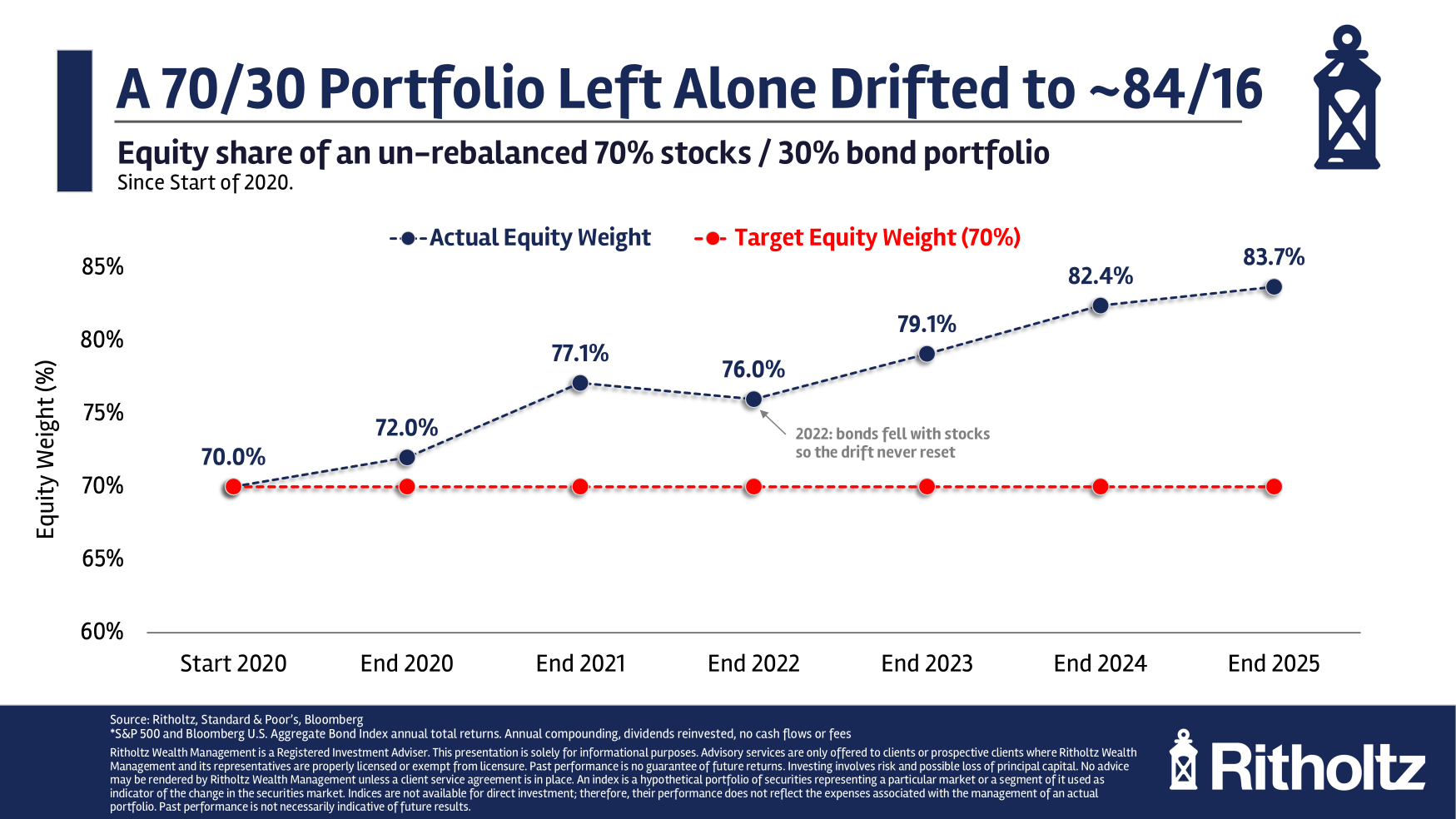
1. Rebalance Your Portfolio: Since the market lows in 2009,2 stocks have trounced bonds. This is especially true for the years 2023-2026, which have all seen double-digit gains in equities and mediocre bond performance, bookended by 2022’s 13% crash and this year’s 2.5% selloff.
Regardless of your starting allocation, the odds are that you have become overweight equities and underweight fixed income. A portfolio that began as 70/30 stocks and bonds is 80/20 today. At the same time, since 2022, the bond aggregate has gone nowhere, with 2026 negative YTD. Stocks gained about 50% over the same period, despite the 2022 bear market. In three years, a 70/30 portfolio drifted to about 79/21; since 2020, it’s 84/16.
The simplest thing to do is to rebalance out of equities and into fixed income back to your original weighting. This, however, does require some tax awareness. Rebalance qualified tax-deferred accounts like IRAs and 401(k)s first; direct new contributions and dividends to the underweight side. In taxable accounts, be aware of the potential tax bill you may be creating; pair sales with harvested losses.
You chose that initial allocation for a reason — a combination of risk tolerance, investment horizon, and the most direct path to meeting your goals. It’s been a long time since investment-grade bonds paid you while also providing ballast against equity volatility.
Yields were above 5% in 2001, 2007, and 2023 (~4.99%) for a hot minute. I have no idea how long yields will stay above 5% this time, but if you don’t take advantage of this opportunity today, I suspect you may regret it later.
2. Eliminate Concentration & Redundancy: Consider the top holdings of active mutual funds; they very often are the exact same dozen or two names. Beyond the closet indexers, active managers chase whatever is hot. What often looks like a diversified portfolio of multiple mutual funds and ETFs has lots of overlap and redundancy.
The easy solution is to pick your favorite – my preference is usually the least expensive funds – and roll the others into it. The idea is to maintain your diversification while reducing the complexity and number of your funds.
The same factors that caused equity overweighting in portfolios have also increased concentration. The run-up in Mag 7 names, the semiconductor boom, and even the spike in energy companies may have created concentration risk in your holdings. That’s before we get to employer stock plans or a lucky purchase of a mega-cap tech name a decade or longer ago that now dominates your portfolio.
There are many ways to reduce this concentration.3
3. Take Out the Trash: Everybody accumulates junk: it piles up in our basements and garages and spare closets. The things we no longer use but aren’t quite ready to dispose of. It’s as true for hoarders as it is for investors.
Now is a good time to work your way through your portfolio and eliminate the detritus that serves no purpose and shouldn’t be there anyway. This includes the sure thing your brother-in-law recommended, your broker’s hot tip (which didn’t work out), the yield play that was guaranteed to safely produce 14% (nope), random NFTs and shitcoins, ETFs that haven’t performed as expected, etc. Even if you rotate the proceeds into your money market, it’s a better use of capital than it is now.
In the back half of a secular bull market, it is always useful to clear out the crap, the stuff that will perform poorly in any drawdown and get utterly murdered in the next market crash.
I say this every few years, and it has never been bad advice.
4. Check Your Home Country Bias: Home country bias – the overweighting of the stocks of the nation you live in – is a global phenomenon. This has been understood since Ken French and James Poterba wrote about it in 1991.4
The U.S. has done very well relative to the rest of the world since 2009; we are in the 4th year of double-digit S&P 500 gains (two of which were ~25%). This makes it likely your U.S. exposure is wildly overweight. The chart nearby5 reveals exactly how concentrated US investors are in U.S. equities.
The U.S. has 4% of the world’s population, 26% of its GDP, and half its stock market capitalization. Yet U.S. investors keep 78% of their equity exposure at home, about 29 points above the US share of global market cap. Foreign investors are already heavily overweight the U.S. too. Norway, Canada, and Denmark each hold more than 40% of their equities in American stocks.
That bet worked for 15 years through 2024; 2025, when international stocks returned 31.2% versus 17.9% for the S&P, reminded us it doesn’t always.
5. Review Your Financial Plan: This seems like a throwaway item, but I assure you it’s not. Lots of changes have taken place in individuals’ wealth simply due to market gains. Are there more kids or grandkids in the picture? Has your income changed materially? Have you altered when you want to retire? Debt, death, and divorce are further reasons to review your plan.
Your plan not only shows whether you’re on track to meet your goals but also helps you get there with less risk and volatility. But only if it’s updated regularly.
Bonus: Here is a 6th suggestion: Update Your Beneficiaries and Estate Documents. The 2025 estate tax change raised the federal exemption to $15 million per person ($30M per married couple) in 2026. Add in the gains since 2009, especially since 2023, and it’s likely a lot about your finances has changed.6
Do you have the appropriate beneficiaries on your accounts? Has your named executor aged out of the role (think next gen instead)? Do you want to make changes to your percentages, add grandkids or charities to the estate?
Beneficiary designations override your will; ex-spouses, deceased parents, and kids who were not yet born when you last updated your papers run the risk of creating an expensive mess.
~~~
You don’t have to make major changes to your assets. These are modest trims along the periphery that align your portfolio with your plan. None of these increase the risk or volatility in your portfolio, and they are likely to increase your chances of achieving your long-term goals.
Take advantage of the opportunities the current market environment has created to thoughtfully make overdue updates and adjustments…
If you need help with your financial plan, investment portfolio, taxes, or estate plans, please reach out to us here.
Previously:
The Evolution of Alpha (April 3, 2026)
What Is Driving Rates Higher and Bonds Lower? (October 6, 2026)
Who Is to Blame for Inflation, 1-15 (June 28, 2022)
The Aberrational Century (September 29, 2026)
__________
1. These are great behavioral hacks that will satisfy your bias towards action, without too much drama for your portfolio…
2. 2009 was the cyclical low; 2013 was when the S&P cleared its 2000/2007 highs, marking the start of a new bull market.
3. We like Canvas Direct Indexing for portfolio tilts and tax loss harvesting; for a single concentrated stock, consider a Section 721 exchange fund; if the position sits inside an already-diversified taxable account, a Section 351 ETF conversion may work. Other options include gifting appreciated shares to a donor-advised fund or selling down over several tax years.
4. Investor Diversification and International Equity Markets by Kenneth R. French and James M. Poterba; The American Economic Review, Vol. 81, No. 2, Papers and Proceedings of the Hundred and Third Annual Meeting of the American Economic Association (May, 1991), pp. 222-226 Published by: American Economic Association
https://www.jstor.org/stable/2006858
5. Visual Capitalist; 2025 data from Goldman Sachs Global Investment Research.
6. Check that your will, powers of attorney, and healthcare proxy are current as well. Make sure the people you name are able, willing, and, if at all possible, local.
