

My morning train WFH reads:
• Land Appreciates. Homes Depreciate. The structure (house) is a depreciating asset: without continuous investment and updates, its value declines over time, even after renovations. The land is the appreciating component: long-term price gains in real estate are primarily driven by rising land values, not by the building itself. Jonathan Miller’s clean reminder of the real-estate math nobody likes: the dirt accrues, the structure depreciates. Useful framing for anyone confused about why the renovation pencils. (Housing Notes)
• There’s Never Been a Better Time to Study Computer Science: The Atlantic pushing back on the “CS is dead” panic — the freshman entering today is graduating into a labor market that still pays for the rare combination of fluency and judgment. Less doom than your timeline thinks. (The Atlantic) see also Tech CEOs are apparently suffering from AI psychosis: TechCrunch on the tech CEO class working themselves into an AI-induced lather — Altman, Musk, Zuck, et al, sounding less like operators and more like a Hieronymus Bosch panel. Funny until you remember whose capital they’re burning. (TechCrunch)
• SpaceX-stasy: This IPO is a trainwreck: Once you arrive at the financials you start to realize what the language is overcompensating for: awful numbers. The company generated $4.7 billion in Q1 2026, up only 15% from the year before (very low for an “AI company”). It also lost $4.3 billion, up 700% from the year before. That means the company is spending roughly twice as much as it makes (and on pace to explode those losses even more), while growing its topline six times slower than Nvidia. The manic SpaceX listing — investor euphoria, narrative compression, and the precise moment “optionality” became the only thing being underwritten. (Prof G Media)
• How Barnes & Noble Became Private Equity’s Most Radical Retail Experiment: A Bloomberg feature on the surprise comeback of Barnes & Noble under Elliott — local manager autonomy, smaller stores, books actually displayed face-out. The rare PE story with a happy ending. (Bloomberg)
• A Century of Stock Market Winners—and Why Most Stocks Failed to Deliver: The compound buy-and-hold return to the entire U.S. stock market over more than 100 years was 1,504,057%. Yet the median individual stock lost money. (Wealth Management)
• ICE Raids Did Lasting Damage to American Businesses: In one corner of Charlotte, foot traffic and sales remain depressed six months after deportation raids. Bloomberg on the Charlotte data — what enforcement actions actually did to local payrolls, vacancies, and small-business closures. The macro story behind the cable news clips. (Businessweek)
• The One Big Reason YouTube Will Never Replace Stephen Colbert: On YouTube, a new generation of hosts is updating the talk show genre for the way we watch now: on our schedule, on our phones and in short clips. It starts with podcasting, which is now being increasingly consumed as a video product. It extends to, say, “The Adam Friedland Show,” whose host’s charm and neurosis would feel familiar to fans of Dick Cavett or a young Woody Allen. It also includes more experimental formats, such as “Subway Takes,” on which the host, Kareem Rahma, engages his guest in a series of quick-witted, subterranean agree/disagree, point/counterpoints, all shot on an active New York City subway train. (New York Times)
• 6 things a neurologist does to keep his brain healthy: Brain atrophy tends to begin in your 30s and 40s, but certain lifestyle changes can slow or even reverse shrinkage. WaPo service journalism — a neurologist’s six habits for keeping his own brain working. The list isn’t novel but the bylined credibility makes it stick. (Washington Post)
• As Trump Politicizes Justice Dept., Prosecutors Struggle With Grand Juries: The NYT on grand juries quietly refusing to return indictments in politically charged DOJ cases. The most important slow-motion check happening right now. (New York Times)
• The universe may be lopsided — new research: The Conversation walks through fresh data suggesting cosmic isotropy may not hold. If it survives replication, every cosmology textbook from the last fifty years needs a chapter rewrite. (The Conversation)
Video of the day: The Real Reason We Left the Gold Standard
Be sure to check out our special Masters in Business this week, Remembering Jonathan Clements with Bill Bernstein and Jason Zweig. The two recall Clements’ impact on the investor community; they discuss his posthumous book, “Money and Me.”
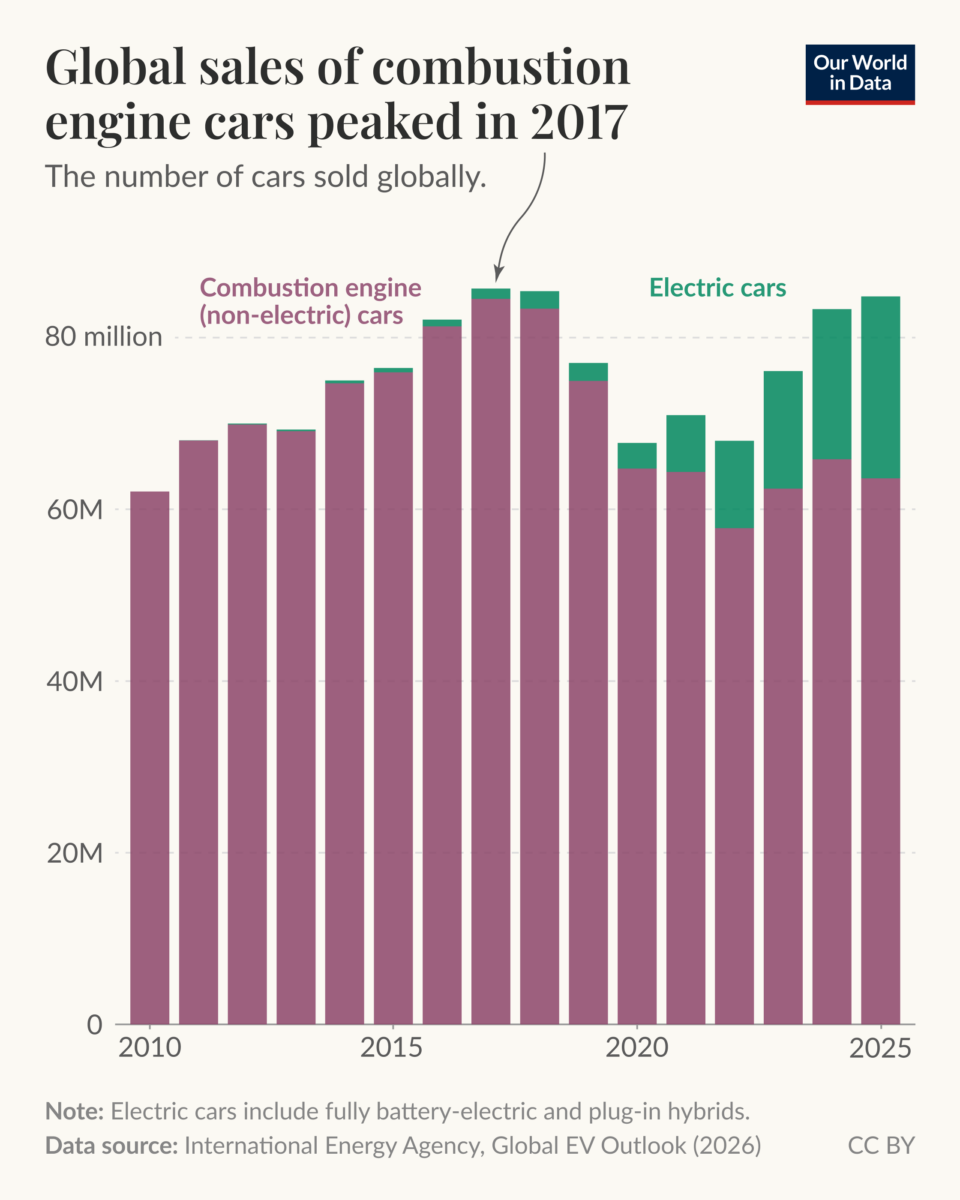
Global sales of combustion engine cars peaked in 2017
Source: Our World In Data
Sign up for our reads-only mailing list here.
The post 10 Thursday AM Reads appeared first on The Big Picture.
