

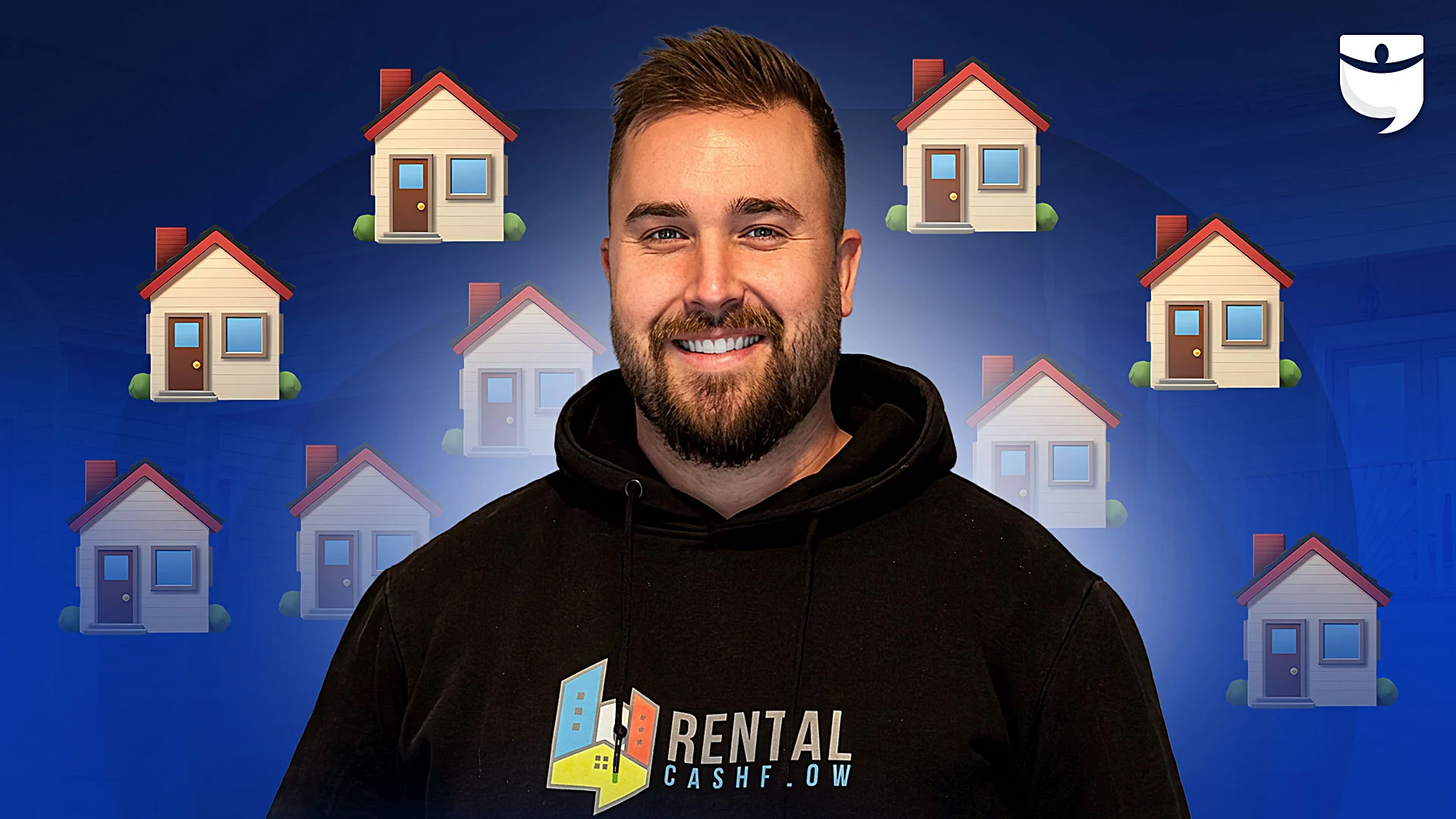

Before real estate, Matt Krueger was making just $35,000 a year. He and his wife were barely getting by, and with a baby on the way, Matt needed to figure out how to get his income up. Fast.
He turned to the one thing his in-laws had been preaching for years: real estate investing. There was just one tiny problem…He had no money!
So, Matt pinched pennies, scraped together the smallest down payment possible, and bought a cheap “grandma” house. He moved in, fixed it up, and a year later, rented it out. Then, he did it again. And again…and again.
Matt was crushing it with this investing strategy, adding hundreds in cash flow with each rental property. But his family wanted to settle down, so he stopped moving and started putting all of his profits and equity to work. Just a few years later, Matt completely replaced his salary and quit his W-2 job. And today, he’s sharing the full playbook that made it all possible.
Henry:
Before real estate, Matt Krueger was making just $35,000 a year. He and his wife were barely getting by, and with a baby on the way, Matt needed to figure out how to get his income up fast. So he turned to the one thing his in-laws had been preaching for years, real estate. But there was one small problem. He had no money. So Matt pinched his pennies, scraped together the smallest down payment possible, and bought a cheap grandma house. He moved in, fixed it up, and rented it out a year later. Then he did it again, and again, and again. Matt was crushing it with this strategy, adding hundreds in cash flow with each rental property, but his family wanted to settle down, so he stopped moving and started putting all of his profits and equity to work. Just a few years later, Matt completely replaced his salary and quit his W-2 job, and today he’s sharing the full playbook that made it all possible.
What’s going on, everybody? I am Henry Washington, podcast co-host and real estate investor out of Northwest Arkansas. And in today’s episode, we have an investor story with Matt Krueger from Des Moines, Iowa. Let’s jump in. Mr. Matt Krueger, welcome to the BiggerPockets Podcast.
Matt:
Thank you. Great to be here.
Henry:
Excited to dive into your story a little more, but why don’t you start off, let’s go a little before the beginning of real estate. Kind of what were you doing prior to real estate and how’d you get into this crazy game in the first place?
Matt:
Yeah, so I grew up a conservative Christian family with a dad that worked in IT, and we were taught young to be smart with our finances. I actually did, I was homeschooled and I did financial piece with Dave Ramsey for a math class, all that stuff. So I ended up going to school to be a youth pastor, graduated with plans to do that, but then landed a job working in cellular retail sales instead at a sprint store, a bottom end sales rep, just to pay bills while I looked for something different. I got married in 2014 when I met my wife. Her parents were already both retired. My father-in-law had worked as a meat cutter at a grocery store. They had tried some other investment opportunities like ostriches. They had a couple hundred ostriches at one point in time, tried to do that, failed at that, got into debt, got into real estate, and they’re in their 50s at the time, spending a month each year down in Tucson and just working on the property.
So that’s what really inspired me to want to do that too. So when we met, I was still working in a sales position, wasn’t a manager quite yet. So I was making 35 grand a year at that time back in 2014. And my wife and I got pregnant, expecting a kid right off the bat, and we both had the desire for her to be a stay at home mom. So that’s when it kind of hit us. It’s like, okay, we got to do something. I like the idea of real estate. My in-laws were able to do no doc loans, all sorts of stuff to get into it where it was harder then for us to do it and we didn’t have any money either. And it’s like, okay, how can we get into real estate? How can we buy a house and how can we start investing?
And driving to work, listening to BiggerPockets podcast, hear about this idea of house hacking, but instead of buying the traditional duplex or fourplex, living in one unit and renting out the others, it was this idea of purchasing a single family home and moving into that house with a smaller down payment. Instead of 20% down, you could do 3% down or something else and then fixing up that house as you live in it and then move out and rent it out. So that was really how we first got started in real estate.
Henry:
Why real estate? Because I’d imagine you had exposure to a lot of different ways to get into business and make money. What about real estate pulled you in?
Matt:
I think the main thing for me was seeing firsthand what it did for my in-laws where they had 20 something properties and he was able to leave his job. I liked my job, but my focus was more on my family, how to spend more time with my kids. I’ve got four kids and wanted more time with them. So especially when we had a kid on the way, I’m like, okay, I need to figure out a way to just build supplemental income at that time. It wasn’t even about financial freedom or leaving a job. It was about how can I make more than 35 grand a year? And this seemed like a good way to do that with little money up front. We utilized a first time home buyer grant. I called 10 banks to get a thousand dollar grant through the Iowa Wild Hockey Team.
I actually went to with their game and held up a check on a teleprompter to get that. Then he crashed. The mascot was at our closing, so that’s how this worked out, but that was cool. And the house was $90,000. This was just a beat up grandma’s home is what it was. And the guy had it listed for 90. I offered him 92 with him paying two grand of closing costs. So we only brought $2,500 to closing. And for me, it’s like, okay, well, I could try to invest in stocks, which I know nothing about. I’ve got somewhat of a mentor here who’s showing me what a good deal looks like and how to build sweat equity. So let’s go that route. 2,500 bucks, I can figure out how to scrap that together and get started.
Henry:
What year was this when you purchased it and in what market?
Matt:
It was 2015 and we bought it in Iowa.
Henry:
2015 in Iowa, first house hack, you paid $92,000 for it. How much money did it cost you to fix it up? And were you doing the work yourself with your family? And if so, how was that being married in a renovation scene?
Matt:
Yeah, so it was difficult. So this house that we bought was the definition of grandma’s home, orange shake carpet in the bedrooms, wood paneled walls throughout the whole house. It even had a carpet throughout the whole kitchen, but it was livable. It qualified for a conventional loan and it was still livable. It was just very outdated. So when we moved into this house, it was kind of one of those things where it’s like, okay, let’s fix things up as we can afford to do it. But then also find the cheapest ways to do it as well. So the wood paneled walls, we just painted them. For the carpet, we ended up getting a kanga back carpet from Menards Midwest Hardware Store.
Henry:
I love Menards.
Matt:
We installed it ourselves. We ripped out the whole old carpet ourselves. We didn’t hire anything to be done at that house. So I utilized the help of my in-laws. My dad does some hobby woodworking on stuff. And then honestly, just a lot of YouTubing and learning how to do this. I mean, I laid down, LVP wasn’t a thing, so laminate flooring through the kitchen, but we bought our supplies from the Habitat for Humanity restore.
Henry:
Oh, that’s a great way to get stuff.
Matt:
Cheap, cheap. I think in the course of the one year, we spent about $5,000 on renovating this thing ourselves. So we lived in there for one year to avoid mortgage fraud.
Henry:
Yeah, good call.
Matt:
And then moved a few blocks away and bought another fixer upper and then rented that house out. So we rented that house out for about a year and a half before we sold it.
Henry:
What were you getting in rent out of it once you moved out?
Matt:
Yeah, so my escrowed mortgage payment, so P-I-T-I, was about 620 bucks a month and I rented it out for $1,200 a month right off the get go.
Henry:
Boo yeah.
Matt:
Yeah. For me, I’m like, man, this is life-changing money, almost 600 bucks a month in cash flow.This is fantastic.
Henry:
That’s super cool. So house had kind of a live-in flip style, but you did a live-in rent and then you ended up selling it a couple of years later. What were you able to sell it for?
Matt:
We sold that house for $135,000. We made about almost $30,000 after everything was said and done, almost my whole salary.
Henry:
Now you said your next deal was just a couple of blocks away. Were you trying to repeat that process, move in, fix it up, rent it out?
Matt:
Yeah. So we repeated the process four times in four years, buying these fixer-uppers each time, things that just needed new carpet, paint, countertops, tile. We were able to be cheap that way and put three to 5% down on each house. So come up with low down payments and found some ways to do even gift to equity on one of them from the seller.
Henry:
I have a couple more questions about this process because it’s an inconvenient one, let’s call it that. So I kind of want to dive a little deeper into what this strategy did for you, but we’ll talk about those things right after the break.
Speaker 3:
Before we go to break, if you’re someone who’s bought a couple of deals and you’re looking to scale up your portfolio into something bigger, I have a really exciting announcement for you. BiggerPockets is hosting its first ever conference focused just on scaling up. It’s this December, it’s coming up soon, this December 5th through seventh in Phoenix, Arizona. We’re going to have a full day of programming with speakers like myself, James Daynard, Kathy Fecke, and Devon Kinard talking about how to scale up and build a sustainable business. Tickets are on sale now, but there are only 100 tickets. So go to biggerpockets.com/conferences now and get your ticket today.
Henry:
All right, we are back on the BiggerPockets podcast. I am speaking with investor Matt Krueger, who was telling us about his journey to getting started. Matt went one of the classic house hacking methods, but a little different. You were buying properties, renovating them, then moving out and renting them out and using low down payment loans because you were living in the properties, which is absolutely a form of house hacking. One of the objections I hear to this strategy for getting started is I don’t want to live in a construction zone or I don’t want to put that stress on my family. How has it both positively impacted your family and your lifestyle and maybe some ways that it didn’t have the best impact?
Matt:
So the process of doing it, there were definitely some challenging parts to it. I don’t share a lot about the emotional strain on your family doing it either, because with each move, we accumulated more stuff and more children and –
Henry:
Well, that’s not the house’s fault, buddy.
Matt:
That’s not the house’s fault, but it was hard. It was really hard.This is not for the faint of heart. This is for somebody who really, really wants this because when we started seeing that cash flow, we’re like, okay, we can keep doing this. And when we got into house number two, we’re like, okay, this could be something that maybe I could leave my job from at the time, or maybe 20 years by the time I’m 45 or something that was… But I didn’t want to keep working a job till I was 60 and this became a financial freedom strategy. Our thought was do 10 houses in 10 years, but the house that we’re living in now, we didn’t love the house, but we love the location and the land. We’ve got an acreage now and we both, when we moved into it, we’re like, we don’t want to move anymore.
We want to be done. So we stopped moving. And I would say that you have to find the right partner to do this with you.
Henry:
Amen, brother.
Matt:
I mean, it’s not easy. It’s even harder to do it by yourself, but having a wife who is extremely motivated, she’s the type of person who’s like… Mariah is my wife. She’s reserved. When I have an idea or land on something, she’s got to really over annualize it where I’m just like, let’s go, let’s go, let’s do it, do it. And then once we finally get into it, then she’s the one that keeps us going and keeps us motivated. But man, I would get home from work and she’s got a baby strap to her back, tiling a backsplash on her own, doing all this stuff. If it wasn’t for her, we would not have gotten to this point at all. So you find that right partner and that’s what’ll help you. But I would also say it helps grow your relationship with your spouse, your partner.
I mean, nothing will get you closer to your spouse than when you, being me, accidentally mixes up way too much mortar and it’s 1:00 AM and it’s a weeknight and you’re tiling a shower and your wife is just like, “Well, I guess we’re just going to have to keep going because you mixed up too much and we can’t afford to let that go to waste.” So you go through those challenges together and you build something together. We built the inside of houses together and it’s something to be proud of. So it helped us in our relationship in that aspect, but it definitely had some challenges.
Henry:
That’s super cool. And thank you for being vulnerable and sharing that. I hope people who are on the fence will consider this as a great way to enter the marketplace. And nothing’s permanent. You can try it and if you don’t like it, don’t do it again. Just figure out a different investment strategy. So you said you bought four of these things. What made you stop that strategy and pivot?
Matt:
So we stopped moving, but we had three rentals and we tucked that cash flow away and used that cash flow to renovate the house that we’re still living in now. Our goal there was let’s build equity onto this house and eventually utilize a home equity line of credit. And that’s what we did. So in the course of two and a half years, we did not buy any new properties. We just fixed up the one that we had and used the cash flow from our rentals to do that. We had an appraisal done and we got approved for HELOC for $160,000. So yeah, built a lot of equity. Bought this house for $180,000 and today it’s worth about half a million.
Henry:
That’ll do. That’ll do, folks.
Matt:
Buy and hold.That’s why you buy and hold, it’s a long-term game. But yeah, so we started using a HELOC to fund our deals from that point.
Henry:
I like that you said that we took a couple of years while we saved money so that we could renovate, so that we could have equity, so that we could take out a HELOC. Your plan doesn’t have to be a 30, 60, 90-day plan. It can be a year. It can be two years. And it gave you, it sounds like a pretty sustainable plan because you ended up with a decent chunk of change. Now you’ve got this line of credit. And so what’d you do with it?
Matt:
Yeah, so we had a few long-term rentals. We wanted to keep doing long-term, but this is also about when Airbnb started becoming more popular and I was watching people on social media start getting into short-term rentals and quitting their job with just two properties and driving Lambos and all of this stuff.
Henry:
So what was this, 2020, 2021?
Matt:
Yeah, it was like 2020. And in 2021, we actually bought two properties. I bought a long-term rental and I bought my first short-term rental. We bought this in Iowa in Des Moines because we’d always been hands-on and I’m like, I want a property that I can renovate, that I can manage locally that’s 30 minutes from home. And then if this works out and we can understand how to run this business, then we’ll buy a property in a vacation market. But our first short-term rental in Des Moines ended up doing really, really well. I bought this house for 160,000. We renovated it ourselves, same method using Habitat for Humanity supplies. And we furnished it with cheap furniture and we got all of our decor from thrift stores. That property, we spent about 25,000 in our furnishing and renovation. So I had about 185 into it. And the first year on that property, it did $57,000 in bookings.
Henry:
Wow.
Matt:
So then I bought another one. And when I bought that next one, I quit my job. I called my boss in the parking lot of the closing office right after we had bought our second short-term rental because I needed proof of income to qualify for the loan, and I quit. Now in between those two, we had done a couple other things. We flipped a condo down south. We bought a couple multi-unit properties, a fourplex and a duplex. So still kept kind of diversifying, but wanted to keep going with short-term rentals and that’s where the cash flow was really coming from. Where we’re making 2,500, 3,500 a month in cash flow off of one property, I knew that we could have me leave my job
Henry:
A
Matt:
Lot faster
Henry:
From
Matt:
That.
Henry:
That’s a heck of a leap because you had one which was doing well, good proof of concept, I’m sure. You bought the second one and then quit before you even knew if it was going to do well or not. So you must have been pretty confident in the numbers. So I want to backtrack to that first one. You buy that first one, got a good deal on it. You furnished it pretty reasonably. It starts producing, but you sound like you were doing all the work. So you were managing the property, finding the tenants, managing the nightly rates, restocking and cleaning, and all of those are things that most Airbnb operators end up outsourcing. So were you considering that you were probably going to have to outsource that at some point and how much that was going to impact your income?
Matt:
Yes and no. You don’t know what you don’t know at the start. I mean, I sat on this for probably a year before we finally got into it. So we did a lot of research and tried to figure it out. It was the analysis paralysis stage, but I think the best way to learn is sometimes oftentimes just doing it and figuring it out as you go. I mean, we started pricing on our own at the beginning, and then I finally started using a dynamic pricing software. Yo started using PriceLabs after a few months and realized I was way under priced, which is why I was getting booked so much. I started using a property management software Hospitable after about six months, which allowed me to automate all of my guest messaging and assign cleaning tasks to us and stuff. So that way I knew when we were cleaning instead of manually putting stuff on my calendar.
So that automated a lot of it. But I mean, honestly, it was a learning curve for us for sure. But with just one property and having it be local, it was easy to figure out as we went with it. So it was fun. We enjoyed the challenge of it and learning something new together for sure.
Henry:
You said you went and bought another one and right after you walked out of the closing of that one, you quit your job. So how’d that second one go?
Matt:
Yeah, so after we bought the first one, we were seeing do really well. I can’t say that it was right at that point that we’re like, okay, well, I can leave my job in a year. That wasn’t really the idea, but we did have some good luck in between these. We went down to South Padre Island for a couple of months during the winter because Iowa winters hit hard. And in the same building that we were staying in, I made a relationship with the property manager. And about a week before we left, he calls me and he’s like, “Yeah, I’ve got an owner that wants to sell.” So we go look at this thing and it’s outdated. It’s a two bedroom, two bathroom condo. It needs paint and carpet and flooring and countertop, but it’s small. And he wanted $210,000 for it. And I knew that other properties in the same building had sold for 250, 260.
So I’m like, okay, there’s some immediate equity here. Didn’t use a realtor, but just bought it directly through him. We wanted to have a short-term rental down there. We wanted to have a place that we could call our own. We fixed this thing up, hired some of the work out. We spent $12,000 and had it completely renovated in three weeks while I’m working remote down there. And then I’m looking around at rental rates and using AirDNA to try and figure out what this thing could rent for. And I’m like, we might cut even, maybe make five, $10,000 a year on this thing, but I don’t think it’s worth the effort of trying to manage something 19 hours away. Third floor walk up, no ocean view as well. So it wasn’t like our dream property that we wanted to live in. Let’s just throw it up for sale by owner on Zillow, see what happens.
Within 24 hours, I had two offers for $5,000 over asking price cash offers. So we sold this thing for $325,000 in the course of five weeks.
Henry:
That’s pretty incredible.
Matt:
Had a check about a hundred grand.
Henry:
If we could go back to those times, I would’ve done some things a whole lot different in my investing portfolio.
Matt:
People call it luck. I’m like, well, I had to do the work. I had to find the property. We put in the effort to get this thing in the first place and I would’ve never assumed that we could have sold it for that much either. So it was timing and it was work, but it was a little bit of luck involved.
Henry:
Yeah, for sure. I think there’s absolutely luck involved when things work out in the market, but you also have to be positioned to take advantage of what the market gives you.
Matt:
For sure.
Henry:
And so if you’re not in the game, you don’t get to take advantage of this opportunity. If you hadn’t taken the risk to buy something, like when you bought it, you didn’t expect this to happen. You took the risk, you got in the game, and you were positioned to be able to sell because you renovated it quickly and took advantage of the upside that the market was giving you.That’s what real estate investing is. It’s being in the game, it’s being positioned to take care of your assets, and then you can capitalize on those assets if and when the market gives you an opportunity to. That’s not luck, that’s investing. So good job.
Matt:
Yeah, a hundred percent.
Henry:
Cool. So you transition now, you’ve got these short-term rentals, and you were obviously depending on that income because you left your day job, but the short-term rental game changed a lot between when you bought these properties and where the short-term rental market is now. So how were you able to stay afloat as things shifted?
Matt:
Yeah, so 2021, 2022, we opened this first Airbnb. We flipped this condo. I used that to buy some multifamily properties. And our goal was to get to a point where my cash flow surpassed my salary, and that was our comfort spots for me to leave my job. So at that point we were, I think I was making like 65 grand a year and our cash flow was averaging around 75 or so. And we’re like, okay, we’re buying this other short-term rental. When we get into this, we’ll be in a good spot. So a year later, we bought a third short-term rental, same market again. Our focus has been on, I’ll call it an accommodation location, not a vacation destination. That’s my coined term. So in my opinion, investing in non-vacation areas is easier. I’ll call it easier. It’s still difficult, but it’s easier because you’re not dependent on people having extra money to travel for fun.
You have people coming for weddings and funerals and family reunions and friend get togethers and birthdays and holidays and work. Even I get a lot of people traveling through for work that book me. Our focus has been four or five bedroom properties. We’re doing hot tubs, murals, game rooms, fire pits, so it becomes kind of a destination. So it’s kind of like one of those vacation style properties, but in a non-vacation market. So we’re elevated above some of our competition that’s not putting in that extra, and it’s helped us to become more successful in some of the top properties in our market because of that. Even through COVID, even through all of this, I did not see a downturn in bookings. In fact, I saw an increase. In 2022, 2023, our properties did one and a half times better than what they had done the previous year.
We actually did this year versus last year. So far, we are trending at about 7% more revenue year over year. So we’re not slowing down. We’re staying consistent because people are traveling for more than just vacations. They’re here for all sorts of stuff.
Henry:
All right. Well, thank you for sharing that because Airbnb is still a viable, in my opinion, investment strategy if you do it in the right place and you provide the right amenities and you can manage your costs, but it is absolutely still a way that you can invest in real estate if done properly. And regular real estate is having a very similar reckoning right now. You can’t be a bad flipper anymore. You used to be a bad flipper and make money. It doesn’t work like that anymore. You got to be really good at your job. So understand what it is you’re getting into and what it’s truly going to take and then apply those things and you can be successful. Welcome back to the BiggerPockets Podcast. I am here with investor Matt Krueger, and we are talking through his investment journey. Now, one of the things that you have, Matt, that I share is a presence on social media.
When did you start building your social media following? And did you start it with the plan on building it or did it just kind of happen?
Matt:
My intention with starting social media was to help teach people how to do what we’re doing, and that’s still what it is. Ultimately, that’s still why I make content. To teach the little guy that’s working the dead end sales job at a Sprint store that he can build financial freedom through real estate and escape the rat race, get out of the job, have financial freedom with his family to wake up and enjoy the day with his kids, go to a pumpkin patch and hop on a BiggerPockets podcast, which I would’ve never thought I’d be in a place like this, going from listening to hoping that I’m teaching somebody through this conversation too. But for me, I listened to people like, and I named them every time, but Zoe McGrath, Michael Elafonte, these people who had a couple of short-term rentals and it changed their life.
And I knew that I wanted to be able to do that for other people. So I’m like, okay, well, in order to do that, I’m going to have to start making some content because that’s how I found out about these people was through absorbing their content. So it was about maybe four or five months before I actually left my job that I started filming and I ended up leaving my job a lot faster than what I thought I would. And that’s when I started being more intentional about content was about the time that I left my job in October of 2022. I think that’s really what got me popular was just people seeing just this normal everyday dude from Iowa actually building a real estate portfolio and doing it without saving up 20% down and being able to do it with a lower down payment and stuff too.
So creative ways to do it as a dad working a lower income job.
Henry:
Being in this privileged position to be able to meet content creators and talk to them on a deeper level, the thing that I see in all of the most successful ones is this true desire to be of service. So if you’re wanting to do this, I think you should absolutely do it if your heart’s in the right place. If you just think you’re going to make money, it’s hard. So just understand what it’s going to take going into it. Can you talk a little bit about how your platform and content has helped your business specifically?
Matt:
For me, content was never really about actually helping my business. And I know this is a weird concept for a lot of people, but I don’t talk about my properties. I go into my properties and I show people tips and tricks, but I never use it as a way to get people to book my properties. It was just more about education and showing people how to run a successful short-term rental business or I’ve got a turnover, this is what I’m doing, stuff like that. And then social media’s turned into a form of monetization for me. I don’t sell courses or mentorships, masterminds, anything like that, but I’ve started working with the brands and companies that I’m using. So I make content with hospitable and proper insurance and Turno, and now I make more through social media than I do through real estate, which is crazy to me, but you can definitely monetize it.
But ultimately my goal with social media is helping people, whether that be speaking at conferences, which I’ve had the privilege to do a couple of times, being on podcasts like this. I was on, I think I’ve got a couple signs back here, but BiggerPockets with Tony and Ashley a couple years ago. I got a business insider feature. That didn’t happen because I decided to just do my own thing in silence. It’s because I started to talk on social media about what we were doing and people noticed that and that’s how I got a voice for myself. So I think as humans as well, we are called to do more than just build for ourselves. We’re called to also help people and inspire people. And social media right now is the way to do that. We’re on the social media run where you can make more money on social media than a lot of major industries.
I mean, making more than doctors and surgeons and all that stuff is wild. And I wouldn’t say it’s easy, but it’s easier than going to school for eight years. You can do that stuff and meet new people and have relationships where you didn’t think you’d be able to before, all while still being able to help people do what you do. So it’s pretty cool. I love it.
Henry:
Man, you’re going to get me preaching, Matt, because you said something I’m very passionate about. Here’s one thing that I’ve learned in life in general. I think that everything that we are put on this planet to do is in the benefit of other people. I think that what we are called to do is not for us. I think that what we are provided with is not for us. I think we’re called to be stewards of it and we’re called to take care of other people. And I love that that’s something that you see and that you recognize and that you put into your business. And so if you’re listening to this and you want to get started in real estate or you want to get started in social media, if your focus is on ensuring that you are doing the best you can for other people, you will have more success because it isn’t for you.
I invest in real estate and yes, it can be financially beneficial, but I am under no illusion that the wealth I create is for me. It is for me to be a good steward of so that I can take care of other people and my capacity to give grows with the more income that I earn. And so I love that. I love that because that to me says these are the kinds of people you need to pay attention to. So if you want to be on social media, keep other people in the forefront of your mind. And if you’re looking for that person on social media that can help teach you something, there’s a million people out here teaching you how to do a million different things, look beyond what they’re saying and see if you resonate with that person as a human being in goals, in morals, in how they present themselves and how they carry themselves, because those are the things that you’ll be able to spot a phony pretty quick and it’ll help keep you out of trouble and it will help you be more profitable when we focus on other people.
But that’s my two cents. I get off my pew right now.
Matt:
I love it. I love it. That’s great.
Henry:
All right. Before we get out of here, just give us a quick update. Where’s your portfolio stand today and do you have any goals for the future that are different than what you’ve done so far?
Matt:
So right now I’ve got 12 properties That number’s fluctuated over the years, but we’ve got narrowed it down to 12. I’ve got a mixture of three single-family short-term rentals, five single-family long-term rentals, and then a four-plex, which is also long-term. So 12 rental units in total. My goal is always to maintain more equity than debt, but I’m not opposed to the idea. If the numbers make sense, I just don’t want to over-leverage myself. But as far as the future goes, I’m interested in some other business ventures too. I’ve though about doing self-storage, that might be the next one. Maybe do a commercial deal or something, maybe a storefront of some kind, like a commercial property and lease it out, get a Starbucks in there or something. I don’t know, maybe that’s too high, but I’m kind of focused on the self-storage game right now. It seems like it could be very passive if you set up the right systems and I’m always interested in learning something new.
So maybe that might buy some more long-term. The short-term, I’m thinking I’m kind of going to be capped at three or four. I just don’t want to over leverage on short-term, just keep diversifying, keep growing. So that’s our goal. And be a dad, spend time with my kids. That’s my goal. Regardless of real estate, whatever I do, be a dad, be a husband, be here, travel with my family.
Henry:
That’s awesome. Thank you so much, man. Thank you for sharing your story. Thank you for sharing the good and the bad, the ups and the downs. Thank you for being vulnerable with us. We appreciate it.
Matt:
Yeah. Thanks, Henry.
Henry:
All right. Thank you everybody for listening to this episode of the BiggerPockets Podcast. I’ve enjoyed this conversation with Matt Krueger. Matt, can you tell everyone where they can find you?
Matt:
Yes, I am on all social platforms. Rentalcashflow is my username simply because it was available when I started making content and it seemed right. So rental.cashflow, TikTok, Instagram, Facebook, YouTube. You can find me there.
Henry:
Awesome. So go check out Matt and his content on socials. Thank you so much for listening to this episode of the BiggerPockets Podcast. We will see you on the next one.
Help us reach new listeners on iTunes by leaving us a rating and review! It takes just 30 seconds and instructions can be found here. Thanks! We really appreciate it!
Interested in learning more about today’s sponsors or becoming a BiggerPockets partner yourself? Email [email protected].

