

[Today’s Iran War post will be comparatively brief, very light at launch and more tweet-heavy than usual because I had competing obligations. Please return at 8:00 AM EDT or refresh your browsers then for a final version]
Even though the Iran and related Saudi-Ansar Allah conflicts are getting less press attention than other hot stories, the sentiment among the YouTubers and Twitterati on this beat is of rising anxiety. While pressure on tectonic plates does not necessarily produce an earthquake, here the intensification of forces suggests a violent, destructive shift.
First a Qatari delegation and then Pakistan’s Asim Munir went to Tehran to try to achieve a resolution or at least a narrowing of positions between the US and Iran. As we pointed out yesterday, experts like Trita Parsi have become even more pessimistic about a peaceful resolution. That was confirmed by Iran hardening its stance, as in further widening the gulf between the two sides.
Some comments from Twitter, first Arya Yadegaar:
@AryJeayBackup
Iran’s top security chief told the US, through Asim Munir, that Iran rejects nuclear talks & transfer of nuclear materials without its 7 conditions being met.
But most importantly: “From Iran’s perspective, lifting the blockade and releasing its frozen assets no longer constitute meaningful concessions to Tehran.”
There was an important outcome of the reportedly only 30 minute Qatar visit; it appears Munir stayed a bit longer. He said the closure of the border with Iran had been temporary and it was now reopened. That means Islamabad is no longer bowing to Bessent’s dictates.
And Brett Erickson:
Increasing indicators seem to point to Iran becoming even more cemented in their inflexibility to move from their negotiating positions.
Just today, we saw Ghalibaf himself indicating that Iran must see the U.S. agree to their 7 key conditions before any possible resolution to the conflict voild take place.
Mohsen Rezaei, the Secretary of Iran’s National Security Council, also stated today that “not a single gram” of Iran’s highly enriched uranium will leave the country.
Even Iran’s more diplomatically-inclined President Pezeshkian has gone silent in recent weeks.
Iran has no INTENTION anymore of giving President Trump a negotiating off-ramp
President Trump is out of options, and the minimal lack of trust that did still exist between the United States and Iran, or perhaps the DESIRE for trust with Pezeshkian and Ghalibaf in particular, has now been proven wrong so many times by the United States that continuing to underplay their hand seems suicidal for any person in Iran to subscribe to.
Iran has TRIED playing nice throughout this war. They haven’t escalated across the Gulf. They haven’t struck the ship to ship transfer point. They haven’t moved against undersea cables.
Why? Because they don’t WANT to cross threshold that could make Trump resort to more insane options.
But at this point, many in Iran are seeing that only TRUE PAIN will be sufficient to bring about a resolution to this war. They tried the Ghalibaf/Pezeshkian approach, and now it’s time for the Rezaei/Vahidi approach.
Others pointed out that China has pretty much halted its ritual calls for negotiations. The peanut gallery speculates that as much as the Persian Gulf disruption imposes costs on them, they will benefit more in the long run via the damage done to the US in terms of military operations and credibility.
In the segment below, Cenk Uygur shows a clip of Israel Defense Minister Benjamin Katz describing how Israel intends to restart the Iran war and strike energy infrastructure and other critical assets. Trita Parsi concurs with Cenk’s reading. He adds that this has been Israel’s plan which was heretofore constrained by the US and that Netanyahu might go ahead before the Israel elections in eight days so as to be able to postpone them.
This segment also mentions the idea of using a MOAB to strike Pickaxe Mountain. Matthew Ho on Judge Napolitano debunks the idea that this would do anything to harm Iranian installations there. Starting at about 22:10, Ho describes that when this type of MOAB was used in Afghanistan against ISIS, it had no effect on tunnels but did terrorize the population.
Consistent with that reading, from Aljazeera’s landing page:
Caveat on the last entry obave: Hezbollah put out lots of decoy launchers for the IDF. So whether this was as real hit is open to question.
Back to the top of the live feed as of 3:00 PM EDT yesterday
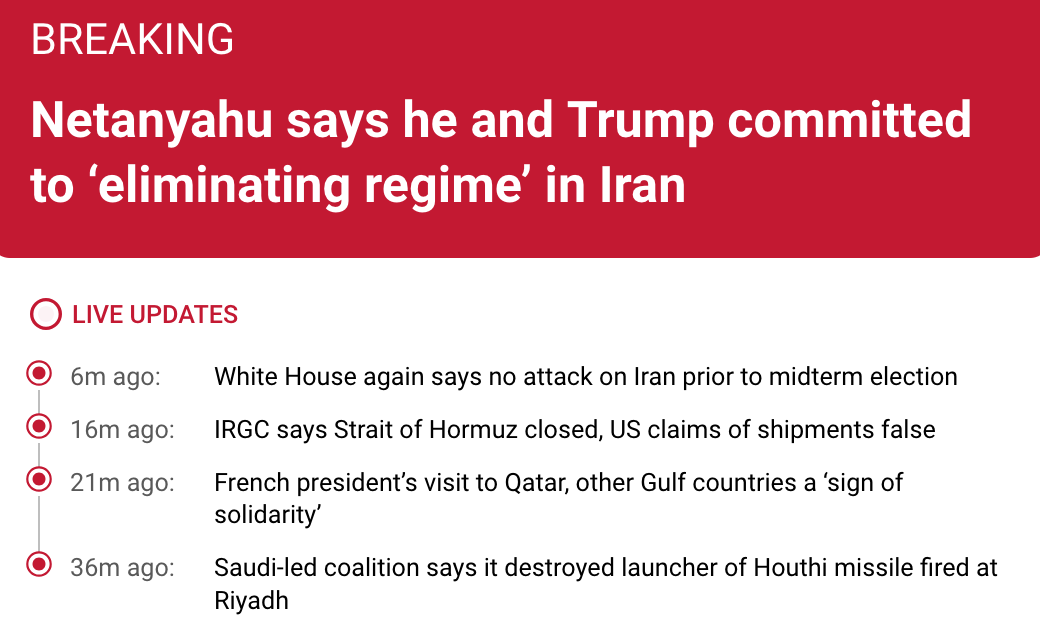
- Israeli Prime Minister Benjamin Netanyahu says both he and President Trump are “committed to completing the elimination of the Iranian regime” and recently “discussed this”.
- Two tankers are ablaze after hitting sea mines in the Strait of Hormuz, the Islamic Revolutionary Guard Corps says. US CENTCOM called the claim “incorrect”.
As for that CENTCOM denial, footage like that below was making the rounds:
The IRGC-Navy published footage of a supertanker carrying over 2 million barrels of crude oil that caught fire after hitting a naval mine in the illegal southern Strait of Hormoz route.
The tanker had turned off AIS radar systems, and ignored warnings. https://t.co/17tH3GiMIC
— Arya Yadegaar (@AryJeayBackup) October 20, 2026
But even with these Israeli belligerent noises, the Iranians, while in a state of readiness, don’t see the US as yet ready to land their promised big blow. From Ehsan Taghadosi on Twitter:
Despite U.S. aerial movements in the region, the current military capability in Iran’s surrounding environment is not such that we should expect a very extensive attack, at least until before the midterm elections.
However, military assessments of an attack by the United States and Israel describe a short 3-day assault but with high intensity. The likelihood of an attack on energy facilities is high, and Iran has threatened a power plant for power plant and tower for tower retaliation.
This message has been conveyed to the Qataris, Omanis, and Pakistanis that Iran’s response will be like the 40-day war.
The US is continuing to bulk up in theater:
BREAKING: The US is sending the USS Theodore Roosevelt carrier strike group and the 13th Marine Expeditionary Unit to the Middle East, adding more than 10,000 sailors and Marines, and will arrive around the November midterms, two US officials confirm to Fox News.
It will be the third carrier in the region, joining the USS George H.W. Bush and the USS George Washington.
This comes in despite today’s baseless reports about an imminent peace deal or negotiations.
Iran said today it is prolonging talks to deny Trump a political victory before the midterms and is preparing for renewed US and Israeli attacks.
— The Hormuz Letter (@HormuzLetter) October 20, 2026
Yet despite this show of muscle, the US is admitting weakness by saying the Gulf States can’t expect all that much going forward. From the Wall Street Journal in Trump Envoy Tells Nervous Gulf Allies U.S. Can’t Guarantee Security Forever:
Tom Barrack, the U.S. ambassador to Turkey and President Trump’s special envoy for Syria and Iraq, said the grand bargains that have underpinned global security for decades are undergoing major transformation, and countries in the Middle East and elsewhere should focus on securing themselves via regional partnerships.
“America as the guarantor to the world, for the last 80 years, it is no longer there,” Barrack said at the Global Security Forum in Doha, an annual summit that brings together top security officials and experts from around the world. “What’s happening in this administration is not an abandonment. It’s a message for realignment.”
“And that message is like raising a teenager. It’s not easy,” he said.
And from Aljazeera in US leaving oil-for-security approach, not Middle East: Envoy Tom Barrack:
The United States is moving away from its traditional security-for-oil relationship with the Middle East and no longer seeks to dominate the region, senior US diplomat Tom Barrack has said.
“The US no longer wants to own,” said Barrack, who serves as US Ambassador to Turkiye and Special Envoy for Syria. “The bargain is not to control, but to not leave. We’re not leaving.”…
Barrack questioned the effectiveness of previous interventions, saying that the US had been involved in ”23 regime changes” across the wider Middle East.
“Every time we try and intervene, change the person or the regime, it seems to have been a mistake,” he said….
Political analyst Luciano Zaccara described Barrack as probably “the most realistic of Trump’s allies” in his assessment of US involvement in the Middle East.
On the Saudi-Ansar Allah front, Ansar Allah is moving closer to control of Taiz:
⚡️BREAKING: Yemen’s Houthis have Captured the Han Mountain from Pro-Saudi Forces overlooking the city of Taiz
All the higher ground is now under the control of Yemen’s Houthis
The Siege on Taiz is now becoming tighter, and Pro-Saudi Forces can’t receive Reinforcement https://t.co/XZX5GLzpov
— Iran Observer (@IranObserver0) October 20, 2026
And:
🇾🇪 In Yemen, the “Ansar Allah” (Houthi) movement is making significant gains in the Jabal Sabr area, the last mountainous region that forces from the Saudi-led coalition have used to defend the strategically important city of Taiz https://t.co/LB1lSEEtxq
— 𝕊𝕡𝕣𝕚𝕟𝕥𝕖𝕣 𝕻𝕣𝕖𝕤𝕤 (@SprinterPress) October 20, 2026
Aljazeera’s latest:
Blockade continues to choke Taiz as food supplies run short
Government forces have carried out strikes west of Taiz, saying they were targeting Houthi military vehicles.
The forces said they conducted sustained military operations, striking positions and military reinforcements belonging to the Houthis, and described the operations as extensive.
Aircraft belonging to government forces have been flying over the city almost continuously for several days, particularly as the Houthis continue to intensify their military pressure, mobilize forces, and attempt to breach the city’s defences through its western entrance.
Government forces have also reported that attacks and shelling are targeting residential neighbourhoods and civilians. There have been fatalities and injuries, as well as damage to civilian property caused by the bombardment.
Turning to the military operations in the city and their humanitarian consequences, the blockade continues to choke the city. There is no domestic cooking gas, and food supplies are running short, according to the government office responsible for monitoring the siege in Taiz province.
Some anti-imperialists are concerned that the Saudis might finally be getting some backing, or that that pretense may be used to stage a bigger operation against Iran:
All of these countries moving “defensive” forces into the Kingdom of Saudi Arabia to protect against Ansarallah air attacks—what happens when Trump-Netanyahu restart their criminal war on Iran. Will they all be at war with Iran too? Is that the unspoken purpose here?
— Mark Ames (@MarkAmesExiled) October 20, 2026
On the other hand, analysts also confirm a risk we flagged yesterday, of danger to Egyptian government of lending more than token support to the Saudis:
🇾🇪 Yemen’s al-Bukhaiti: “Any Egyptian involvement in the aggression against Yemen means Egypt would stand in one trench with the American, Israeli, and British enemy, against Yemen. And this will stain Egypt’s honorable history… and will create an internal breeding ground for takfiris.”
“The Egyptian people are a red line… The Egyptian people are of us, and we are of them.”
— COMBATE |🇵🇷 (@upholdreality) October 20, 2026
Brandon Weichert sound an alarm about Turkiye lending real support to the Saudis in Turkey’s Coming War In Arabia:
Turkey’s hesitation to intervene in Saudi Arabia’s war with Yemen’s Ansarallah should not be confused with indifference. Erdogan may be waiting for precisely the moment when Turkish intervention becomes indispensable to Saudi Arabia’s survival. If Ankara can rescue the Kingdom, it could emerge as the dominant security power in the Middle East, displacing American influence while positioning itself to counterbalance Israel.
Turkey’s President Recep Tayyip Erdogan has submitted the Mecca Defense Pact to Turkey’s Parliament. The details of the Mecca Defense Pact are stunning. Especially considering how reluctant two of the three members of the alliance have been to come to the aid of the third member, Saudi Arabia, as its war with Ansarallah of Yemen continues to go badly.
According to the Middle East Eye, the Mecca Accord locks Turkey, Pakistan, and Saudi Arabia into a perpetual, NATO-like mutual defense pact. Once all three countries ratify it, they cannot leave the Mecca Accord for the first decade.
The 16 points of the Mecca Accord include articles on increased intelligence sharing among the three members. Each will engage in joint weapons production and joint training operations. A Pakistani national will serve as the alliance’s first secretary-general, and Riyadh will host the alliance’s headquarters.
The Kingdom of Saudi Arabia has already activated the Mecca Accord’s defensive agreements in response to Ansarallah’s growing threat. Pakistan has increased its footprint in the conflict, although there is more that it can—and possibly will—do, once the Turks officially ratify the Mecca Accord in their parliament.
Color me skeptical. On the one hand, Douglas Macgregor has repeatedly described the Turkish forces in glowing terms. And Turkiye will not want Iran to secure the position, as Robert Pape has put it, of becoming the world’s fourth global power. But on the other, the Turkiye Parliament has yet to approve the pact. Erdogan has made an art form of stringing that along to secure concessions, as he did with Sweden’s entry into NATO. And Article 5 is a weak alliance, requiring members only to consider committing forces, not obligating them to do so.
Russia, an important off-and-on ally of Turkiye, is backing Iran. Is Turkiye confident enough to side against Russia and China, particularly when Russia is on a trajectory to secure substantial control of the Black Sea?
Consider further that Israel has repeatedly said that Turkiye is next on its menu. Mind you, odds favor Israel being too depleted militarily and economically to achieve that ambition. But does Turkiye want to extend itself before it is sure Israel is not able to move on Turkiye?
Mind you, this possibility bears watching, but if I were Erdogan, I’d want a very big prize for taking this level of risk, and am not sure it is there to be had.
Other broadly related news: French cities are burning, yet Macron runs away. From Aljazeera’s live feed:
French president’s visit to Qatar, other Gulf countries a ‘sign of solidarity’
There are a lot of issues being discussed during Emmanuel Macron’s visit to Qatar.
Defence matters are going to be on the table, as well as energy prices and cooperation in this regard.
Macron’s visit to Qatar and the region is very significant. It comes at a decisive moment with high energy prices and the closure of the Strait of Hormuz.
It also serves as a sign of solidarity with Gulf Cooperation Council countries at a time of heightened tensions and potential escalation between the US and Israel and Iran.
Oil mavens were upset that Iran would take a meeting over the clearly over-hyped Qatar-Pakistan proposal lowered WTI by $5:
Bloomberg denied the fake news
Now Iran directly denied the fake news
Oil prices remain crushed through the floor despite not only nothing changed, but there will be one more day of crude oil barrels supply deficit in the world
Never seen a market so manipulated ever before
— JustDario (@DarioCpx) October 20, 2026
qCaptain questions Iran’s count of damage by mine in Iran Claims More Tankers Hit Mines in Hormuz, But Evidence Remains Elusive, using the fresh IRGC report as a point of departure:
Iran’s Revolutionary Guards claimed Tuesday that a supertanker caught fire after striking a naval mine south of the Strait of Hormuz, adding to a series of similar claims that have yet to be independently substantiated.
The Islamic Revolutionary Guard Corps (IRGC) Navy said the tanker was violating Iranian transit regulations when it struck a mine, according to Reuters. In another statement carried by Iranian media Tuesday, the Guards said two tankers had been set ablaze and disabled by mines along a route south of the strait that Tehran considers unauthorized.
Neither statement identified the vessels or provided independently verifiable evidence of the reported strikes. The Guards also did not make clear when the two tankers were allegedly hit, leaving open whether the latest announcements describe new incidents or repeat earlier claims.
The reports follow several similar announcements in recent months, many involving unnamed tankers said to have exploded or caught fire while attempting to use shipping routes not authorized by Iran.
But assessments from the UK Maritime Trade Operations (UKMTO) and the Joint Maritime Information Center (JMIC) have repeatedly questioned those accounts.
In its latest advisory, issued October 18, JMIC directly addressed Iranian claims that two supertankers struck mines on October 17.
“On 17 Oct the IRGC Navy claimed that two supertankers had struck mines in the Strait of Hormuz; there is no substantiation to these claims,” the advisory stated.
The assessment, which covered developments through October 18, was issued before Tuesday’s latest statements.
A Pattern of Unverified Mine Claims
The October allegations are not isolated.
On July 18, the IRGC claimed two oil tankers exploded and caught fire after entering a minefield in the southern Strait of Hormuz. The Guards accused U.S. intelligence agencies of encouraging the vessels to use the route but did not identify either ship. U.S. Central Command rejected the account as false.
A similar claim followed on August 31, when Iranian state television reported that a supertanker had struck two naval mines, caught fire and come to a complete stop while attempting to use the southern passage.
CENTCOM issued an unusually direct denial.
“No ships have hit mines in the Strait of Hormuz,” the military command said, describing Iran’s announcement as an attempt to intimidate commercial shipping through disinformation.
Mind you, UKMTO re-reports only cases of ship damage submitted by vessel owners. There have been claims by independent commentators that IRCG hits on shuttle vessels on the Oman side are underreported. But it is hard to think damage to a supertanker would go missing.
And signs of budget pain among ordinary US consumers are rising:
This is a bad sign, because people stop paying their car note last, for obvious reasons. Auto loan delinquencies going up mean people have tried everything else to get by first and are now at risk of losing their ride.
— Ryan Grim (@ryangrim) October 20, 2026
Done for today! See you tomorrow!
