

The first few times I saw mention of the GFC being caused by rising bond yields, I let it go. I assumed it was hyperbole or perhaps an inartfully phrased diatribe.
But this week, I read the following sentence:
“That, after all, is what happened when the 10-year crashed through 5% to trigger the financial crisis in 2007.”
…and I could not let it go. At best, it is misleading; at worst, it reflects a fundamental misunderstanding of the underlying causes of the GFC.
A short-rate chronology to refresh your ~20-year recollections: In June 2007, the 10-year broke above 5% and peaked at 5.26% on June 12; this was its highest since 2002. Mortgage rates jumped to 6.7%, and the Bear Stearns hedge funds imploded later that month.
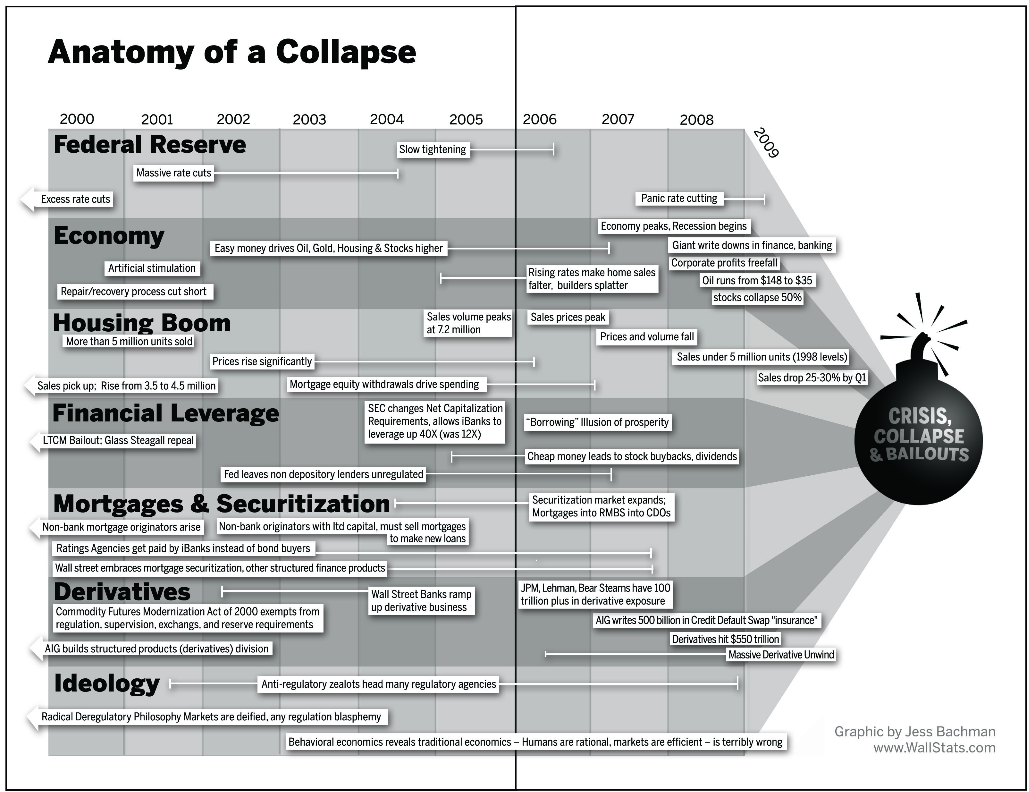
But the “trigger?” No, much more likely were all of the other factors shown in the graphic above.
Consider: Home prices peaked a year earlier; HSBC took its subprime charge months earlier (February 2007); New Century filed bankruptcy in April; ABX indices had been collapsing since January 2007. Subprime was already failing across the board — credit quality issues led to resets, all driven by the no-doc underwriting; CDO leverage was in place long before the 10-year was near 5%. Even those Bear HFs crashed because they were leveraged on collapsing paper — the markdowns in their subprime CDO collateral were the issue, not 10-year Treasury yields.
In fact, the Treasury sell-off was not the cause at all.
Notably, there is nothing special about a 5% yield on the 10-year. In 2007, rates were above 5% for six weeks. It was there 12 months prior, in June/July 2006, at ~5.25% — and nothing broke. The Fed funds rate had been at 5.25% since June 2006, after 17 hikes! Might that have been what drove ARM resets?
It’s also worth noting that from 1975 to 2000, the 10 Year averaged over 8% and 30-year fixed mortgages were 10% — without incident.
In a normal economic environment, rates rising over 5% do not contribute to mortgage stress or financial fragility. But in a situation where leverage has run amok, poison is circulating through the entire financial system via securitized subprime junk, all the while traditional lending standards were abandoned — yeah, higher rates are gonna be one of the elements that send the chickens home to roost.
~~~
I spent two years researching and writing “Bailout Nation”; in none of that time did I ever come across any data or analysis that remotely suggested yields at 5% were a proximate cause (in the legal or literal sense) of the crisis — or even the trigger. Huge leverage, no-doc loans, ultra-low rates, securitized subprime mortgages, and radical deregulation were the primary causal factors.
But in the aftermath, too many people wanted to deflect blame from their own professional behavior onto something, anything, other than their own roles in causing or exacerbating the crisis. In addition to blaming low-income borrowers, the GSEs, Veterans and the FHA, now we have a new category of wrong: Pretending that 5% yields were a proximate cause of the financial crisis. It wasn’t.
See also:
Why the bond market is acting like it did before the Great Recession (Fortune, August 20, 2026)
Hope I Die Before I Get to 7% 10-Year Yields (Bloomberg, October 14, 2026)
Rapid bond yield moves have preceded nearly every major financial blowup (Yahoo, October 8, 2026)
Previously:
Who is to Blame, 1-25 (June 29th, 2009)
A Memo Found in the Street (Barron’s Sept 29, 2008)
Subprime Mortgages: America’s Latest Boom and Bust (May 8th, 2008)
Misunderstanding Credit and Housing Crises: Blaming the CRA, GSEs (October 2nd, 2008)
What caused the financial crisis? The Big Lie goes viral (November 12, 2011)
Full Archive:
Misunderstanding the Financial Crisis (2005-2026)
