

It’s the end of September, and that means I am busy working on the Q4 quarterly call (out early October). I decided to surface to share two tables I find absolutely fascinating.
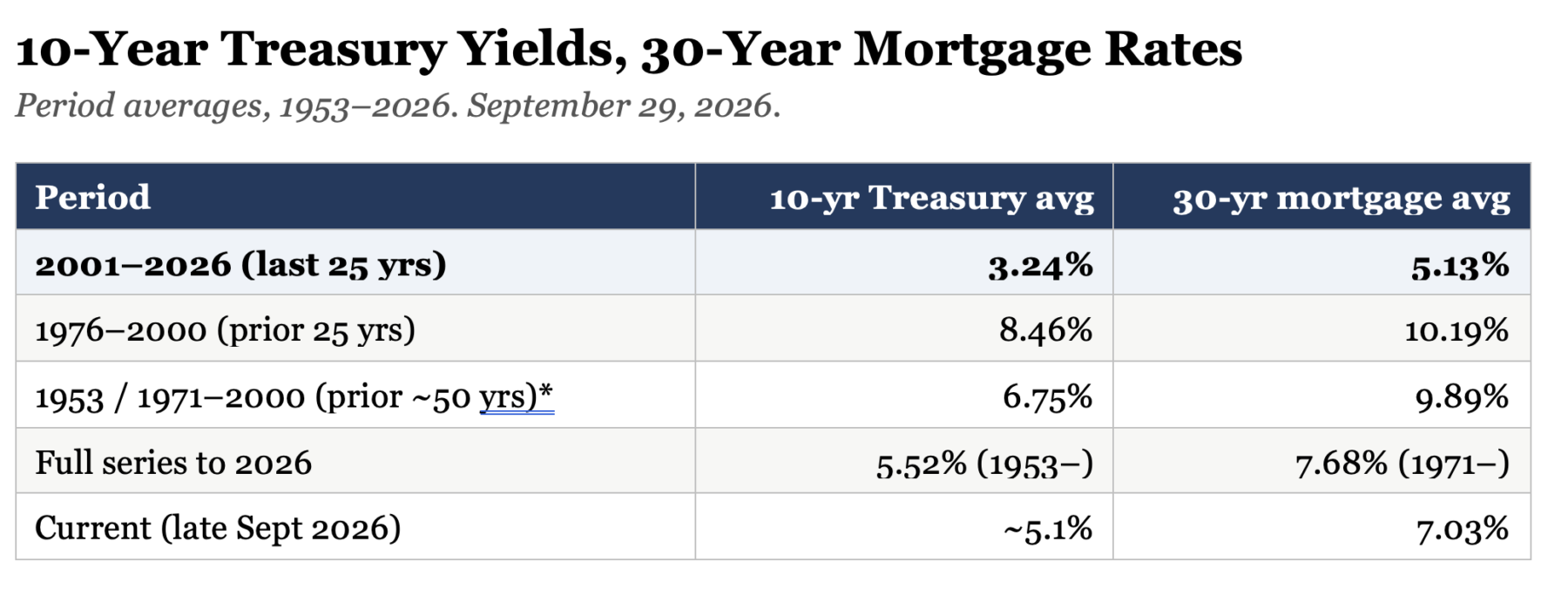
The first table (above) compares the 10-year bonds and the 30-year fixed-rate mortgage across two distinct time periods: The present era, back to the dotcom implosion, versus the 25-year period before it. The numbers are telling:
Since 2001, the 10-Year yielded ~3.25%; mortgages have averaged ~5.1%.
The prior 25-year run — from 1976 to 2000 — saw the 10-Year yielding ~8.5%; mortgages averaged ~10.2%. That’s literally double the ultra-low rate levels we have enjoyed in the first quarter of the 21st century.1
The past 25 years have been marked by very low average 10-year yields and very affordable 30-year fixed mortgage rates. This is especially true compared with the prior 25-year period.
I have legitimate concerns about other factors driving rates higher, and I’ll address them in the coming weeks. If you want an early preview, consider these:
10 Drivers of Higher Interest Rates
1. Covid Fiscal Stimulus
2. AI-Accelerated GDP Growth
3. Inflation: Oil and the Iran war premium
4. Inflation: Tariff Trade policy
5. Rest of the world sours on US Treasuries
6. Duration: Weak Demand for long-dated paper
7. Deficits
8. Corporate Supply (competing with Treasury)
9. Japan leads Global rise in yield
10. Rate Normalization, Post QE/ZIRP
Today’s tables are all about #10 above.
There’s been a lot of angst over changes in the bond market for numerous reasons, but I can’t help but wonder how much of that concern is simply that we’ve become so terribly spoiled by very cheap credit and the most affordable mortgages in our lifetimes.
Look at the 10-Year Yield by decade below. Right after World War 2, the 19-year was at ~3.25%. That rose each decade and peaked in the 1980s at 10.6%. Now we’re back to an average for the 2020s of 3.1%. But that’s likely behind us, as yields have climbed back over 5%—today, the 10-year Treasury is at 5.3%.
Perhaps we should have appreciated how good we had it when money was free…
~~~
More next week…
Previously:
What’s Upsetting the Bond Market? (August 25, 2026)
T-Bills and Chill? Try Munis & Chill Instead (September 10, 2026)
Corporate vs Treasury Debt Duration (September 8, 2026)
Managing Stocks & Bonds During a Low Yield Era (November 18, 2020)
__________
1. And it only took a major terrorist attack, a financial crisis, and a pandemic to achieve it!
