

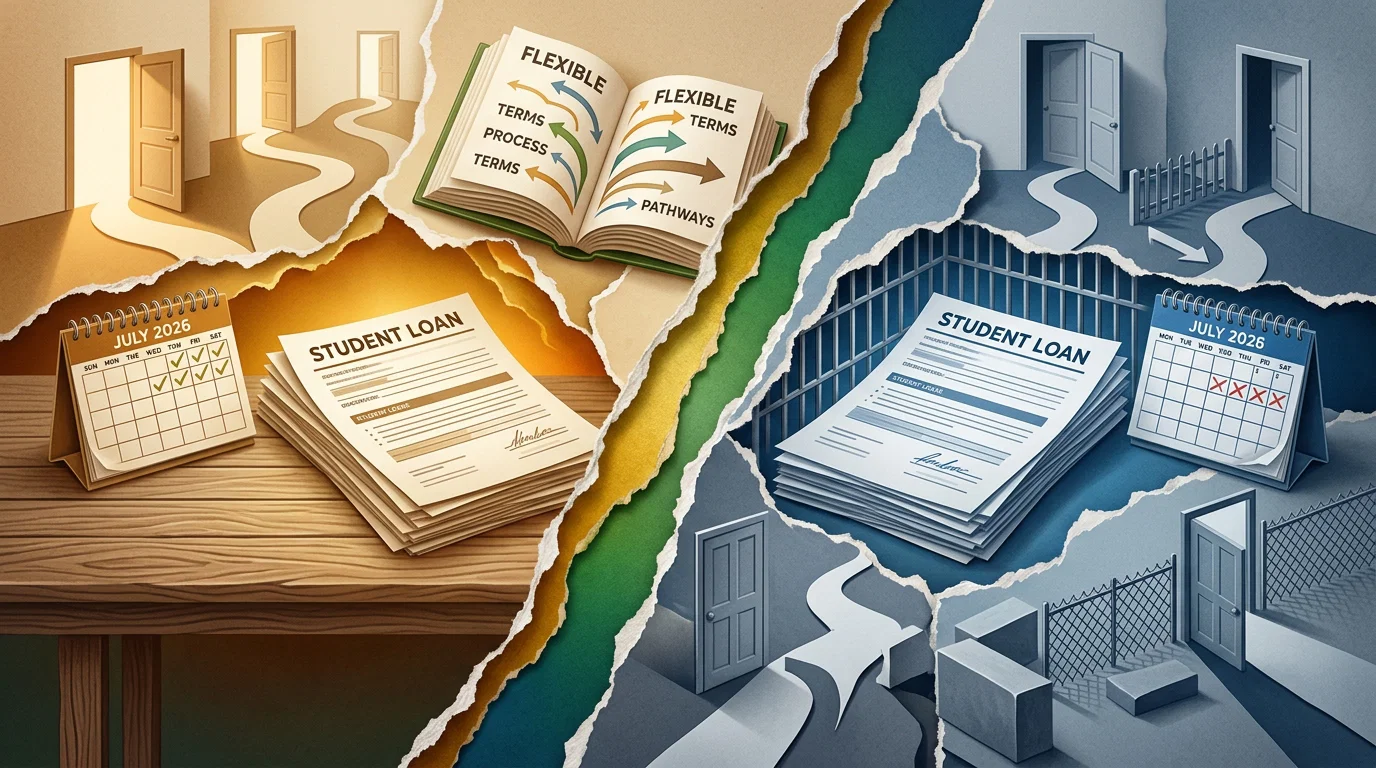
The federal government just split student loan borrowers into two groups: those who borrowed before July 2026 keep access to income-driven repayment and forgiveness strategies, while everyone after gets strict caps, fewer options, and tax bills on forgiven debt. If you’re on the wrong side of that line—or helping someone navigate it—the math on graduate school, Parent PLUS loans, and even retirement contributions just changed.
The July 2026 Dividing Line – 00:05:30
The One Big Beautiful Bill Act created two distinct classes of borrowers. Pre-July 2026 borrowers retain access to Income-Based Repayment (IBR) with payments at 10-15% of discretionary income and forgiveness after 20-25 years. Post-July 2026 borrowers get the new Repayment Assistance Plan (RAP) with 1-10% payments based on income but forgiveness only after 30 years. Anyone who takes out even one loan after the cutoff loses access to the old system entirely.
New Borrowing Limits – 00:12:00
Federal loans are now capped at approximately $65,000 total for undergraduates (via Parent PLUS), $20,500 per year for graduate students, and $50,000 per year for professional programs like medical, dental, and law school—with a $200,000 lifetime cap for professional degrees. These limits fundamentally change which graduate programs remain financially viable without substantial family wealth or private loans.
The Death of Parent PLUS Loans – 00:35:00
Parent PLUS loans have become a loan of last resort. They now carry roughly 9% interest rates, offer zero income-driven repayment options, and place all legal responsibility on parents alone. Students are morally but not legally obligated. For parents with good credit, private loans offer better rates and the option to cosign, putting responsibility on both parties.
Private Loans About to Surge – 01:10:00
With federal borrowing caps forcing graduate students to seek alternative funding, the private loan market is poised for massive growth. Rate spreads can reach 7 percentage points between best and worst offers. Students should establish credit history at least three years before grad school by opening a credit card early and rate shop aggressively across multiple lenders.
IBR vs RAP: Know Your Repayment Plan – 00:18:00
Pre-July 2026 borrowers can access IBR with payments capped at 10% or 15% of discretionary income and forgiveness after 20 years for undergrad debt or 25 years for graduate debt. Post-July 2026 borrowers get RAP, which starts at 1% of income for those earning under $15,000 and scales up to 10% for higher earners, with forgiveness only after 30 years. The difference in both payment structure and timeline is substantial.
The Tax Bomb Returns – 00:28:00
Forgiveness through income-driven repayment in the private sector is once again taxable as income starting in 2026, after being tax-free from 2021-2025 under the American Rescue Plan. Public Service Loan Forgiveness (PSLF) remains tax-free. For someone who has $100,000 forgiven while earning $75,000, they could face a tax bill on $175,000 of income in the year of forgiveness.
PSLF and Current Litigation – 00:52:00
PSLF remains the strongest forgiveness option for qualifying public service and nonprofit employees, requiring 120 qualifying payments while working full-time. The PSLF Buyback program allows workers to purchase credit for months spent in forbearance or deferment. Current litigation primarily affects niche groups rather than broad populations, though ongoing challenges to Department of Education rules create uncertainty.
AGI Manipulation as Tax Strategy – 01:02:00
Since income-driven repayment calculates payments based on Adjusted Gross Income, maximizing pre-tax 401(k) contributions, HSA contributions, and other above-the-line deductions directly reduces required loan payments. For borrowers paying 24% federal tax + 5% state tax + 10% to student loans, that’s a 39% effective marginal rate—making traditional pre-tax contributions far more valuable than Roth accounts until loans are paid off or forgiven.
College Negotiation Leverage – 00:42:00
Demographic decline and new federal borrowing limits have created unprecedented negotiating power for students. Non-elite schools facing enrollment pressure are offering substantial last-minute discounts—Syracuse gave uncommitted students $20,000 per year just to fill classes. Students should compare competing offers from similar institutions and negotiate aggressively, especially at schools outside the top tier where enrollment pressure is highest.
Notable Quotes
Travis Hornsby: “We’re going from this borrow as much as you want, pay very little to a program of you can only borrow a set amount and it’s capped.”
Travis Hornsby: “If you’re in a twenty-four percent federal bracket and you’re in five percent state tax bracket, and then you’re paying ten to student loans. That’s forty percent.”
Brad Barrett: “Everything is negotiable. It literally never hurts to ask.”
Travis Hornsby: “The listeners that you guys have dramatically underestimate how wealthy they are going to be one day.”
Brad Barrett: “The student loan system has effectively been rewritten. There is now a major dividing line between people who borrowed before July 2026 and those borrowing after it.”
Key Takeaways
- If you borrowed before July 2026 and are in SAVE forbearance, choose your repayment plan before being automatically placed on standard repayment
- Open a credit card as an undergraduate to establish three years of credit history before grad school if you may need private loans
- File a tax return immediately after graduating to lock in low-income year for income-driven repayment calculations and maximize interest subsidies
- Max out pre-tax 401(k) and HSA contributions before Roth if you have student loans—your effective tax rate includes loan payments
- Negotiate financial aid packages aggressively by comparing competing offers from similar schools, especially at non-elite institutions facing enrollment pressure
- If you’re a public servant affected by SAVE forbearance, consider applying for PSLF Buyback to convert forbearance months into qualifying payments
- Shop multiple private lenders if borrowing for grad school—rate spreads can be as wide as 7 percentage points between best and worst offers
Resources
Student Loan Planner consultation services
