

This is Naked Capitalism fundraising week. 647 donors have already invested in our efforts to combat corruption and predatory conduct, particularly in the financial realm. Please join us and participate via our donation page, which shows how to give via check, credit card, debit card, PayPal. Clover, or Wise. Read about why we’re doing this fundraiser, what we’ve accomplished in the last year,, and our current goal, supporting the Coffee Break/Sunday Movie features.
Iran appears to have wasted no time following the end of the UN meetings in New York, at the end of which POTUS Trump rejected Iran’s ceasefire offer.
US Made Threatening Moves
As is so often the case, American military moves in West Asia were ominous:
BREAKING: Heavy US military air traffic over the Middle East today, with four KC-135 and KC-46 tankers, two P-8A maritime patrol aircraft over the region, and two C-17 strategic airlifters over western and central Saudi Arabia, hours after Trump rejected Iran’s proposal and told… pic.twitter.com/Anzw64Ofaa
— The Hormuz Letter (@HormuzLetter) September 26, 2026
And the data over the past month seems to confirm American claims of successfully routing around the Iranian blockade of the Strait:
🚨Gulf oil exports top 20 million barrels a day for the first time since the war began
Oil exports from the Persian Gulf and Gulf of Oman climbed above 20 million barrels a day on a 7-day average this week, according to preliminary Kpler data. The figure covers Strait of Hormuz… pic.twitter.com/czHcl7NcpI
— Drop Site (@DropSiteNews) September 26, 2026
The sanctions are having other pernicious effects as well, per the FT:
Iranian pharmacists have warned of a worsening shortage of medicines as the US war and blockade complicate the country’s ability to import and pay for medical drugs.
While the country of 90mn produces most of its own medication domestically, it relies on imports of ingredients from countries including India and buys medicines and vaccines from Europe and elsewhere.
But ministers have acknowledged in recent weeks that securing those supplies has become increasingly difficult.
The US has for months blockaded Iran’s southern ports, the main corridor for the country’s medicine imports, while a growing number of international flights — on which they are also brought in — have been cancelled because of American sanctions on airline service providers in third countries.
Several pharmaceutical factories were also hit directly or indirectly at the height of the US-Israeli bombing campaign, officials said. All this has forced Tehran to tap strategic reserves of medicine and look for alternative overland routes for imports, officials said.
Hadi Ahmadi, a spokesperson for the Iranian Pharmacists Association, said about 60 medicines used for life-threatening diseases, such as for the blood disorder thalassaemia, were in short supply.
Israeli analyst Danny Citrinowicz saw something coming, posting before Trump announced no ceasefire:
What happens the day after Washington says no?
Iranian leaders are also reading the American political calendar. They understand that a major escalation before the midterms could impose significant political and economic costs on the administration, particularly through higher oil and gasoline prices. Trump himself has publicly acknowledged the connection between the Iran conflict, energy prices and the midterm timetable.
If Tehran concludes that Washington wants to avoid a broader confrontation before November, it may decide that escalation, rather than compromise, offers the better path to leverage. The question then becomes whether Iran would move beyond absorbing the economic pressure of the U.S. blockade and take new steps to impose costs on Washington and the global economy, particularly around maritime traffic and energy flows.
The Strait of Hormuz has already become one of Tehran’s principal sources of leverage. Recent negotiations have centered precisely on the tradeoff between reopening the strait and easing the U.S. blockade.
So the administration should evaluate the Iranian proposal against two scenarios, not one. The first is the cost and strategic consequence of accepting a deal that largely revives the previous framework. The second is the likely Iranian response if Washington rejects it.
The real policy question is therefore not only whether Iran’s offer is acceptable. It is whether Washington has a credible strategy for what comes next if it is not.
Fire In the Hormuz
The Hormuz Letter reported:
BREAKING: Iran has launched anti-ship missiles from Sirik in southern Iran toward vessels under US escort in the US-backed southern Omani corridor of the Strait of Hormuz, with several large-scale explosions heard in the Strait over the past hour and at least one oil tanker confirmed hit, per initial reports.
Local sources say “a serious naval conflict” is ongoing tonight. The explosions in the past few hours are in the double digits, with further explosions minutes ago around Qeshm Island.
And
BREAKING: Iran’s IRGC has substantially escalated its targeting of vessels in the Strait of Hormuz over the past hours, launching anti-ship cruise missiles and drones while fast-attack boats engage tankers with guided rockets, machine guns and small arms, per initial reports and a senior Iranian source.
At least 3 vessels have been struck and a 4th has turned around, with a second source putting the number struck tonight at up to 6.
And
BREAKING: Iran is laying naval mines in the US-backed southern Omani corridor of the Strait of Hormuz tonight. At least some of the 10+ missiles fired so far carried mines, per initial reports and a senior Iranian source.
UPDATE: Some UNCONFIRMED reports suggest that some of the missiles fired by the IRGC into the Strait of Hormuz contained sea mines and may have been deposited into the Oman route in the Strait of Hormuz that the US had been utilizing to push oil shipments through. If true, Trump… pic.twitter.com/fg68fiezLH
— Brandon Weichert (@WeTheBrandon) September 27, 2026
Iranian Threats
Warning to ship owners:
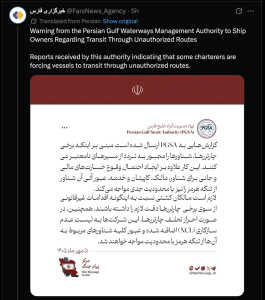
The Iranian Fars News agency posted the following:
Warning from the Persian Gulf Waterways Management Authority to Ship Owners Regarding Transit Through Unauthorized Routes
Reports received by this authority indicating that some charterers are forcing vessels to transit through unauthorized routes.
This action, in addition to creating the risk of financial and personal damages to the vessel, owner, captain, and crew, also imposes restrictions on the future passage of that vessel through the strait.
In the event of confirmed violations of the charters, these companies will be added to the incompatibility list, and the passage of all their vessels through the Strait of Hormuz will be restricted.
Followed soon by this apology from said ship owners:
Ship Owners’ Apology for Unauthorized Passage of Vessel Through the Strait of Hormuz
Following a warning from the Persian Gulf Waterway Management Authority to ship owners regarding the coercion by certain charterers to pass through the illegal route of the Strait of Hormuz, they sent an email apologizing from Iran. Sections of this letter state:
We, the shipowners, hereby formally offer our apologies regarding the unauthorized passage of the vessel through the Strait of Hormuz.
This incident occurred entirely as a result of the mandatory and direct instructions of the charterer. The ship’s captain, under intense commercial pressure, had no choice but to carry out the instructions, and this is what led to the violation.
Warning to enemy navies:
IRGC Navy: In the new war, enemy vessels will not be safe even in the Indian Ocean
Deputy Political Officer of the IRGC Navy: If another war occurs, without a doubt, we will attack and strike their vessels and destroyers even in the Indian Ocean.
FARS also had this interview with Iranian President Pezeshkian in which he said, “Pezeshkian: We and Yemen did not intervene in the attack on Saudi Arabia’s hinge line. The possibility that Israel carried out this action to inflame the disputes is not far-fetched.”
One US analyst comments:
IRAN WAR: Once again, we see a day with enormous volumes of Iranian targeting of vessels crossing the Strait of Hormuz.
Once again, we see President Trump doing nothing about it.
While the correct decision to avoid further escalation, it is a horribly embarrassing pill to…
— Brett Erickson (@BrettErickson28) September 26, 2026
Much Drama In Iraq
Protests erupted in Baghdad and Basra due to the Iraqi government’s decision to participate in US sanctions on Iranian flights.
VIDEO | Crowds in Iraq protest the abrupt suspension of flights arriving from Iran into Baghdad and Basra due to US sanctions targeting Iran’s aviation sector and airlines. pic.twitter.com/lCrGdDNW0u
— The Cradle (@TheCradleMedia) September 26, 2026
This account reads quite a bit of significance into the unrest:
🇮🇶|Basra Just Erupted. The Oil Capital of Iraq Is Protesting the Blockade on Iranian Flights. The Government Is Losing Control of the Street.
Basra is not Baghdad. It is not Najaf. It is not Erbil. It is the south. It is the Shia heartland. It is the oil capital. It is where the… pic.twitter.com/95nnA6FrHa
— Aprajita Nafs Nefes 🦋 Ancient Believer (@aprajitanefes) September 26, 2026
There’s also a kerfluffle about who rescued a tanker owned by Al-Shaghanba tribesmen from Somali pirates. Some claim it was Iraqi tribesmen who flew across the region, boarded a pirate-held tanker, and personally liberated it, others claim the Al-Shaghanba tribesmen worked with Somalia’s Puntland Maritime Police to effect the rescue, others claim it was the Puntland police alone. I’m not in a position to adjudicate this dispute, but it’s an interesting tale regardless.
US funding for Kurds in Peshmerga is over, per 964 Media:
ERBIL — The international coalition’s financial assistance to the Peshmerga has ended with the expiry of a four-year agreement, and the ministry has asked Baghdad to cover the gap by paying Peshmerga salaries on the same basis as federal security forces, a senior official said.
The final payment, covering August and September, was distributed on Thursday, said Lt. Gen. Bakhtiar Mohammed Sadiq, secretary-general of the Ministry of Peshmerga Affairs. The agreement ran from Sept. 21, 2022, to Sept. 21, 2026, with the assistance reduced by 25% each year until it reached zero.
It was part of a memorandum that tied international support to reforming and unifying the Peshmerga under the ministry. The Kurdistan Region formally declared that unification complete on Monday, replacing the party-aligned 70 and 80 commands with two area commands and 11 divisions, and Kurdistan Region President Nechirvan Barzani and Prime Minister Masrour Barzani both called at the ceremony for Baghdad to meet its obligations on Peshmerga pay. Coalition countries have supported the reform with advisers, training, equipment and logistics, and Peshmerga officials are seeking bilateral military cooperation with them after the mission ends on Sept. 30.
Saudi Arabia Takes Its Licks, But Tries to Keep It on the Down Low
NEW: It is worth noting that Saudi Arabia is largely NOT issuing public early warning alerts for targeting of their capital, Riyadh.
Multiple times now, Riyadh has been targeted by Ansar Allah (Houthis), but alerts have not been issued despite confirmed and verified strikes…
— Brett Erickson (@BrettErickson28) September 26, 2026
Yemen’s Ansarallah military media release footage from Rajoum drone dropping projectiles on Saudi-backed forces’ vehicles. pic.twitter.com/C2QHIXriJZ
— MenchOsint (@MenchOsint) September 26, 2026
Saudis Hit Civilian Infrastructure in Yemen
The Al-Dalil Bridge, linking Ibb Governorate with Dhamar Governorate and from there to the capital Sana’a in the north, and on the other side connecting it to Taiz Governorate and the southern governorates, was targeted by the Saudi enemy today. pic.twitter.com/mPOB5meVbF
— Hussain Albukhaiti حسين البخيتي (@HussainBukhaiti) September 26, 2026
Yemen’s Armed Forces (Ansarallah) Spokesman:
“Over the past 24 hours, Saudi Air Force fighter jets conducted 27 airstrikes using F-15 and Typhoon that took off from Khamis Mushait and Taif airbases, targeting civilian infrastructure including bridges, roads, and other sites in… https://t.co/BmmSxvL1Hm pic.twitter.com/UODvlo6kk6
— MenchOsint (@MenchOsint) September 26, 2026
The Saudi enemy targets a water project and communications networks in the Al-Akboush area in the #حيفان district of #تعز https://t.co/1heBLT6TjN
— Hussain Albukhaiti حسين البخيتي (@HussainBukhaiti) September 26, 2026
Saudi airstrikes reported in the Al-Ahkoum front in Taiz area, reportedly targeting a water project and the communications network according to Al Mayadeen. (Control map from @war_cube) https://t.co/y4jStTlYPR pic.twitter.com/fdpThxEqKN
— MenchOsint (@MenchOsint) September 26, 2026
Around the YouTubes
Ali Alizadeh is a London-based Iranian-British political analyst who sees the hand of a dead man in today’s scenarios.
Michael Farris talks to US naval vet Jim Webb.
The people of Pakistan should rise up against the corrupt Zionist government of Pakistan.
Imran Khan is the true leader of Pakistan
👇👇 pic.twitter.com/Bx5xVn3OoT
— Hussain Albukhaiti حسين البخيتي (@HussainBukhaiti) September 26, 2026
Former Pakistani soldier Adil Raja speaks to Yemeni spokesman Hussain Albukhaiti.
Stay safe, y’all!
