

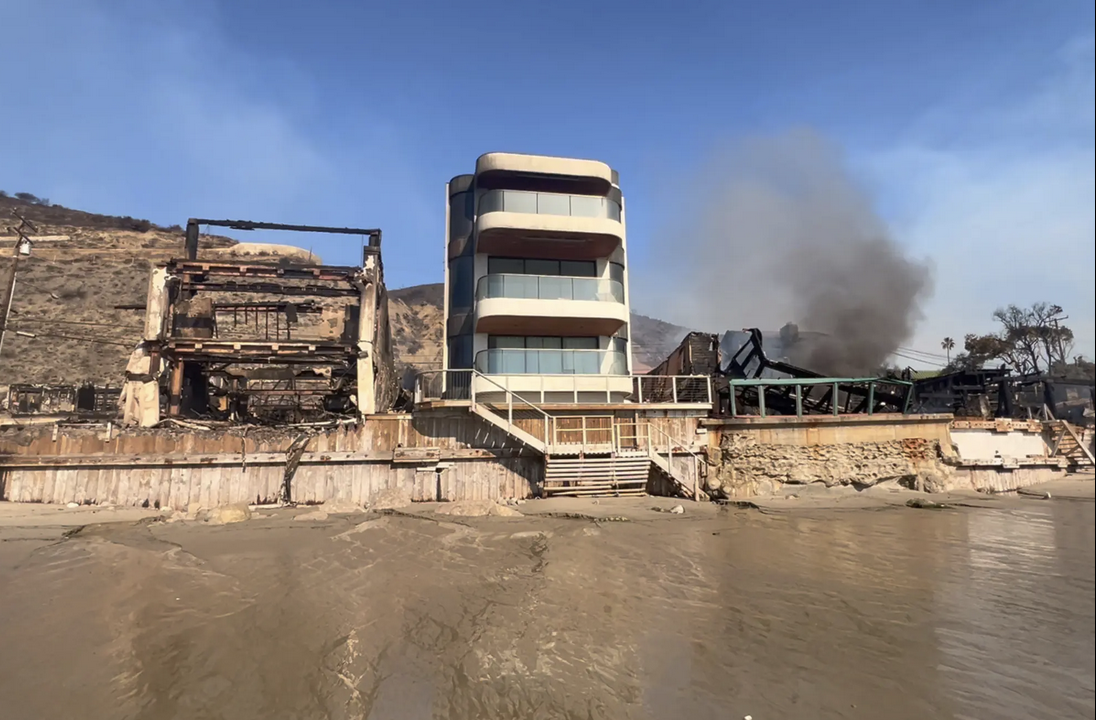
Yves here. We’ve discussed the problem of not just homes in certain areas but entire communities and areas becoming uninsurable in the US, with Florida coastal areas and more recently, swathes of California serving as canaries in the coal mine.
One issue not often discussed is the fact that the building material overwhelmingly used in the US, wood, is a big reason for this vulnerability. Here in Asia (as in the Middle East), concrete structures are far more common. They hold up better in severe storms and suffer limited damage in fires. Other materials and design choices can reduce the risk of severe damage in a fire. See this example from the big Malibu blaze:
The New York Post gave a longer-form treatment:
“The survival of homes, while others around them were destroyed, can actually be attributed to a mix of careful planning, structural integrity, environmental factors, and sheer effort,” says fire safety expert Daniel Vasilevski, of Bright Force Electrical.
Firstly, homes that survive could just be made better, and with fire-resistant materials such as stucco, metal, and stone, and roofs made of clay or metal. Windows could be double-glazed, keeping them from shattering from heat and not allowing flames to enter the home. Sealed gaps in walls will also stop smoke and fire from entering the home where it can spread and do more damage.
“The choice of materials isn’t just an aesthetic or cost decision,” says Vasilevski. “It directly impacts a structure’s ability to withstand extreme fire conditions as well.”
“The major factors affecting whether a home will ignite in a firestorm has to do with the materials it is constructed of, its state of repair, and the management of surrounding decorative vegetation,” adds Wayne Whitney, fire investigator with Fire Scene Analysis.
“The homes featured in the provided internet stories looked to have noncombustible roofs and exterior walls with plenty of ‘defensible’ space in their immediate surroundings.”
However, it is always easier to build afresh than to retrofit, although some measures, like having fire breaks around house, double-glazed windows, and sealing possible air vents do not seem unduly hard or costly. But will they make enough of a difference to give insurers confidence?
Admittedly, the UK faces even more issues, particularly floods. I’ve seen houses in flood-plains near the Thames built on metal stilts, so the ground level area underneath the house was for parking and limited storage. So again, better new construction could work. But Murphy neglects to mention a likely outcome: managed or de facto retreat (he acknowledges it only in passing, that insurance should be adequate to finance moving to new housing). That means over time, realizing huge losses in housing stock and any nearby commercial buildings.
As we pointed out in late 2025:
Our articles on how home insurance is becoming unaffordable and even close to unavailable in some parts of the US, like swathes of Florida and California, have been parochial, since they have been about what is happening in the US, where home insurance is integral to getting a mortgage. So home insurance become pricey and scarce will over time blow back to housing prices. And as more and more parts of the country have prices correct to reflect scarcity of insurance and the cost of insurance (even assuming one can get it) eating more of total housing costs (as in reducing what buyers are able to pay for mortgages) and have some area be denied home insurance entirely, there will be rising losses of what was once wealth (home values) and possibly a rise in defaults (losses to lenders).
The article, by focusing on Florida and flood risk, gives short shrift to wildfire risk. As Europeans and Canadians can attest, areas once thought to be safe have turned out not to be after protracted dry and hot periods. Over the longer term, it’s not clear how long the current model of mortgage finance, which depends on home insurance, will endure in most US markets.
One has to think that this exposure exists in countries where mortgaging to buy homes is common. The financialized US has one of the highest uptakes of home mortgages, but there are other countries where mortgages are mighty popular. This screenshot is from Forbes, and is based on a 2022 OECD report on which countries have the highest percentage of homes owned free and clear. You can see the US is close to the bottom. My guesstimate is that any country with less than 40% of homes owned outright is mighty exposed to climate change > higher cost/scarcer home insurance > difficulties in getting/affording mortgage > major home price correction. Can readers in any of these countries tell us if their pundits or officials have started to worry about this risk?
By Richard Murphy, Emeritus Professor of Accounting Practice at Sheffield University Management School and a director of Tax Research LLP. Originally published at Funding the Future
Climate change could make homes across Britain uninsurable, and the government has no plan for what happens next.
Floods, heat waves, droughts, wildfires and rising sea levels are increasing insurance claims, and as premiums rise, some risks will become too great for private insurers to accept at all. Flood-prone areas in England, including the Severn Valley area and parts of South Yorkshire, are already seeing costs rise and cover become harder to find, and the existing government Flood Re scheme is limited in scope and time-limited.
This matters because a house that cannot be insured cannot be mortgaged, and a house that cannot be mortgaged cannot be sold at its expected price. That traps homeowners in negative equity and could leave entire neighbourhoods effectively unsalable, creating a climate change property blight in the UK.
This video explains why private insurers cannot solve a macroeconomic risk like this, why government must become the insurer of last resort, and why prevarication on flood protection, honest risk disclosure and floodplain building bans will turn an environmental crisis into a financial one.
This is the audio version:
There is no Debate Ammunition for this video as I did not have time to make it.
This is the transcript:
Will climate change make your home uninsurable? This is no longer a distant question. It’s becoming one we need to answer now.
Floods, heatwaves, droughts, wildfires and even rising sea levels are becoming more frequent events. We know we face risks, and the biggest risks may not be to our homes themselves. It may be that they cannot be insured anymore, and if they can’t be insured, they can’t be mortgaged, and they can’t be sold. This is when the climate crisis becomes personal.
Insurance holds the housing market together. Most people cannot buy a home without a mortgage. Mortgage lenders require buildings insurance to protect their loan. If insurance becomes unavailable, mortgages become much harder to obtain. And if buyers cannot get mortgages, many homes become impossible to sell, at least at the prices that people expect. People are going to become trapped in their homes as a consequence, and this is going to be an enormous problem.
Climate risk is then creating new property risks, and the financial markets and even central banks are beginning to recognise that’s the case. Winter flooding, droughts, subsidence, wildfires and rising sea levels are all threatening our homes physically. But the reality is that the biggest risk comes from the fact that every one of these risks increases the likelihood of insurance claims, and more insurance claims means higher insurance premiums. And eventually, some risks will become too great for private insurers to accept.
We know there are some communities that are already feeling this pressure in England, and I stress, in England, at present. Flood-prone areas have seen insurance costs rise and cover become harder to obtain. This is hitting the Severn Valley. It’s hitting areas in South Yorkshire. There are others as well. The government has a scheme to cover those risks. It’s called Flood Re, but it’s limited in scope and also time-limited. So, it is no answer for the many people who are now going to be exposed to new risks from all the issues that I’ve mentioned. And as a result, climate change is going to affect the insurance market, and so the mortgage market, and so house prices long before disasters happen, but it’s the disaster or rather the threat of it, which is creating all of this change. And as we’ve seen over the last week or so, wildfires are now a real risk in the UK, as they are in Europe.
What we’ve seen so far may only be the beginning. Climate change could create a financial trap for people. It’s worth reiterating the point. Houses that cannot be insured become difficult to mortgage. Houses that cannot be mortgaged become difficult to sell; their prices fall. Families could then become trapped in negative equity, which means they have mortgages on their properties which are bigger than their current value, and they will not, in that case, be able to leave. And even whole neighbourhoods could become effectively unsaleable as a consequence.
We are seeing the potential of climate change property blight arising in the UK, and there is no market solution to this. Private insurers cannot solve this problem. It is a macroeconomic risk we are facing, and that is the job of government to address.
The job of markets is to price risk, not absorb unlimited and unknowable losses. And throughout the market, as climate risk increases, premiums will rise, or cover will disappear because that’s the only reaction that private sector insurers can provide to this risk that they face. That’s why government has to become the insurer of last resort in the UK now; the insurer who will take on the risk of you living in your home and provide the insurance that you need so that you can, first of all, live there knowing that if a disaster hits, you will be covered, and secondly, so that you can move home.
The government has to take on this role, and it needs a plan to do so now, because the risk is not just about insurance; let’s be clear. The risk is about the actual things that we face.
The government should be investing in flood protection, drainage and wildfire prevention.
It should require honest disclosure of climate risks when homes are sold, but that’s not part of the required programme at present.
And it should be strengthening building standards where adaptation is possible.
We do not need to be building on floodplains for any longer. That is a risk we cannot face.
The government should, in other words, create a long-term strategy for insuring climate risk. And it should extend its existing backup flood insurance scheme to cover everybody who is at risk now and accept that this is going to be a permanent feature of government activity for time to come.
I stress this is about much more than insurance. Climate change could reshape Britain’s housing market. It could leave thousands of people trapped in homes they cannot sell, and that will create a financial crisis as well as an environmental one. Banks that do not think that they can recover their mortgage loans might also be in trouble when 85% of their loan book is made up of mortgages at present.
But the government has, at present, no clear answer to any of this. It’s being silent, and yet it urgently needs to talk about the risks that we face. These risks are real. They’re deeply personal for every property-owner that is impacted, and prevarication will no longer do. Andy Burnham might be new in office, but he has to deal with old problems. We’ve known this problem has existed for a long time. Now he has to act on it.
