

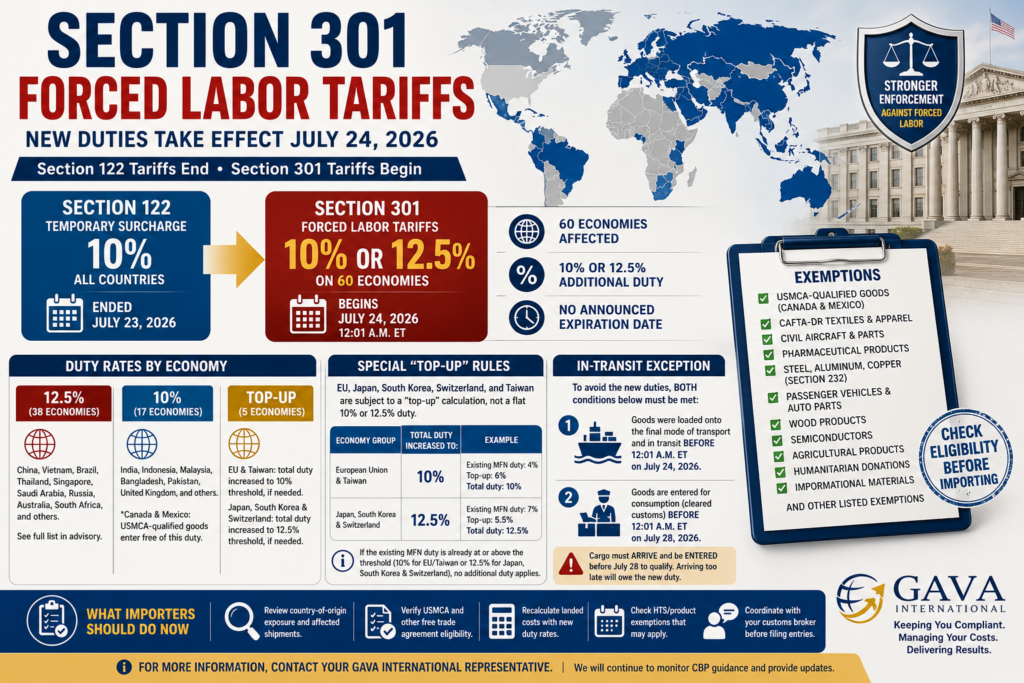
Overnight, the Trump Administration announced a new, massive set of tariffs, claiming authorization by Section 301 of the Trade Act of 1974. The full list of the 60 countries tariffs were levied on is at The Independant.
These are as likely unlawful as the IEEPA tariffs were, but for different and more technical reasons. Congress did give the Executive branch limited authority to impose these sorts of tariffs, but with a very specific set of guidelines and procedures to follow.
The documents filed claim these were followed properly, but their own language makes it clear this is unlikely.
The new strategy is to use the complexity of Section 301 to provide SCOTUS cover to allow what is plainly a usurpation of Congressional authority.1 It was impossible for any credible court to have supported the IEEPA tariffs, as they were so clearly unconstitutional.2
This time, the tactic was slightly cleverer, and enumerated by the WSJ’s Greg Ip:
“To Trump, though, court rulings are road maps, not roadblocks. February’s court ruling simply rerouted him to tools the court hadn’t explicitly prohibited. And fortunately for Trump, Congress has over the years scattered many such tools through the law books, many largely forgotten or unused.”
When the WSJ accuses the White House of abusing rules to accomplish their agenda, regardless — well, that’s really something.
Note that the document filed at 12:01 am last night was the USTR’s final “Notice of Action.” It references the evidentiary findings in a separate June 2, 2026 document titled “Acts, Policies, and Practices…” (See sources below)
On March 12, 2026, the USTR initiated, on its own, 60 simultaneous investigations. This is not the comprehensive document it appears to be at first glance. About 360 of the 431 pages (page 73 on) are the tariff schedule.
Rigorous, they are not.
All 60 country-specific “Determinations of Action” are identical boilerplate. Each is a single paragraph, and the template is word-for-word the same — only the country name, the rate (10% or 12.5%), and the cross-references change. No country-specific evidence, no discussion of any particular economy’s laws, enforcement record, or forced-labor exposure appears. Somehow, every major trading partner qualifies for tariffs — which is the reveal that this is not specific to any one nation’s behaviors.
Technically busy, analytically thin boilerplate is no way to manage trade policy…
Sorry, but nobody really believes that this administration performed 60 investigations, created a comprehensive report, analyzed 1,600 comments, and held a hearing, all in ~4 months, with seven weeks from proposed action to final tariffs that was anything more than just going through the motions. None of the 60 economies received individualized analysis or consideration in that window as required by statute.
A West Coast friend who alerted me to this late last night had already done the deep dive into the Federal Register and the 431-page United States Trade Representative document. His conclusion?
“The most recent research shows US economy paid 95% of the tariffs cost, and while more than half of that was initially borne by companies in lower profits, by this spring it was mostly consumers paying. His voters are innumerate, as is he… It basically concedes there were no USTR investigations, DJT picked the countries, and picked the rates.”
A document whose superficiality confesses that none of the applicable laws or procedures were followed should not withstand court scrutiny. No true analysis of various countries (only 1/2 page each); no calibration of tariffs in response to specific illegality; most important of all, no analysis of how the behavior in question negatively impacted US companies as required by section 301.
To actually determine what countries are using forced labor and its economic impact on US companies would take a lot more time, personnel, and intellectual firepower than the 4-month attempt applied here.
This was simply a response to the IEEPA loss at the Supreme Court. And if SCOTUS acts as it has since 2024, by the time they get around to striking this down in 2028, the damage will have already been done.
~~~
You would be wrong to think of these critiques against tariffs as merely a leftist tirade or partisan attack. The conservative Reason Foundation, a libertarian organization, observed: Trump Imposes Massively Harmful and Illegal Section 301 Tariffs, stating, “The new policy is based on sham investigations, and runs afoul of the major questions and nondelegation doctrine.”
Of course, these tariffs should be struck down, but if SCOTUS takes another year (again), there will be real economic and reputational harm done.3
Previously:
Winners & Losers of SCOTUS Decision Striking Down Tariffs (February 20, 2026)
Part II: IEEPA Tariff Ruling’s Losers (February 23, 2026)
Tariffs archive
See also:
Trump’s Trade Wars Are Back—Despite the Supreme Court
By Greg Ip
WSJ, July 23, 2026
Sources:
Report in Section 301 Investigations Acts, Policies, and Practices of Various Economies Related to the Failure to Impose and Effectively Enforce a Prohibition on the Importation of Goods Produced with Forced Labor
USTR, June 02, 2026
USTR Makes Findings and Proposes Action in 60 Section 301 Investigations Relating to Failures to Take Action on Trade in Forced Labor Goods.
Press Release
USTR, June 02, 2026
Notice of Actions in Section 301 Investigations of Acts, Policies, and Practices of Various Economies Related to the Failure of Each Economy to Impose and Effectively Enforce a Prohibition on the Importation of Goods Produced with Forced Lab
OFFICE OF THE UNITED STATES TRADE REPRESENTATIVE, July 24, 2026
Docket Nos. USTR–2026–0265, USTR–2026–0266
__________
1. t is very difficult to predict what a renegade, corrupt, partisan court will do.
2. And yet it still attracted three votes in favor: Justices Clarence Thomas, Samuel Alito, and Brett Kavanaugh ignored the plain text of the Constitution.
3. There is a real chance SCOTUS allows this to slide, 5-4.
