

[Today’s Iran war post launched more or less complete. I do not expect an 8:00 AM EDT update unless there is big breaking news]
When Iran retaliated ferociously to the illegal and unwarranted war launched by the US and Israel on February 28, many commentators said that Iran’s objective was to inflict such a painful and humiliating defeat that the US would not think of attacking Iran for at least a decade. Iran recognized that it was of paramount importance to prevent a nation-state version of a “mowing the lawn” scenario. where the US and Israel launched periodic attacks on Iran to keep Iran in a weakened condition.
That has not happened. JD Vance is bragging that the Memorandum of Understanding (MOU) was merely a device intended to bring Iran to heel, and if that did not work, it would still buy time for the US to restock its oil supplies and weapons. I confess that I had not wanted to believe1 Alexander Mercouris that Russian officials told him that they were concerned that Iran had fallen for a Minsk-type “deal,” intended simply to buy time so they could have another go. As we will describe below, the US is complying with the MOU only in areas that advance its interest, which here is to allow Iranian oil to go unfettered to buyers. It is not hard to imagine that the US plans to extend it beyond 60 days.
In the meantime, Iran seems stymied. A fresh report from supposed IRCG sources that Iran had force the grounding of a cargo ship was a fake; that vessel foundered in March. If this was indeed Iranian messaging, trying to flog a bogus story to demonstrate its Strait of Hormuz macho is an admission of weakness. 2
The open question is whether the oil will come out of the Gulf at a fast enough pace to prevent the US from falling over the much-reported (among real economy oil types) oil cliff. Both Lloyd’s List and Bloomberg describe the current level of oil leaving the Gulf as a “surge” even though the number of ship transiting is still about 25% of the pre-war normal. However, those transits included cargo ships, cruise ships, and even sailboats. The current vessel activity in the Strait of Hormuz is almost entirely VLCCs. So the level of tanker movement (and thus crude supply) looks to be higher than the 25% ship count would suggest.
Keep in mind the arrival date of any oil cliff was expected to be pushed back by virtue of already-loaded tankers in the Gulf getting to market, so some relief was baked in. The question is how much newly loaded crude is getting out of the Gulf. I have not seen good commentary on that yet. If readers have seen any, that would be very much appreciated.
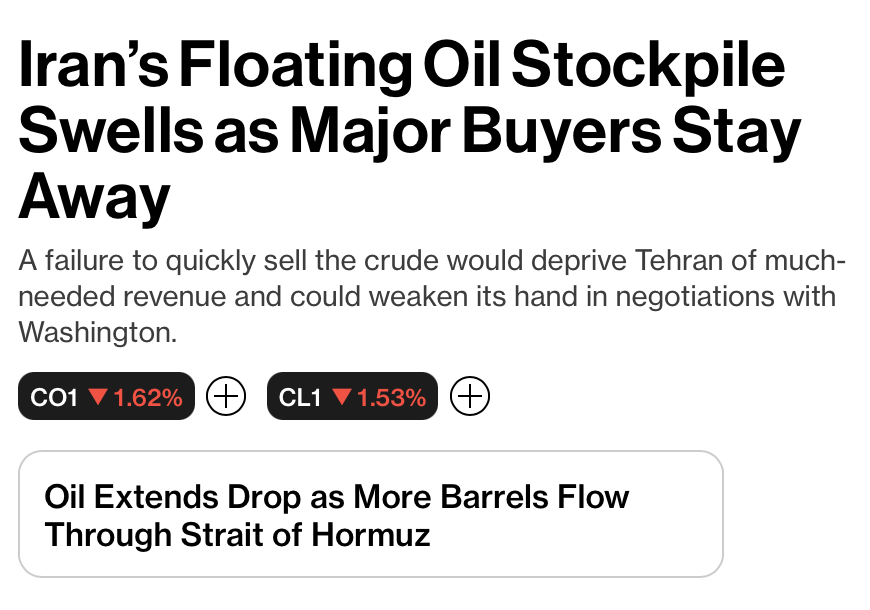
Oil prices continue to fall, but experts have argued that paper oil price have become a vehicle of registering sentiment about the negotiations, and not the state of oil supply and demand. From the Bloomberg landing page:
From Oil Extends Drop as More Barrels Flow Through Strait of Hormuz:
- Oil fell for a third day as flows through the Strait of Hormuz climbed and there were signs of progress in indirect talks between the US and Iran.
- Brent for September traded below $71 a barrel, while West Texas Intermediate was around $68, after oil supply through the Strait of Hormuz reached more than 10 million barrels a day.
- Total US stockpiles have fallen to the lowest levels since March 2025, with inventories excluding strategic reserves at around 1.2 billion barrels, after 12 straight weeks of declines.
Oil fell for a third day as flows through the Strait of Hormuz climbed and there were signs of progress in indirect talks between the US and Iran.
Brent for September traded below $71 a barrel, after sliding more than 3% in the previous two sessions, while West Texas Intermediate was around $68. Oil supply through the critical waterway has reached more than 10 million barrels a day, underscoring Tehran’s now-limited ability to halt shipping, a US official said, while President Donald Trump hailed progress in negotiations….
While total supply is still crimped, the United Arab Emirates’ exports have reached pre-war levels thanks to workarounds, and key US crude grades have slumped to trade at discounts as demand for American supply fades.
“Prices continue to drift lower as the gush of oil escaping the Strait of Hormuz coincides with SPR releases and curtailed demand, as flare ups between Iran and the US remain contained at least for the time being,” said Saul Kavonic, senior energy analyst at MST Marquee, referring to the millions of barrels of strategic petroleum reserves countries tapped to replace lost Gulf supply.
This seems to be the latest traffic update. Note Kpler indicates a mix of vessels, so the one breakdown I saw earlier this week, which showed inbound transits looking overweight VLCCs, may have been an anomaly:
Hormuz traffic holds steady
The Strait of Hormuz remained open and active on 30 June, with 34 verified crossings recorded and traffic evenly split by direction. The dataset showed a broad mix of commercial, energy-linked and support movements, while route visibility remained… pic.twitter.com/cVZHRte4Hy
— Kpler (@Kpler) July 1, 2026
But experts had said the key metric was new loadings in the Gulf, and they do seem to be increasing, although again, I have no idea if they are sufficient to merely delay or actually prevent going over the oil cliff:
And Saudi Aramco is loading more tankers inside the Strait of Hormuz / Persian Gulf. Satellite imagery from earlier today shows 3 tankers taking crude in the Sea Islands at Ras Tanura and the SPMs at Al Juaima’h https://t.co/hwJULSIMjx
— Javier Blas (@JavierBlas) July 2, 2026
Keep in mind that this level of activity is occurring despite the shipping community still deeming the Strait of Hormuz to be a high-risk region. From Agence France-Presse in Shipping employers and unions still consider Hormuz a war zone:4
Unions and shipping employers said in a statement on Wednesday that they will continue to designate the Strait of Hormuz as a warlike operations area until at least July 9, maintaining double pay for seafarers in the area despite the fragile truce.
The status only covers ships whose companies are signatories of the International Bargaining Forum (IBF)’s labor agreements – around 15,000 vessels worldwide, according to the IBF.
From Aljazeera’s live feed as of 10:00 AM EDT yesterday:
Ships still using Oman route through Hormuz despite Iran warnings
Vessels are continuing to pass through the Strait of Hormuz using the Oman-designated route despite Iran’s rejection of the lane and warnings to ships crossing outside routes approved by Tehran.
Maritime data reviewed by Al Jazeera showed 21 ships, including oil tankers, have used the Omani route since the first meeting of the joint Iranian-Omani Hormuz committee on June 29. The committee was set up to continue talks on managing navigation in the strait and related services.
Oman announced the shipping transit route last week saying it coordinated it with the International Maritime Organization to help ensure freedom of navigation through the strait.
The US is continuing to draw on the Strategic Petroleum Reserves, but at a lower rate than its recent 8-9 million barrels a day. The last week’s report claimed a 5.5 million but HFI Research called out a computation error and said it looked to be 6.4 million barrels.3 The inventories at Cushing increased modestly to 19.666 million barrels. Keep in mind the operating minimum is believed to be 18 to 19 million barrels. The system could conceivably function for a brief time with less.
And to the Vance admission of the US clever scheme to use the MOU to keep Iran from engaging in military operations while the US resupplies:
🔴 Vance Says US Is Using the Iran Deal to “Refill” the Oil Market, Then “See Where the Hand Is”
🔸 US Vice President JD Vance said the Trump administration is using the memorandum that ended the war with Iran “to sort of refill the world’s oil economy… and then to see where… https://t.co/8U5rfJ0C9q pic.twitter.com/t7f5Hvs7B1
— Drop Site (@DropSiteNews) July 1, 2026
Former Lieutenant Colonel Karen Kwaitkowksi says in her discussion below with Mario Nawfal that the US could sufficiently rebuild weapons stocks so as to be able to pound Iran again after the midterms:
Kwaitkowksi and Nawfal also discuss Israel Defense Minister Katz’s threat to assassinate the new Supreme Leader, Mojtaba Khamenei, and whether they would make an attempt were he to appear at the extended funeral events for his martyred father starting this weekend. I do not see how this would work to Israel’s advantage given low weapons supplies, unless Israel intended to provoke such a massive retaliation as to give a thin justification for using nuclear weapons.
Moreover, it would seem unwise to act before Israel had cemented its control over US military and intel:
Don’t call this an integration if the two militaries: this is creating a clear hierarchy, with Israel on top and the US under its command.
How do I know that? It is simple: under the new agreement, the US will have to share its secrets with Israel, but Israel won’t be obliged… https://t.co/jmf0YWIOnR
— Alon Mizrahi (@alon_mizrahi) July 1, 2026
Once that happens, it would become impossible for the US to cut Israel off from SIGINT and other targeting information, which otherwise would be the fastest way for the US to bring Israel to heel.
Trita Parsi, in a new Substack post, reports that Iran is expecting an attack sooner, as in by October, due to Israel election timing:
Will Israel restart the war with Iran before the October elections? This is the consensus view emerging within Iran’s internal
national security debate over the past week….
…two developments stand out: the recent Israeli-Lebanese agreement and its impact on Hezbollah’s military posture over the coming months.
From Tehran’s perspective, the agreement hands Israel a significant advantage in any renewed war with Iran—one it lacked in February. By allowing Israeli forces to remain in parts of southern Lebanon, the deal appears to contravene the MOU while fundamentally reshaping the military balance. Israel’s continued presence in these strategic positions would make it far more difficult for Hezbollah to mount the kind of offensive operations that proved critical during the previous round of fighting.
That matters because, in February and March, the Iranians say they used only about 40 percent of their offensive capabilities against Israel, because Hezbollah carried much of the remaining burden. At the time, pundits in the West were debating why Tehran hit the UAE harder than it did Israel….
Netanyahu’s motivations are clear. Beyond his long-standing desire to use American force to subjugate Iran to Israeli domination and achieve a regional balance favourable to Israel, he now also has stark political and personal reasons to restart the war.
The MOU has come at a steep political cost for Netanyahu….
And of course, if he loses the elections, he will likely spend the next few years in jail, as he will lose his immunity as Prime Minister and face trial over corruption charges….
From Tehran’s perspective, there are three plausible scenarios. The first is that the White House is aware of Israel’s plans and helped broker the Lebanese agreement in part to facilitate them. The second is that Washington is unaware of Netanyahu’s intentions but would nonetheless come to Israel’s defense—and perhaps even join the offensive—once Netanyahu resumes the war. The third is that the administration is caught by surprise, chooses not to restrain Israel, but also refrains from direct military involvement in the conflict.
Tehran does not believe Israel’s advantage in Lebanon will prove decisive. Iranian officials remain confident they can impose severe costs on Israel and deny it its broader strategic objectives. But a renewed war could still achieve Netanyahu’s most immediate aim: killing the MOU.
The US is trying the GCC in opposition to Iran over the Strait of Hormuz. Note that even though these nations are justifiably angry with the US for launching a stoopid war that cause them a lot of damage, at the same time, they do not want to become hostages to Iran by conceding control of the Strait. From Middle East Eye’s live feed:5
Centcom leads regional security dialogue with Middle East military officials
US Central Command has led a “security dialogue” alongside Bahrain’s defence forces with military officials from across the Middle East.
Representatives from Egypt, Jordan, Kuwait, Lebanon, Oman, Qatar, Saudi Arabia, Syria, the United Arab Emirates and Yemen discussed “enhancing defence collaboration across the region”, Centcom said in a post on X.
Centcom Commander Admiral Brad Cooper said the discussions “underscored our shared commitment to regional security and stability”.
Oman and Iran are tying to agree on a Strait of Hormuz scheme but are still at odds on whether payments are obligatory. Mandatory payments would violate UNCLOS and would open up Oman to ICJ lawsuits if it participated. From DropSite on Twitter:
This idea came up on Twitter earlier this week, but again notice the critical “voluntary” part:
Interesting development, now even UN’s International Maritime Organization (IMO) seem to agree with Hormuz fee, if it’s in form of a voluntary fund, same as with the Strait of Malacca in 2007. https://t.co/lsJIl4dCoq pic.twitter.com/CEnZznvlkC
— MenchOsint (@MenchOsint) June 30, 2026
⭕️ The New York Times: Iran and Oman are moving forward with a proposal to collect fees from ships transiting the Strait of Hormuz, despite U.S. objections, citing Iranian and diplomatic officials.
The Times reports:
🔹Oman has reportedly proposed a system modeled on the Straits of Malacca and Singapore, where shipping companies “voluntarily” contribute to navigation and safety services.
🔹Iranian officials, however, say the payments would be mandatory.
🔹The White House and Secretary of State Marco Rubio has said Washington opposes monetizing passage through the strait “whether it is called a fee, toll, or donation,” while Iran insists the waterway will not return to its prewar status.
The New York Times reports on another fresh US move to curry cooperation, in U.S. Resumes Dollar Transfers to Iraq After Monthslong Suspension.
So far, Iran is only administering wet-noodle lashings in response to these US efforts. Admittedly the US has not gotten far enough to justify harsher action:
⚡️🇮🇷🇺🇸 — Iran’s Deputy for Legal and International Affairs of the MFA Gharibabadi in response to the US CENTCOM-led security dialogue held in Bahrain:
“Hormuz is defined under Iran’s command, not CENTCOM. A military summit in Bahrain cannot establish legal order and security for…
— MaxOsint Intel (@maxosintintel) July 2, 2026
Iran does not seem to be succeeding in holding its boundaries in negotiations. See this headline from Aljazeera’s landing page yesterday:
It also does not appear that Iran had yet secured the release of the first $6 billion of Iran’s frozen assets. From Arya Yadeghaar on Twitter:
Iran’s delegation, led by senior negotiator Gharibabadi, finished talks in Doha about implementing the MoU.
– Iran, Qatar, and Pakistan held 2 trilateral meetings.
– Iran complained about US violations, especially:
• Continued war in Lebanon
• US military buildup in the region
• Threatening & interventionist statements by US officials
– Violations of the MoU will be formally documented, reported, discussed, and decided on.
– Iran will spend part of the initial $6 billion on goods needed by Iran, purchased according to Iran’s announced needs and made available to Iran.
– No direct meeting took place between the Iranian & American delegations in Doha (they were indirect).
I read this as Iran blinking on Iran having maintained that it will have unrestricted authority as to how to spend the frozen assets.
#URGENT Iran’s deputy foreign minister says part of $6B in frozen assets will be used to buy ‘needed goods’ following Doha talks
— Anadolu English (@anadoluagency) July 1, 2026
Admittedly Iran’s hands appear somewhat tied, as we described yesterday, under the terms of the 2023 Biden agreement (that is the $6 billion being wrangled over now) which set the transfer as being for humanitarian purposes. This entry from the Aljazeera live feed seems consistent with our reading:
Iran raises ‘US violations of obligations’ at Doha talks
We have more on the technical talks that just wrapped up in Doha.
Iran’s Deputy Foreign Minister Kazem Gharibabadi told state media the Iranian delegation held two rounds of meetings with mediators Qatar and Pakistan…
The second meeting, with Qatari officials and the country’s central bank, addressed the release of some $6bn in frozen Iranian funds. According to Gharibabadi, the talks covered issues related to the cost of part of the initial $6bn, with an agreement that Iran would use the funds to buy goods according to its “declared needs”.
Another recap from Arya Yadeghaar on Twitter on how the MOU discussions look from an Iranian vantage:
Status of the end-of-war MoU — Day 13
• Iran’s oil sanction relief has been implemented, and part of the money from oil sales has been transferred to Iran’s central banks.
• Iranian ships are passing through the naval blockade.
• None of Iran’s frozen funds have been released so far. (Violation of clause 11)
• The Omani-US corridor in the Strait of Hormoz is active. (Violation of clause 5)
• US forces & equipment in the region are increasing, and the USS Boxer has also been sent toward West Asia. (Violation of clauses 2 and 9)
• US officials continue to threaten Iran. (Violation of clauses 1 and 2)
• War & occupation in Lebanon are continuing intensely. (Violation of clauses 1 and 13)
• The US Vice President (JD Vance) described the goal of the MoU not as ending the war, but as preparing for what will happen next (war). (Violation of clauses 1, 2, 13, and 14)
• The Persian Gulf Cooperation Council denied any investment for Iran’s reconstruction. (Violation of clause 6)
Done for today! I plan to take tomorrow off.
_____
1 Readers have been taking umbrage in comments at my contesting their readings of events and documents in an Iran-favoring way, as in letting their sympathy for Iran skew their perspective. I did exactly that when I initially rejected the Russian assessment via Mercouris. Hopium and black/white thinking are poor foundations for analysis.
2 Hormuz Letter is generally accurate when quoting media sources, so it looks as if Iran did try to depict a ship grounded months ago as the result of fresh IRCG action. I do not see this story on the PressTV English site:
BREAKING: Iran’s IRGC has grounded a foreign container ship in the Strait of Hormuz US-backed Omani corridor after not using Iran’s approved route, per Iranian state TV.
Iran says it has “repeatedly warned captains, shipowners and officials of shipping companies around the world…
— The Hormuz Letter (@HormuzLetter) July 1, 2026
BREAKING: Iran releases footage of the foreign cargo ship stuck in the Strait of Hormuz after “attempting to transit using a US-suggested route” this morning, calling it “an incident even worse than sinking,” per IRIB. pic.twitter.com/7pilA3pdkP
— The Hormuz Letter (@HormuzLetter) July 1, 2026
And per Aljazeera’s live feed:
TankerTrackers says grounded Hormuz tanker tied to Iranian oil magnate
As we’ve been reporting, Iranian state media has reported that a foreign cargo ship using a “US-suggested route has run aground” in the Strait of Hormuz.
Now, TankerTrackers.com, a maritime traffic monitor, says the ship had “actually been stuck in this same spot since March”.
It identified the vessel as Arista, and said that while the ship is Comoros-flagged, it is part of an operation managed by Iranian oil magnate Mohammad Hossein Shamkhani, the son of the late senior Iranian security official Ali Shamkhani.
3 Also keep in mind reader ilsm’s observation: “Although drawing conclusions on inventory change from one observation is not wise. Lesson learned in my youth managing inventories.”
Looking at our modified adjustment, EIA miscalculated ~915k b/d of imports/exports this week or 6.4 million bbls.
Expect EIA’s report next week to show a higher-than-expected crude draw. pic.twitter.com/7z2NinpTyz
— HFI Research (@HFI_Research) July 1, 2026
4 Another traffic indicator: local news confirmed that 10 of 11 Thai vessels in the Gulf have departed, with the last one collecting cargo before its planned exit.
5 We were remiss in not including a key bit of an earlier fakUS muscling of the critically important Saudis, in our post yesterday:
The Wall Street Journal reported a crisis in US-Saudi Arabian relations. Trump threatened to withhold missile interceptors from Saudi Arabia during the war. Here is what happened and why it matters.
1) In early May, Trump announced Project Freedom on social media without…
— Shaiel Ben-Ephraim (@academic_la) July 1, 2026
