

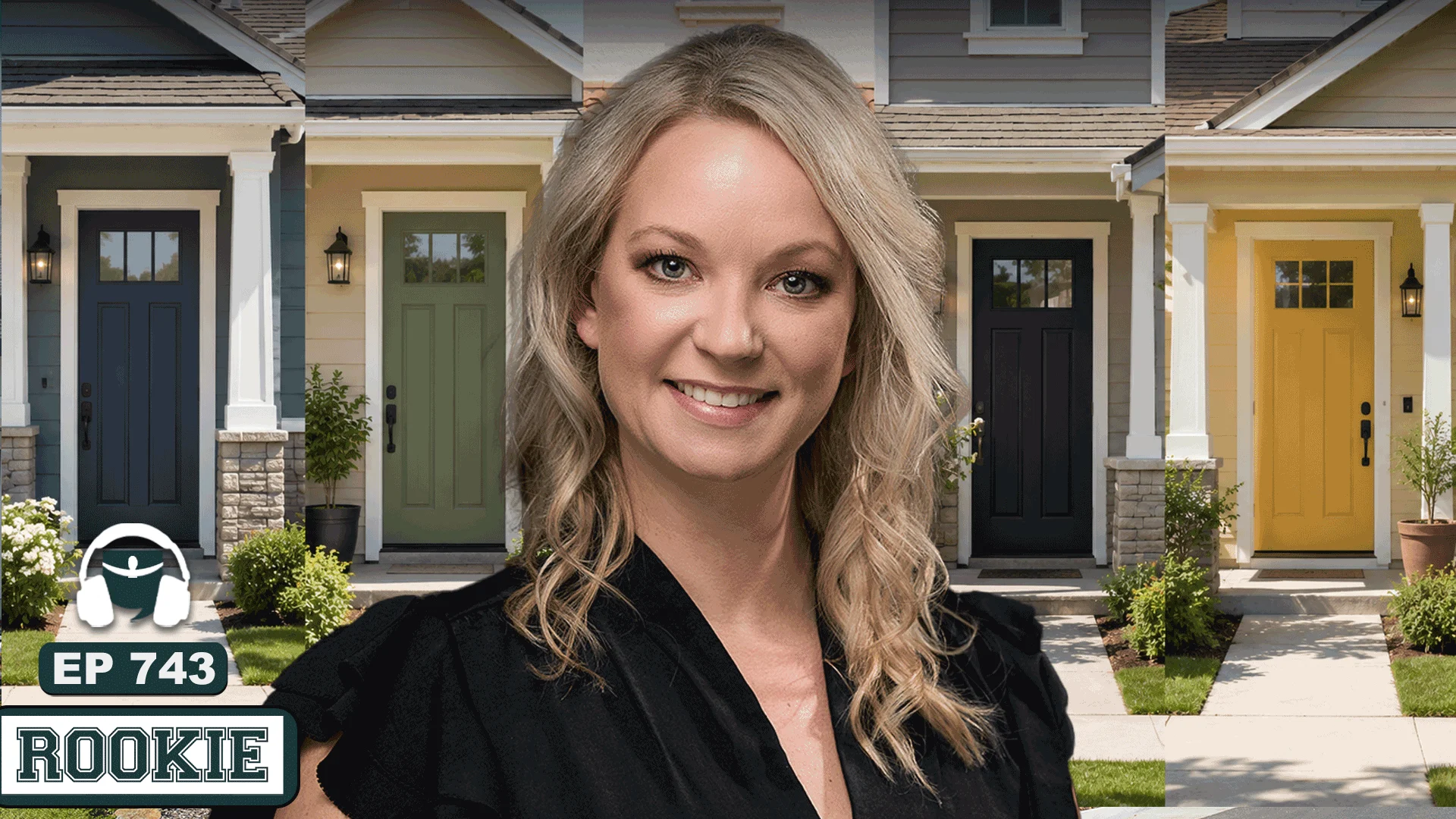
Your first rental property rarely comes from sitting back and waiting. It usually comes when you put yourself out there, talk to others about what you’re building, and stay in the game long enough for the right moment to show up. That’s exactly what today’s guest did, and it led to a wild deal that kickstarted her real estate portfolio!
Welcome back to the Real Estate Rookie podcast! Stephanie Wagner spent nearly 20 years in a full-time job, putting her real estate dreams on hold through a marriage that wasn’t working. Then, she used her divorce as the starting line. Six months later, she closed on her first real estate deal, a duplex she was able to house hack. Today, she owns five rental units and even has her real estate licence!
Stephanie shares about the everyday moment that led to buying an off-market deal, the second deal that involved a tricky tenant situation, and the mindset shift that separates the investors who start from the ones who never do. If you’ve been holding out for the “perfect” moment to invest in real estate, Stephanie’s story is proof that you just need to take action!
Ashley:
What if you found your very first real estate deal, not on Zillow, not on the MLS, not driving for dollars, but standing in line at a food truck outside your hospital waiting for your lunch?
Tony:
And what if that one deal sparked so much in you that you went from nearly two decades as an x-ray tech to becoming a real estate investor, a licensed realtor, and someone doing her own home repairs all while keeping a promise to her late aunt to do that?
Ashley:
This is the Real Estate Rookie Podcast. I’m Ashley Kehr.
Tony:
And I’m Tony J. Robinson and our guest today is Stephanie Wagner. Stephanie is an X-ray tech in interventional radiology by day, a landlord, a realtor, and a woman who decided after her divorce that she was capable of a lot more than she had given herself credit for. She owns three rental properties in the Midwest and on a mission to show other women that real estate is for them too, no matter where they are in life. Stephanie, welcome to the Real Estate Rookie Podcast.
Stephanie:
Hi guys. Thank you for having me.
Ashley:
Well, we are so excited to have you. Let’s start at the very beginning. You spent nearly 20 years as an x-ray tech and that was kind of your whole identity. What made you even start thinking about real estate as something that you could do?
Stephanie:
Actually, it started out as a kid. I have a couple of aunts and uncles that own several rental properties and I remember going to a couple of them as a kid. And I remember actually that my aunt that was kind of influential in my life, she actually rented one of the units that one of my other uncles owned. My dad is one of 10 kids, comes from a really big family. And my dad was over there one day helping my uncle who owned the property. There’s three uncles that were in this whole situation, but my dad was helping them fix a pipe in the basement. And I remember being like, “Man, this is really cool. My uncle has this business where the family is involved in it. ” And how I though that was really influential to me that maybe one day I could have the same thing.
And so that’s kind of what sparked my interest in real estate. And then as I got older, I ended up graduating college and my uncle who owned the rental property that needed that repair pulled me aside and was like, “Hey, how are you planning your retirement? Are you doing a retirement fund? How are you investing?” And he’s like, “Have you ever thought about investing in properties?” And I was like, “I really would love it. I remember being a kid and being around you, being with you and your rental properties.” And I was like, “I don’t really know how to do it. ” Well, I had been graduated I think for about two years when I had met my husband at the time and we ended up getting married and it was just something that wasn’t interesting to him. He was very comfortable with just having the single family house that we owned and really had no interest in doing real estate investing.
When I got divorced, it was like it’s now or never. I’ve got one life to live and I have to do a better job of living it and I’m just going to do it. So I ended up buying my first property.
Tony:
So it sounds like real estate was a seed that was planted for you early on, but it took some time and some life changes to get there. I think just one question, because I want to get into the first deal because you founded in line in a food truck, which is probably one of the craziest stories that we’ve heard in the podcast. Before we get to that though, divorce is something that is difficult for so many reasons. And I think a lot of folks kind of use that, I won’t say as an excuse, but sometimes it is something that people fall into more of a rut afterwards. They’re trying to kind of put the piece of their life back together. But it sounds like for you, it was really more so like a rebirth, like a reawakening. What was your mindset coming out of that difficult situation, Stephanie, that allowed you to pivot into this thing you’ve always wanted to do?
And I know not everyone listening is going to maybe be dealing with a divorce, but sometimes there are other things that happen. We lose a loved one or we lose a job. Something else somewhat traumatic happens and we can’t find a way to kind of get ourselves back on the horse. What did that look like for you afterwards to really rebuild in the way that you wanted your life to look like?
Stephanie:
That’s a great question. I think for me, I think anyone who knows me on a personal level knows that I’m a get it done kind of person. I’ve always been the kind of person where life will throw something at you. And to me, it’s okay to have a brief pause where you are focusing on your healing and religning and what your goals might actually be both personally and professionally. But just because you’re getting divorced or you’ve had some sort of a hardship doesn’t mean that you have to let the world keep you down. It’s really ultimately up to you and the decisions you make in life that can keep you. It’s either they keep you down or you choose to take that negative and you turn it into a positive. For me, this is something I’ve always wanted to do. And I remember my dad when we went to look at that first property, I remember him being like, “Steph, this is going to be hard.
Do you think you can do this? ” And I was like, “Dad, what’s the worst that happens?” I call Lisa back up and we list the property and I sell it and then I just rent the rest of my life. And I was like, “I mean, I can totally see why people would want to rent.” I mean, there’s not a lot of responsibility when you’re a renter. A lot of the responsibility falls on the owner of the property, the landlord to take care of your tenants. And so for me, just because you experience a hardship in life, whatever that might end up being, it’s really up to you to make the best of your life. Like I said before, you only have one life to live and you really have to do what it takes to make your dreams come true. And if your dream is doing real estate investing, sometimes it isn’t always easy.
Not everybody wants to house hack a house where they’re living in one unit. For me, I lived in one unit and I rented out the other. You could also have a single family home where you’re renting out bedrooms. That’s not for everybody. It’s not the life for everyone. But if you want to build wealth in real estate, you kind of have to make some sacrifices and you have to have a certain personality to be able to reflect that. And for me, I knew that that’s what I wanted to do. I knew that working a full-time W-2 job isn’t something that I want to do all the time. And I’m hugely passionate about real estate, whether it’s building wealth in real estate or affordable housing. I’m very, very passionate about it. And I guess for me, that’s actually what keeps me going is it’s a passion of mine and you have to find what your passion is.
It might not be real estate investing. It might be something else, but you have to do whatever it takes to make that dream happen.
Ashley:
And sometimes too, Stephanie, it’s not even the dream or the passion of real estate. It’s what real estate can do for you and give you. And real estate just ends up being the best vehicle to get you to that point in time. So that’s a great example of how you were able to stay motivated to stay on this path. So you eventually did get your first investment property and you ended up getting a little discouraged after walking several properties with your agent, but then one day waiting for lunch at your food truck, what exactly happened in that moment?
Stephanie:
Yeah. So I was outside at the hospital I work at, and I remember discussing with one of our OR nurses that I had looked at a property with my agent and how I was like, “Man, the numbers just didn’t make sense.” And even then, back then I didn’t really know about the numbers, but I knew enough to know that this house needed a lot of work. I didn’t have the funds to do it properly. It was like a full gut on the second floor and the first floor was rented. So I would be living in the unit that was already gutted and I just knew that I couldn’t do that. So I was talking with Chad about it, one of our nurses. And I was like, “Man, the market is insane.This house needs so much work.” To me, it was like a dumpster fire. And I know that now as a real estate investor, a dumpster fire could equal opportunity.
But at the time I wasn’t in the mindset where I was brave enough to do this, but not brave enough to take on that big of a project. So when I’m talking with him, there’s this lady who kept turning around and looking at me. And then she’d look at the food truck and then she’d turn around and look at me again. And then I was like, “Well, maybe she knows Chad. I don’t know. ” So then Chad gets his food and walks away and then it’s the same thing. She’s looking at me. And then finally she came next to me and was like, “Hey, I overheard the conversation you had with that man and I heard that you’re looking at buying a property.” And I was like, “I am. I’m actually looking at buying a rental property.” And she’s like, “Oh, that’s insane.” She’s like, “Where are you looking at buying?” And I was like, “Oh, I’m looking at buying in West Dallas and Waukesha.” And she’s like, “Oh, my fiance and I are getting ready to list our duplex in West Dallas.
If you’re interested, you can come and look at it. ” And I was like, “I’m absolutely interested. An off-market deal with no competition. In this market, I’m absolutely interested.” So we exchanged phone numbers and I’m texting her back and forth and she’s like, “You’re asking me questions that I don’t know the answers to, but I’m going to give you my fiance’s number and he’ll be able to answer questions about the mechanicals and roof and all that stuff.” And I was like, “Perfect.” So then I’m exchanging information with him. He gives me a list of updates and I was like, “Man, this is legit. They’re really going to list this property. And I just feel like I got a gold mine for my first one.” So then I was like, “I don’t know what to do now. This is for real.” So I text my agent and I was like, “Lisa, I think I found a property.
It’s not on the market. What do I do? ” And she texted me back two words and it was, “Call me. ” And I was like, “Man, am I in trouble? How does this work?” So I just talk with her about how I feel like this is a real thing, that these people are actually getting this house ready to be listed. And I would really like to see it. What does that look like for me? And so she explained to me kind of what buyer agency would mean. She would represent me as the buyer and she would help facilitate the purchase of the property, drafting the contract and going through everything with me. And she asked me if I could communicate that information to the seller, and I did. And he was interested in what we had to offer. So I said, “Well, at this point, I’ll just turn over communication to Lisa and you guys can discuss things further.” And then she helped me facilitate buying the property.
It was kind of a crazy story. I never thought that talking about a failed attempt at buying real estate could end up turning into actually buying one off market. But this is what goes to show talking to people about being an investor, talking to people about being a realtor and expressing what your dreams, you just never know what can happen from those conversations. It’s really important to let people know like, “Hey, I’m doing this thing. Are you interested?” If you’re not, you might know someone that is. So you can end up getting a deal that way. And I think now that I know a lot of investors end up getting properties that are off market just by having a simple conversation.
Ashley:
Well, every time I’m in line for something now I’m going to make my kids ask me, “Mom, you have rentals. Mom, what’s the next house you want to buy? Mom, where are you wanting to look for a house?” And bring up conversation of buying rental properties maybe so it’ll overhear. And I want to hit on that point of using an agent for an off-market deal because usually everybody tries to avoid paying commission to an agent. And I’m selling a property right now that I’m selling to my tenants. I am having my agent represent me as the seller to negotiate and to handle the whole deal with my tenants. So it is worth it for me for her to handle all the paperwork. It is worth it for her to deal with the home inspection, for her to just handle the whole transaction for me. And we’ve had a thing come up where we have to replace the chimney and my agent got all the quotes from me.
My agent coordinated with the tenants when the work would be done and all this stuff and then negotiated with them that they’re going to pay half of it. So right there, it’s already been worth the percentage that I’m paying an agent. And especially if this was your very first deal that you were doing, it is so nice to have somebody to kind of walk with you and show you the ropes of what you should do. There’s so many things. Even just doing a walkthrough inspection before you close on the property. The day that you close, nobody’s going to tell you that. And how else would you know unless your agent says, “Okay, we’re going to the property at noon. You’re closing at one. We just want to make sure everything’s okay.” So I definitely do think that paying an agent, even if it’s an off-market deal in some cases can be super valuable.
Stephanie:
I agree with you. As a realtor, I also agree with you, but it also takes almost the pressure off you trying to communicate and get this deal to close between buyer and seller. Selling a house and buying a house can be hugely emotional depending on the situation and having that buffer between people, it makes things easier. Not only that, but it takes away the legal liability of things too. I’m taking on that responsibility as the agent. I’m willing to drive that bus. And that’s something I think that’s frequently overlooked. And then even if say I’m working a transaction and I don’t have the knowledge of something, I work for a brokerage that has 900 agents in it and I can reach out to all of them and ask them questions. Or someone has a contractor they prefer to work with, but I’m working a deal and we need to get something done before closing.
More often than not, I send out an email and five minutes later I have five people emailing me back a contact. And so working with an agent, even as an investor can be hugely valuable just in that in itself, especially if you’re buying a property that could potentially be like you’re out of state and you’re buying a property in the area that I’m in. I know the area. And if I don’t know the area, I can reach out to people that do and I’m going to drive that area because my name’s on the dotted line here too and I want to make sure that my client is taken care of. So there’s a lot of value I believe in having a realtor work a transaction even if it is off market.
Tony:
Lots of great lessons for rookie investors to learn as they go through that first deal and an experienced agent can sometimes help with that learning curve. We want to take a quick break, but when we come back, I want to hear about the second deal because Stephanie said she wishes she had managed the tenants a little differently on that one and that there’s a really important lesson in there for any rookie who’s thinking about the people side of being a landlord. We’ll be right back after this.
Ashley:
Okay. Welcome back. So Stephanie, let’s talk about deal number two and the tenant situation. So on this one, you wish you had managed your tenants differently. So let’s kind of set the stage here. They are on a fixed income and raising their rent has been really challenging for you. Walk us through this situation and maybe some of the lessons you have learned being a landlord.
Stephanie:
So I think the people aspect of being a landlord to me is like the hardest part. You can call a plumber to fix a leaky pipe or you can call an electrician for an outlet issue. But managing people, I think really in any aspect of life is always the hardest part. And with these two particular tenants, they have been at that property and lived in the duplex for one for 20 years and the other for 13. So they’ve been there, this is their home. However, raising a rent to what we considered market value is really hard on two people that are on a fixed income. And so I think in this transaction, I wasn’t able per the contract and what I agreed upon, I wish I would’ve pushed harder to have the tenants removed so I could have brought tenants in that could have paid market value.
But if I wanted to buy the property, the people who were selling it, it was an estate and they are not landlords. The person that passed away was a landlord and they were willing to take on that responsibility. The family that inherited the property did not want to do that. And they didn’t want to be responsible with removing the tenants. And I wish I would have pushed a little bit harder to have them removed only because the fact that they are extremely low rent paying. One, I was able to get on HUD housing through the housing authority and we were able to negotiate that up too close to what market value is. And then I had the second tenant apply for housing asistance too. However, we’re still kind of waiting to see on that. I gave her a deadline of what I could keep her for, for how long.
And then if we go past that deadline and she’s not able to get approved or increase her rent, then I will give her 60 days and she’ll have to vacate.
Tony:
Yeah, because I’m just curious, when you say that you got the first tenant on HUD, was that you applying as the landlord on their behalf or was it the tenants going through that process themselves?
Stephanie:
So the tenant, he already was aproved and was receiving benefits from the housing authority. I had to work with his social worker to get his rent up to what would be close to market value. And so when I was working with his social worker, I had to run comps, like rental comps and send them to her to prove that this would be rent in that area to get his unit up to market value. Now he’s lived there for 20 years and it’s hard to do improvements to increase the value more when someone’s already living there, but there’s some things that can be aproved on when a tenant is living there. So if I wanted to raise it higher in their mind, I needed to do improvements on his unit. However, I also knew buying this property that it was a bit of a hoarding situation with that tenant in particular, which was a big reason why the property did not sell for the three…
Oh no, it was six months. It was on the market for six months before I ended up writing an offer. And that’s why they didn’t want to deal with somebody who had a hoarding situation. But for me, it was like this property, if he were to leave, could increase the value exponentially just by him leaving the situation. And I ended up getting a screaming deal on it because of his hoard situation. It brought a lot of opportunity for me and I was willing to take on the responsibility of having to have him removed if he doesn’t stay in compliance with fire code compliance and ordinances. And I work with him on that. There’s a dumpster on site right now and he’s removing some of his stuff from the property so he can stay in good standing for the housing authority and he can still receive his voucher.
Tony:
I’ve actually never heard of a landlord going to the tenant’s social worker to try and increase the rents. And that’s like a tactic that I guess I’m learning about for the first time.
Ashley:
Stephanie, is that their caseworker through HUD and section eight that’s specifically for housing? Yes. Yeah. So Tony, it’s like when they go and get a voucher, they’re assigned a caseworker. So everybody that has a voucher has a caseworker and they are the ones that find them an apartment and kind of handle everything and all the paperwork and stuff like that and schedule their inspections and stuff like that. Yeah.
Stephanie:
He’s my point of contact. We have a good relationship. I have a good relationship with my tenants, so I’m grateful for that. So I’m able to communicate with him and express my wishes and what my expectations are. But if I do end up having a problem, I can reach out to her as well. I’ve not had a problem. It’s not been an issue. But getting him up to what would be considered close to market value for rental in that area. It took a couple of months and I don’t even know, probably 50 emails back and forth to try to prove to them like, no, he’s paying $600. That’s definitely not market value. And it’s kind of the same with the other lady. I have a point of contact for her. We’re just waiting to hear if she can get approval yet. She’s on the wait list.
And I had her apply for it. I mentioned it to her that if this doesn’t go through and someone else tries to buy the property, they’re going to have to raise her rent exponentially. And if she doesn’t get on the wait list now, she could be even if another buyer bought it, she could be losing her home. And that was something that we discussed and she applied even before I bought the property.
Ashley:
Now Stephanie, what are you using to manage the properties? You’re self-managing. Are you using any tools, software, apps at all?
Stephanie:
I’m not. So this is like now that I’m transitioning and have five doors, before self-managing, just the one property was totally easy to do where I just collect either Zelle or Venmo payment for rent. But a couple, these last two tenants, they write checks. And so I’m really not into whole driving around to collect checks. So I do think I do plan on transitioning to a software here pretty soon to collect rent payments in itself. But I do have lease agreements that are drafted through Wisconsin Legal Blank, which is something that a lot of investors do in Wisconsin. It’s drafted by an actual real estate attorney. And so then you can modify any rental agreement you have to reflect the situation you have with your tenants, including drafting an addendum if you do have any issues that need to be discussed that aren’t included in a standard rental agreement.
Ashley:
That’s cool. I haven’t heard of that resource before. BiggerPockets does have that too where you can get a lease that’s a standard template for your state where attorneys from each state have gone and created them and then you just kind of fill in the blanks and kind of tailor it to that’s at biggerpockets.com. You can find those lease agreements. So Stephanie, just to kind of get the full picture here today, what is your real estate portfolio? What does it look like?
Stephanie:
So I have a single family home in Lake Geneva that came with the purchase of the property that I bought last summer. And so it’s a single family home and a duplex in one property. And then I have a duplex in West Dallas, Wisconsin also. So it’s five doors.
Ashley:
How long was this period of time from when you got divorced to purchasing your first property to today?
Stephanie:
So I told myself I wanted three rental properties in five years after my divorce. And I’m not going to lie to you, I got that by the skin of my teeth. I set that goal and I had that dream in my mind. I was like, I want three properties. I want that within a five year timeframe after divorce. And the first one I was able to get six months after divorce. And then the other two, it was a couple years later, but it ended up being, I guess, technically like a three family, but I did it by the skin of my teeth.
Ashley:
Well, Stephanie, you have been really passionate about women investing and that this is something women can do. And so tell us more about how your passion kind of coincides with that in real estate investing and why you think more women should be real estate investors.
Stephanie:
So it’s so funny to go from where I was in my divorce to here where I am today and how when I bought that first property and I have a very close relationship with my dad and he’s taught me so much about home repairs and how I held a reciprocating saw for the first time when I was doing a kitchen rehab. And I was like, “Man, I don’t know how to use this. ” And my dad showed me how to use it and he’s like, “Now it’s your turn.” And then I was thinking to myself, “Well, what if I screw up?” And he’s like, “Then you do it again and then you keep learning and you do it again.” And I think going from like, “I don’t think that I can do this, ” to, “Man, I can change out a light fixture. I can change out replace a vanity.
I can do all these things I never thought five years ago where I would be. I never thought that I could ever do any of those things or was told that I couldn’t do them, that I wasn’t capable of doing it. ” And now I’m like, “Man, this is not saying that it’s always easy, but it’s way easier than I was led to believe.” Women have such a tenacity to get things done and are able to move forward through any kind of hardship or bump in the road super quick. They’re able to be like, “You know what? This is a problem. I acknowledge it. I’m going to create a plan and I’m going to set a strategy to be successful and make it happen.” And I think every woman is capable of doing this just because you don’t hold a power tool and you’ve never done it before.
Five years ago, I never did either. And here I am now. I think there’s something hugely valuable about investing in real estate. And I think personally for me, I learned very early on relying on anybody, whether it’s a man or a woman for financial security is a mistake. If you have a relationship where you’re a stay-at-home mom and it works for you guys, that’s wonderful and I’m happy for you. But I think it’s always helpful to have an education where you can have a backup plan if something doesn’t work out or say something happens in your life where there was a situation and someone passes away. You have a backup plan and you have a strategy to set yourself up for financial success and real estate is a great tool to do that.
Tony:
Stephanie, it’s great advice. And I love the advice your dad gave you of like, “Well, if I mess up, I’m just going to try again. I’m going to figure this out until I figure it out. ” But it also kind of ties back to what you said earlier, Stephanie, of, hey, what is the worst case scenario? If I buy this house and it doesn’t work, well, what do I do? I guess I’m just going to sell it. That is my worst case scenario. And I think if we can reframe not just investing in real estate, but any major kind of life decision around, okay, well, what is the worst case scenario? A lot of times it melts away some of that fear that we have before we take that step. So I appreciate you sharing that story with us. We have one more break and then we’re going to close out with what Stephanie would tell herself.
If she could go back to that food truck moment and what she wants every woman listening right now to hear, we’ll be right back after this.
Ashley:
Okay. Welcome back. So Stephanie, let’s go back to that version of you that was standing in front of the food truck, discouraged from a weekend of house hunting, not even knowing that you’re about to find your first deal. What was going through your mind and what would you tell that same person now who’s maybe feeling discouraged because they have not found that first deal? I
Stephanie:
Feel like I’ve learned so much in the timeframe from where I was on that first deal standing outside the hospital. I had no idea what I was capable of doing until I had to do it. I had to learn how to do it. I knew that I wanted to be a real estate investor. I knew that it was something I never had done before. And I knew that it’s okay to make a mistake and it’s okay to keep moving forward if you do make a mistake. I never thought that I could do the physical aspect of it. I knew that managing the people part was always going to be a little bit challenging just because there’s so much emotion involved with someone having a home. Even a rental property is a home to someone and it shouldn’t be one of those things where it shouldn’t be taken lightly.
It’s a big thing. It’s a big responsibility as a landlord. And I knew going into this that it was going to be a lot could be a lot of work. And like I said before, it’s not for everybody, but I think standing outside the food truck and anybody who’s kind of thinking like, I’ll never get my first deal, it’ll happen. If you keep pushing for it and you really make it the focal point of what your life is, it will happen. You just have to keep trying. And it doesn’t have to be an off-market deal. You can work with a realtor and you can find an amazing opportunity. I mean, I work with people all the time that are looking for properties, whether it’s a single family or an investment property. But I think for women in investing, we are capable of doing so much more than we are ever led to believe.
And I wish more women would consider going into real estate investing and realizing the opportunity you can gain from building equity in real estate and what that can do for you and using it as leverage to create a financial strategy that could make you successful. You can use equity in real estate to even invest in other properties, or you could even use it to buy into a business that you’re looking at starting. There’s so many ways that you can make money in investing and using really the bank’s money to leverage your future.
Tony:
Yeah, Stephanie, I love that advice because there’s… I think again, it kind of goes back to what I said before the last break, but just we build certain things up to be scarier than what they actually are. And one of the mental reframes that I always try and coach people on is we have to try and separate the difference between comfort and confidence. And a lot of times we don’t take these big steps in life because we’re searching for comfort. We want to feel comfortable with that decision when in reality, what we need to be searching for is confidence because comfort only comes when you’re operating inside of your comfort zone. And by definition, if we’re doing something new, at least anything of meaning, it means we’re stepping outside of our comfort zone. And if we’re waiting for that comfort to appear before we do this big incredible thing, we’ll never take that step because we’ll never feel comfortable.
So I think you didn’t put it in these words, but that’s what comes to mind as I hear your story is that you focus more so on not being comfortable, but on taking that next step confidently.
Stephanie:
Yeah. I think anything with personal growth, like you’re saying, to me, you have to get comfortable with being uncomfortable. You can only excel in life if you are willing to take that leap of faith and really it’s believing and trusting in yourself that you can do it. I know for me, I didn’t think I could do it and I’m doing it.
Tony:
You had the goal, you said five years, three properties, you knocked that out. What’s the next milestone for you inside of your portfolio? What are you building toward today?
Stephanie:
I think for me, I listen to a lot of podcasts that you guys produce. And for me, it’s not so much about the properties, like the amount of properties, but it’s the quality of property. And I like to look and focus more on the numbers and what those properties can do for me. It’s not about how many properties I have in my portfolio. It’s about what dollar amount I can make. And eventually I would like to be doing real estate investing full-time. I don’t know. I’d have to create a strategy on what that would look like to leave my W-2 job. I work in interventional and I’ve been doing it for almost two decades and I can’t imagine. It’s weird to imagine leaving that full-time to do real estate full-time. But I do think if I actually were to do that, I’d have to create an actual exit plan.
Ashley:
And I think that’s a good career field where you could even go down to part-time, correct?
Stephanie:
Oh yeah, for sure.
Ashley:
My sister is an x-ray tech and she’s going to school right now to be a PA, but it’s been a really nice flexible career for her to be able to go down to part-time so she can do her schooling too. And I think careers with that opportunity of how you don’t have to make the drastic shift of I’m quitting, I have to either work full-time or I have to retire where there’s kind of that mix where you can go down to part-time I think is a really nice thing.
Stephanie:
Yeah, I considered that too.
Ashley:
Stephanie, thank you so much for joining us today on Real Estate Ricky. Please tell us where people can reach out to you and find out more information about your investing journey and what you’re doing.
Stephanie:
So you could reach out to me on Facebook. It’s stephaniewagner@shorewestrealtors. And then you could also find me at savvysteph_realestateadvisor on Instagram or you can email me at [email protected].
Ashley:
Well, Stephanie, I really enjoyed hearing your experience so far in real estate and also some of the lessons you learned, but also a lot of the mindset pieces that you are able to share with us today. Thank you everyone for joining us. I’m Ashley. He’s Tony and we’ll see you guys on the next episode.
Help us reach new listeners on iTunes by leaving us a rating and review! It takes just 30 seconds and instructions can be found here. Thanks! We really appreciate it!
Interested in learning more about today’s sponsors or becoming a BiggerPockets partner yourself? Email [email protected].
