

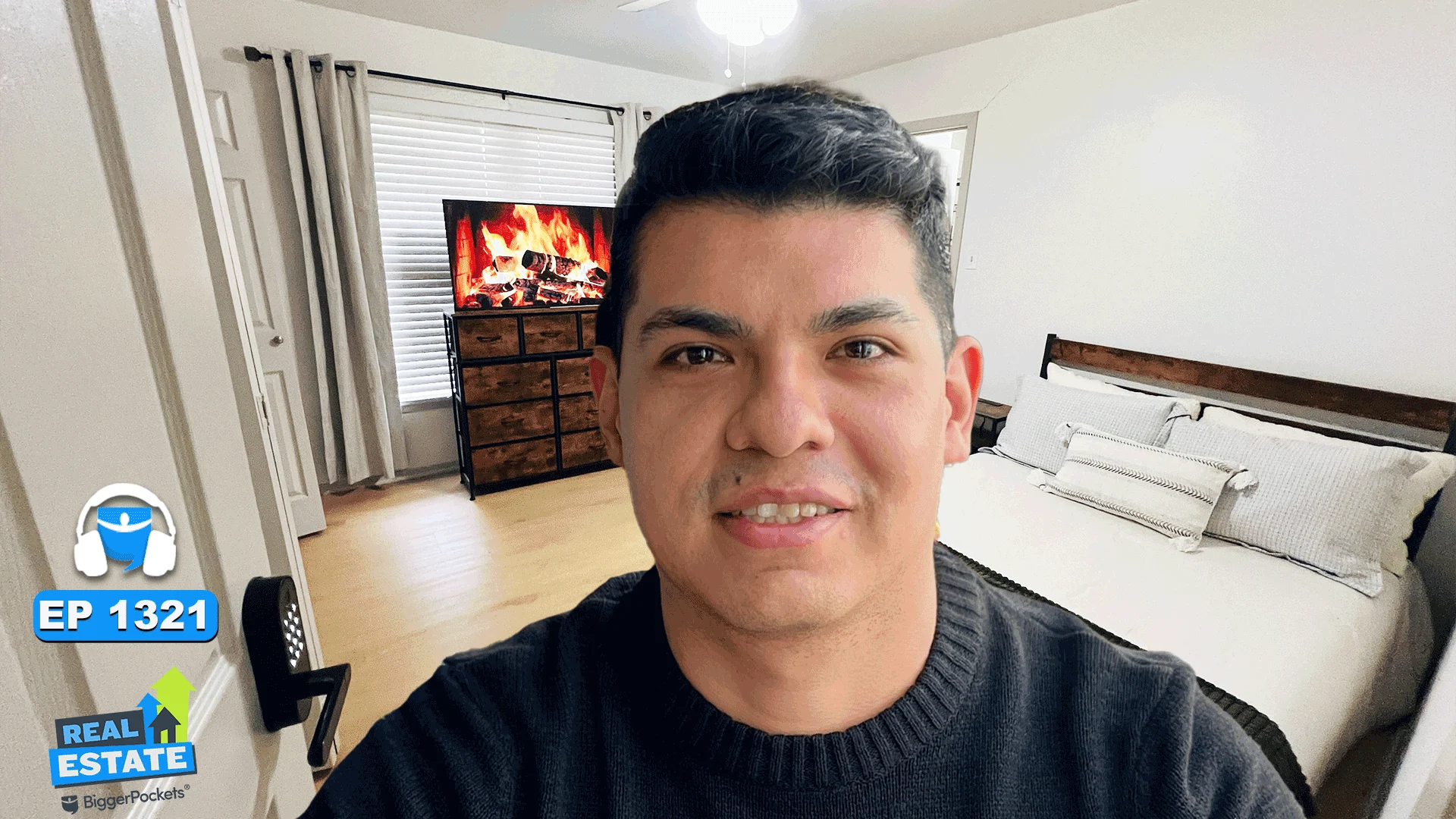
Three years ago, Andres Martinez was waiting tables. Today, he owns 10 rental properties, manages another four, and has a rental portfolio that brings in over $13,000 in monthly cash flow. He’s even been able to quit his job and focus on his rentals full-time. But how did he pull all of this off—and in such little time?
Early on, Andres had one goal: maximize the cash flow on every property he bought. This led him to co-living, an investing strategy where you have multiple tenants under the same roof. The cash flow was so strong that he has deployed this strategy across his entire portfolio.
But the journey hasn’t been easy. In today’s episode, Andres shares all the growing pains—from making 200 cold calls a day to find off-market deals to working with shady contractors and navigating difficult tenant disputes.
Through it all, his pure hustle and grit have paid off. Whether you’re looking for creative ways to scale your real estate portfolio or create enough cash flow to replace your salary, Andres has a blueprint that works—even here in 2026!
Henry:
Three years ago, Andres Martinez was waiting tables. Today, he owns 10 rental properties, manages another four, and has a rental portfolio that brings in over $13,000 in monthly cashflow. He’s even been able to quit his job and focus on his rentals full-time. So how’d he pull all this off starting in 2024? Early on, Andres had one goal, maximize the cashflow on every property he bought. This led him to co-living, a strategy where you have multiple tenants living under the same roof. The cashflow was so strong that he deployed this strategy across his entire portfolio, but the journey hasn’t been easy. In today’s episode, Andres shares all the growing pains from making 200 cold calls a day to find off-market deals, to working with shady contractors and navigating difficult tenant disputes. Through it all, his pure hustle and grit have paid off. Whether you’re looking for creative ways to scale your portfolio or create enough cashflow to replace your salary, Andres has the blueprint that works even here in 2026.
What’s going on everybody? I am Henry Washington. And today on the BiggerPockets Podcast, we’re bringing you an investor story with Andres Martinez from Dallas, Texas. Let’s jump right in. Mr. Andres Martinez, welcome to the BiggerPockets Podcast. How you
Andres:
Doing, Henry? Thanks so much for having me.
Henry:
Glad to have you, man. Excited for you to be here. Now, I understand you’ve been on the rookie podcast before, but for those who haven’t heard your story, why don’t you give us a little bit of your background and how you first got into real estate?
Andres:
I’ve been doing real estate since January 2023. I was working full-time as a waiter. I went to college for music. I studied jazz, as you can tell from my
Henry:
Albums
Andres:
Here. That did not go well. I realized a starving artist. I was working as a full-time in a restaurant business. And then I started making pretty good money as a waiter, honestly. I was very close to the six figures on the years. And then I got married and my wife is like, “You need to buy a house.” Perfect. We need to buy a house. And then even though I was reporting all my income because it was cash, we couldn’t really qualify for the house that we wanted. This is the time where the interest rates are just starting to go high. So we missed the three or 4%, but now there are seven
Henry:
And a half. Oh, so this was like 2023, late 2023. Late
Andres:
2023, exactly. November, December. And we missed it because we couldn’t find the right lender. So now when we find the lender in December, he’s like, “Well, sorry, now it’s 7%.”
Henry:
Oh, wow. So
Andres:
I was like, “Okay, how do you buy a house without a mortgage?” So I fell into the rabbit hole of creative finance. I jump into there. I didn’t know what wholesaling was back then. I just started making calls. I found my first deal in two weeks, take my wife to see the house. She’s like, “Absolutely not.” So I was like, “Okay.” So I told her agent, “Look, it didn’t work for us. Thank you.” So now I was part of a real estate mastermind. So I go to our local meetup and I told the guys like, “Yeah, I found this deal. I just didn’t know what to do with it.” And this guy’s like, “Why don’t you wholesale it?” I said, “What do you mean?” He was like, “You can make money just by flipping the contract.” And I was like, “Teach me.” So we call the agent again on that same meetup, called the agent.
I was like, “We’ll see the property again tomorrow.” We go, he runs the numbers and he’s like, “This is a good deal, man. We can make some money here.” He get under contract and he showed me how to flip that paper. And I was like, “We just make $10,000 in a few phone calls?”
At that time when I was doing the waiter stuff, I was flipping furniture online. I was trying to start any type of side hustle, flipping phones, washers, dryers, clothing on eBay, anything I could get my hands off, make money. But I never really thought I could make money on real estate because I don’t come from a family with money. I’m an immigrant. I’ve been here since I was 18 only. So when that happened and I was like, okay, this is it. I saw Dr. Strange and the Marvel movies.This is the one. And I went straight ahead, started calling nonstop.
Henry:
Okay. So you said you found that first deal in two weeks that you ended up eventually wholesaling. How’d you find that deal? Just calling agents on the MLS? Calling
Andres:
Agents on the MLS. Wow. Imagine three days into real estate. Yeah, do you want to do seller finance or sub two? No, I getting 500 calls every day. I was like, okay. And then eventually this girl’s like, “Yeah, we had this property on a contract with somebody else, but they couldn’t perform. Do you want to come see it?” And she sends me the terms, she sends me the mortgage sheet. I got lucky. After
Henry:
500,
Andres:
600 calls, somebody say yes.
Henry:
You called 500 to 600 people?
Andres:
Every single listing on Zillow.
Henry:
Folks, if you are listening right now, that is absolutely not luck. That is hard work paying off. Yes, that seems like a long shot. Sure. But if you sit down and you put effort in and you call 600 people determined to get a deal, you’re probably going to get a deal. And that goes for almost anyone. If you are in a market and you call the right list and you have that much dedication, you’re going to stumble across a deal. So no, that’s not luck. I call that positioning. You put yourself in the position to be ready to capitalize on a deal. You got paid to get an education in how to do a wholesale deal. So how long did it take you to land your
Andres:
Next one? Nine
Henry:
Months. Nine months. I didn’t
Andres:
Know that you can pull lists of low equity or seller finance. I was just calling every single listing.
Henry:
So
Andres:
Now I’m pulling lists. I’m making calls. I’m getting better at sales. I’m getting better at my pitch. Nothing, nothing, nothing, nothing, nothing, nothing. Nine months later, it was a very humbling lesson because I was about to give up. Actually, I had given up two weeks prior to that because we went to the doctor with my wife and we found out she was having some health leisure. So I need a lot of money. I was about to sell the house. All my savings were about to go there. No more wholesaling. Because at this point, these nine months, I got fired from my job twice because every time a seller calls me back on a Friday night, instead of having fajitas on my hand, I have my phone.
Henry:
And a
Andres:
Manager’s yelling at me. I was like, “Hold on. If this is the 10K call, I’m about to walk out. This is my real proof of concept.” It never happened. So we’re driving back from the doctor’s appointment and I’m just like, “Okay.” I tried. I tried. I made two, 300 calls every day manually and somebody pick up the phone. It didn’t work. I really did my best. I didn’t take days off Monday to Sunday. It’s not for me. And then on that drive home, I get a text message back. “Hey, Andres, this is Andre. You called me a few months ago. You explained to me about the seller financing and you were right. The person who got me in their contract for this price, they couldn’t close. Can you help me out? Because now I already moved out of the house and I am behind one month of the payments.
And I’m a human person and we got under contract and that was my first wholesale assignment fee of $10,000. A week later, I got another message back. Hey, do you still want to buy this house? And then the cycle of wholesaling, you need to build a pipeline. The pilot came back to me. So
Henry:
I
Andres:
Started making money now.
Henry:
This is how direct-to-seller marketing typically works for anything, whether you’re going to wholesale it, whether you’re going to keep them for yourself. When you’re doing direct-to-seller marketing, sometimes what you’re doing is you’re starting to roll that snowball, right? Because you’re putting in effort and people are saying no, but you’re also giving them the idea that working with you or your creative strategy or even the idea to think about selling is just now popped in their head because they weren’t thinking about it before until you called. And so they said no, maybe because they didn’t understand it, maybe because it wasn’t the right time. But once you plant that seed, it starts to grow. And then at some point they may decide, oh, let me call Andreas. He called. He said he could do this. Now I’m in the right space. So you got to get the snowball started.
And where people fail with direct to sell and marketing is they quit before their snowball gets big enough to start producing results for them. And so they say it doesn’t work and they’re done. And then they miss their opportunity because maybe somebody else starts marketing in the meantime to that same list. And then those leads that they started to foster end up going to somebody else, man. So that’s super cool. So you’re wholesaling, your proof of concept worked, then you start popping off $10,000 checks, $7,000 checks, $9,000 checks. So it’s working. What did you move into after that?
Andres:
When I got it started, even before real estate, the reason I was doing the side hustles is because I’ve always wanted to achieve the point that I achieve now where I have enough cash flow. I don’t have to leave my house. I leave my house right now once or twice a month. I don’t pick up the phone for anybody except if it’s an emergency for my tenants because now I have AI running everything. That level of freedom for somebody like me who had to start working at 14, who has always, depending on somebody else, I wanted to flavor that. And once I did, I realized I really like it and I don’t want to go back to being on the hustle. A lot of people think because I hustle hard, it’s because I have the alpha type. I want to be the big CEO. I want to make the billion dollars.
I am very okay making my 20, 30K a month passive income, working maybe 20, 30 hours a month. Not having to talk to anybody on the phone. I don’t have to talk to sellers. I don’t have to talk to agents. But the transition was, it’s very interesting. So going back to the beginning, on that deal with the real estate investor, we went to the home and he’s like, “Okay, I will make this work, but I need to put 10 rooms.” I was like, “Absolutely not. You’re not going to raise money for that. You’re going to borrow from somebody money. You’re going to steal it. Then you’re going to walk away.”
Henry:
No,
Andres:
I pass on that deal, but I got me thinking, hold on, maybe there’s something here I don’t know about room rentals. And I’m already part of a mastermind, so I start talking with people, “Have you heard of this?” I was like, “Oh yeah, I’ve heard about this. I have that. Yeah. This, this and that.” I was like, “Holy shit, look, okay, that’s it. That’s the end goal, cashflow.”
Henry:
So I have several more questions about how you transitioned from this, but I want to get into those right after this break. All right, we are back on the BiggerPockets podcast with investor Andreas Martinez. Andres started off wholesaling, did several wholesale deals, made good money, and then decided, you know what? I’m not going to do that anymore because I want to try this co-living thing. So you started to research, you learned about co-living. Did that deal that you were trying to wholesale become your first co-living property or did you end up wholesaling that?
Andres:
No. That same meetup that I went where I made my first wholesale deal for $500, it happens every Saturday of the first month. I was on the way there and I got a call from my boss because I’m still working at the restaurant. I was like, “I need you.” And I was like, it was like January 2nd, brand new year. I woke up early, I shave a workout. I was like, “I’m going to go meet a lot of people. This is my year. And I miss a meetup.” And I get a text message from another guy that I was kind of coaching, teaching how to do wholesale. He was like, “Hey, this agent was walking around the meetup.” And this is a creative finance meetup, full of creative finance investors. He was describing this property, these five rooms, three bedrooms, and the seller is in pre-foreclosure and he doesn’t really want to make a lot of money.
He just wants to help the seller. But nobody else pay attention to it. And I automatically, nobody pay attention because they don’t know co-living. Text the agent, I was like, “I’ll call you as soon as I get out of work.” I was supposed to get out at four. I didn’t get out until 110. I gave him a call. He was like, “I was waiting for your call.” I was like, “Can we jump on a Zoom?” Saturday at 11:30 at night, we’re on a call for an hour. The next morning, we’re meeting at the property with the seller before I go to work. Property under contract. $3,000 down. I got a 2019 house, corner lot, five bedrooms, three bathrooms, ready to go for co-living.
Henry:
And so you essentially take over payments on this property and you convert it to co-living. Did you have to add any bedrooms or did you just do it co-living as it sat?
Andres:
So I bring the deal to my mastermind to make sure that, even though I already knew it was a good deal, I just needed. I was about to put a lot of money in the conversion. It was about $40,000 to add three more rooms. We needed to redo the flooring because it was carpet. I needed to put now LVP paint. I don’t know anything about construction yet. And the guy who’s hosting the mastermind, he’s like, “Andres, do you want to sell me this?” And I was like, “Oh, I really got a deal. I really got a deal.” And he was like, “This works long-term rental, section eight, meantime rental, Airbnb, and you’re going to go for the world strategical living.” I was like, “That’s what I want to try because it’s in a great area. It has already five rooms, but I need to put three more to make maximum profit.” And on that call, I was like, “It’s going to be a lot of money, but I wish I could partner with somebody.
I don’t have to use my money.”
Henry:
So the money you were raising was the money for the renovation because you bought it sub two, but when you buy it sub two, that just gives you the money to buy it. If you’re going to renovate it, that’s got to come out of your pocket. You
Andres:
Need the renovation, you need the furniture, you need the refrigerators and stuff, holding costs.
Henry:
So about how much were you trying to raise to get all this done?
Andres:
58,000. And on that Zoom chat, somebody text me. He was like, “Hey, Andres, we have money. Can we partner?” I was like, “Okay, let’s talk about it. You bring all the money. I’ll bring everything else. I’ll manage it and then we’ll go from there.” We go under contract, we close, we start renovations. My contractors end up stealing a lot of money, no performing. I lost at that point because it was my responsibility, $40,000 out of my pocket to rebuy all the flooring. Oh, boy. The guys who were doing the work at the house, she never paid them. So they were trying to come back and to destroy the bathrooms that they had built. I had to stay at the property. Oh
Henry:
My goodness.
Andres:
Heart attack after heart attack. I was going to Home Depot in the morning, doing the renovation myself at the end, going back to work all day, double shift because now I needed money. Everything that I went from home selling was kind of gone.
Henry:
Going
Andres:
Back at night. Anyways, we went live on March 1st. I was fooled in two weeks.
Henry:
Oh my goodness. And how much were you renting each bedroom for? At
Andres:
The beginning, it was between eight and 850. The private bathroom was for $1,000. So the total income was somewhere around 6,500.
Henry:
$6,500 a month. And what was your mortgage taxes insurance?
Andres:
2,100.
Henry:
Oh my goodness. After
Andres:
Expenses and everything, the net was at the beginning, somewhere around 27, 2,800.
Henry:
Yeah, man, that’s a phenomenal cash flowing deal. What area of the country or what city are these deals being done in?
Andres:
Mainly Fort Worth, Texas. Now I’m in DFW, but at that point I started mainly in Fort Worth, Texas.
Henry:
So what did the next deal look like and how long did it take you to get that? Well,
Andres:
I was finished the renovation. I contacted everybody that I knew. I need help. I end to meet this investor who already had another property coming up. And he was like, “Hey, since you know how to operate, you can get the properties, you can find the tenants, let’s partner up.” Because I’m already partners with a contractor. And I was like, “Okay, perfect. That’s the second property.” We jump into it. Turns out the contractor ends up scamming him and scamming me. Boy.
Henry:
Oh for two on contractors. The
Andres:
Main guy who was working for the contractor ends up renting a room in the second house.
So I’m walking through the house. I was like, “Hey bro, you’re still missing trim here and there and there.” Eventually three days later, I was like, “Hey, rent is due.” And then he explodes like, “You haven’t paid my boss. She says you haven’t paid her for a month.That’s why she doesn’t have money, blah, blah, blah.” And I showed him the receipts like, “We already pay her.” She was gone. So he was like, “I don’t have money.” And I was like, “Okay, let’s get to work.” And then I started just asking people, “Do you need a contractor?” He did a good job. And he’s the main guy.
Henry:
Find
Andres:
Him a job, find a second one. I was like, “Okay, can you find bigger houses?” I was like, “Yeah, let me keep buying them.” So now I was doing my food renovation. I learned a lot of construction there because he’s been doing construction for 20 years. So we started doing more co-living for me, co-living for other investors, working with code enforcement, learning how to do permits. Now I had an already under contract that was a fix and flip. We did the flip, we did another flip. I bought another co-living. So now instead of doing the wholesaling, now the contractor gig took up. And if you ask me between being a contractor and a wholesaler, I would say being the contractor.
Henry:
So that first co-living deal, you had a partner because the partner gave you the money for the renovation, the furniture, and then you guys were fifty fifty. Second deal was a different investor than who you were partnered with before? Yes,
Andres:
It was a different investor. He already wanted to invest in co-living, but he was missing the operations because operations is very heavy in co-living. So it was the same deal, fifty fifty. But he was like, since you are messing up on the contractor stuff, let me bring my partner because she’s the contractor and then the whole thing. Got it.
Henry:
So that ended up being a debacle from the contractor side. But it sounds like you were still able to get the house fixed up. And then were you able to get that one rented out? And how many bedrooms were in that one?
Andres:
That one was eight bedrooms with an ADU in the back. And
Henry:
You were renting the rooms in that one for about how much? A little
Andres:
Bit less, between 750 and 800.
Henry:
So give us the breakdown on that. What was your mortgage, taxes, insurance, and what were you bringing in a month?
Andres:
Gross income was around 64, 6,500 as well. Pretty similar because we didn’t have the ADU fully functional yet. That would’ve been an extra thousand.
Henry:
Wow. We
Andres:
Would kill it. PITI on that one was like 2,300, but we had a HELOC that we also took on second position because the star had a HILOC. So it was like an extra 300. But the net was still around the same, 22, 2300 at that time.
Henry:
Yes. That’s super cool. You were finding the people who either have the deals or can find the deals, and you bring the operations and the experience. And then you’re typically fifty fifty in those deals. So either somebody brings the money or the deal, you bring the operations, the experience, and then you fifty fifty. But it sounds like you realized after two failed renovation projects with contractors running off with some money that you were like, “This is a gap that I need to fill.” So tell me about that. Did you go out and hire guys that you keep in-house or do you have just other GCs that you work with that mainly only work for you? What does that structure look like?
Andres:
So what I realized at that point was this contractor, she didn’t know anything about a contractor. She just happened to find her main guy and his team was doing the stuff. So I was like, “I can do the same. I can find the deals, I can find the houses. With the difference, I can work because I already finished my house. I did the flooring, I did the tile, I did drywall.” I have a better understanding of that. So I was like, “Look, if you help me learn this more, I can get you jobs.” Because as a wholesaler, if I come with a contractor, at that point I was still thinking about wholesaling. It’s a double win. So we started doing that.
Henry:
So this was the guy who was living in the place. You said he did good work. So you said, “I’ll be your new GC if you start working for me.” And so you kept him busy. So now you’re able to manage the renovation and then manage operating the property. So that’s the value that you bring to the deal. And then somebody else either brings the deal or brings the money and then you fifty fifty on the co-living.
Andres:
Yes. So we did that one a month after I did one more because I still had the leads coming from wholesaling. So I bought one more house, I raised the money, I did my own construction. Usually contractors are telling six to eight weeks. I was able to do it in two weeks. And I started realizing, okay, all these people are just talking bullshit because they need to split their teams here and need to split their damn. If you keep a group in one house, framing takes one or two days. Drywall takes two more. Then you put the texture, it dries, it paints. That’s done.Because the electrician can come in the morning, can come at nine, the AC. So it doesn’t take unless you’re doing plumbing, electrical course, all of that. So I started keeping the guys busy. I started making money there. Slowly fade away from wholesaling.
Henry:
So you’re GCing for other investors either on flips or other co-living properties? Mainly
Andres:
Co-living. I’ve done 29 now.
Henry:
That’s really cool, man. I love to see that transition. So that’s on the GC side. Would you mind just giving us a total breakdown of your portfolio as a whole to get an idea of what your business looks like?
Andres:
Yes. So I have right now 14 properties. I own 10 of them and I have four under management. On average, each one nets 1,900, 2,000 right now. All
Henry:
Right. So across that portfolio, Andreas, what is the net cashflow? What do you put in your pocket every month?
Andres:
So all the properties net around 26, 28,000 a month, depending on the vacancies and all of that. And I take 50% of that. So I take home myself 12 to $14,000 a month. Man,
Henry:
That’s super cool. Congrats on building that. I do have some more questions because I know there’s people listening who are very curious about co-living. So I’d love to get some of your thoughts around best practices, things people should avoid if they’re getting into this business. And also just thoughts around the management because it is a very management heavy business. Leases are a big thing and making sure all that’s sorted out. And so I’d like to dive into that, but first I want to take a quick break. All right, we are back on the BiggerPockets Podcast with investor Andreas Martinez, who started off in this business wholesaling, but transitioned into a niche called co-living. Now, co-living has been a buzzword for the past couple of years. It’s really started to pick up steam. More people are getting into this space mostly because affordability of housing is tough, especially in larger metro areas where real estate prices are higher.
And so for people who are interested, what are some of the most important things they need to be thinking about when operating a co-living business? This
Andres:
Is not a passive strategy at all.
Henry:
You’re
Andres:
Having the complexity of having multiple personalities living under one building. So everything that you’re thinking right on your head that is a red flag, it is a red flag. But there are ways to go around it. There are ways to fix it. There are ways to manage it. So you need to develop a lot of systems to be able to run this because for people who are starting it out, if you’ve never run a side hustle, if you’ve never run a business on the side, if you’ve never had that mentality, it could be overwhelming for you if you start growing your portfolio a lot. So just to start with one, start with two, give it a few months, see if you like it, and then decide to move forward.
Henry:
Okay. Let’s play a game of myth busters because there’s a lot of assumptions that people make with co-living. Myth number one or truth is that co-living’s going to have high turnover. So you’re going to have people moving in and out all the time, short leases. It
Andres:
Depends what type of business you want to run. If you allow somebody to come for three months in your house because they are on an internship or just because they’re getting divorced, then yes, you’re going to have turnovers. And this is what I try to explain to people when they come to my groups and want to learn about co-living. I am focused on co-living because of the affordability issue. I don’t want to have people out of state coming here for a month or two. I am targeting the guy that works at the gas station, the lady that works down at the McDonald’s. They don’t make enough to rent their own studio, but they have a job here. They have their family here, and they want to be independent. So they come to my house. I always start on a month-to-month lease because in Texas, if I don’t like them, I can let them go.
If they don’t like me, we can just part ways amicably. And I always tell them that, look, it’s a month, maybe two months, make sure you like it. And at that point, either you sign a 12-month lease or you’re out.
So once you stabilize the property, you don’t have turnovers. And it’s 107 rooms that I have. It will be impossible for me to run all of these by myself with no BAs if I had high turnover. The problem of the weekly rental and all of that, imagine you have to move so many people
Henry:
Weekly.
Andres:
You need a big team. And every time you bring a personality into the house, like, oh my God, who’s coming now? It’s a big gamble.
Henry:
Given this method, do you find that you usually have people that stay there entire term and then re-lease up with you? I have
Andres:
Five people that I’ve had since my first house. Actually, three of them on my first house just signed in January an order one-year lease.
Henry:
Oh man, that’s really cool. You
Andres:
Have to think about it. And that’s what I tell people. Why would they leave? They have the same job. They haven’t gotten a pay raise. They are not going to college. They’re not going to get a higher paying job. And they have not found a partner yet. And this is people between 25 and 35. We’re not talking about elderly or any people disabled. The house runs well, the house is clean, the house is safe. They know that management is on top of everything. Why would they leave?
Henry:
All right. Myth number two or truth is that there’s too many people issues and my phone is going to be going off all day long with tenants complaining about their housemates. Yes,
Andres:
If you don’t know what you’re doing. For example, a lot of people don’t want to talk to them upfront. They want to have a message and auto approval ratings, like no background checks. If you allow that type of people in your house and then you get mad because they didn’t wash the dishes, that’s on you. You’re a terrible operator, you’re a terrible manager because you have to realize everybody comes from a different background. For this person, that means clean. If you rent the same house and you have somebody else who comes from a different background who they know what clean is and they come in and they see dishes all the time, I’m out of here, bro. The model that we run is we are very upfront. Before they even come to see the house, there’s eight people here. You’re going to have to be extremely clean, especially in the bathrooms.
If you don’t like it, just let me know, cancel the showing. And a lot of people do. And that’s good. Go leave somewhere else. I want to have people here who need it in my houses. And when they come, they follow the rules. I really have almost no problems with dirty dishes or people fighting in the house or that they don’t take the trash. It’s all about pre-screening, man. It’s every landlord’s secret is pre-screening. We
Henry:
As landlords have to stop putting off our failures on our tenants. Our job as landlords, no matter what type of landlord, is to be great at tenant selection. The better we are at tenant selection, the more profitable that we’re going to be. All right, here’s one that you may not have had to experience yet, but it is one that people think about. When going to sell a property, do you have to un-renovate and put it back in its original condition? You
Andres:
Can sell it as a co-libian to another investor. But you heard me say, I bought a five bedroom house and I added three rooms. That’s only two by fours on drywall that can be taken out in one day. Maybe going to cost me three to 4,000 to report a house and put it back to normal. Now I can resell my property to the normal world. I don’t have to wait for a Collibian investor to come and buy this house because if you’re buying a house that is already renovated, if the investment was so good, why are you selling? On top of that, an appraiser walks into the house and they don’t see a living room. They’re like, “What is this? How do I compete?” So there are very few lenders who will help you finance a ready converted co-libian. But as an investor, I want to keep my options open.
The
Henry:
Other myth slash truth is parking is going to be an issue. Everybody’s going to fight over parking spots. The neighbors are going to complain because there’s cars on the street.
Andres:
Yes, that’s true.
Henry:
And how do we deal with it? My first
Andres:
House, my neighbor, he wanted to call the city on me. He was very mad that we were going to rent. And I was like, “I have my own parking in my corner lot, bro. And all my houses are either corner lot. I have parking in my backyard. So there is absolutely no reason why my tenants would park against their houses. In fact, it is in my lease. If you own to any more houses, we have parking pictures there where they’re supposed to park. I check the cameras once a week at the beginning. Once the tenants are on their behavior like, okay, we only park in our house. They stick to it. So I don’t have parking issues after that. But it’s true. If I didn’t buy the right house with parking, I will be struggling. All right,
Henry:
Andreas, thank you so much for playing that game. I know a lot of people have similar questions. There’s probably even more questions. So if you’re listening and you’ve got questions, drop a comment below and maybe we can help you get some answers to those questions. Or check out the BiggerPockets forums and make a post in there and there will be tons of investors who can help you with some of these ideas. Andreas, is there a way people can find you if they want to learn more about co-living or just learn more about you in general?
Andres:
Yes. My name is Andres Martinez, REI on YouTube and Instagram. I have a lot of free content on YouTube. So for people who are curious and want to hear more about the actual Colibean, you can go in there. If you want to message me, you can find me on Instagram, Andres Martinez REI. And also I have a school group now that is free to join. We meet once a week and I hold two or three hour calls for people to come ask me because my inbox is full of the same questions over and over and over. And it’s not that I don’t want to answer, but I don’t have time. So if you want to get free game, I host a call once a week, come in, ask me. I’m live for two or three hours. And then after that, go home.
Henry:
Awesome. Thank you so much, Andreas. Thank you for sharing your journey. Thank you for the lessons and being open and honest with us. And thank you so much to the BiggerPockets community for listening. We’ll see everybody on the next episode of BiggerPockets. Thanks
Help us reach new listeners on iTunes by leaving us a rating and review! It takes just 30 seconds and instructions can be found here. Thanks! We really appreciate it!
Interested in learning more about today’s sponsors or becoming a BiggerPockets partner yourself? Email [email protected].
