

This question keeps coming up — first Cash, now Bonds — so it’s probably time to address why the fixed-income market seems to be having a rough go of it lately…
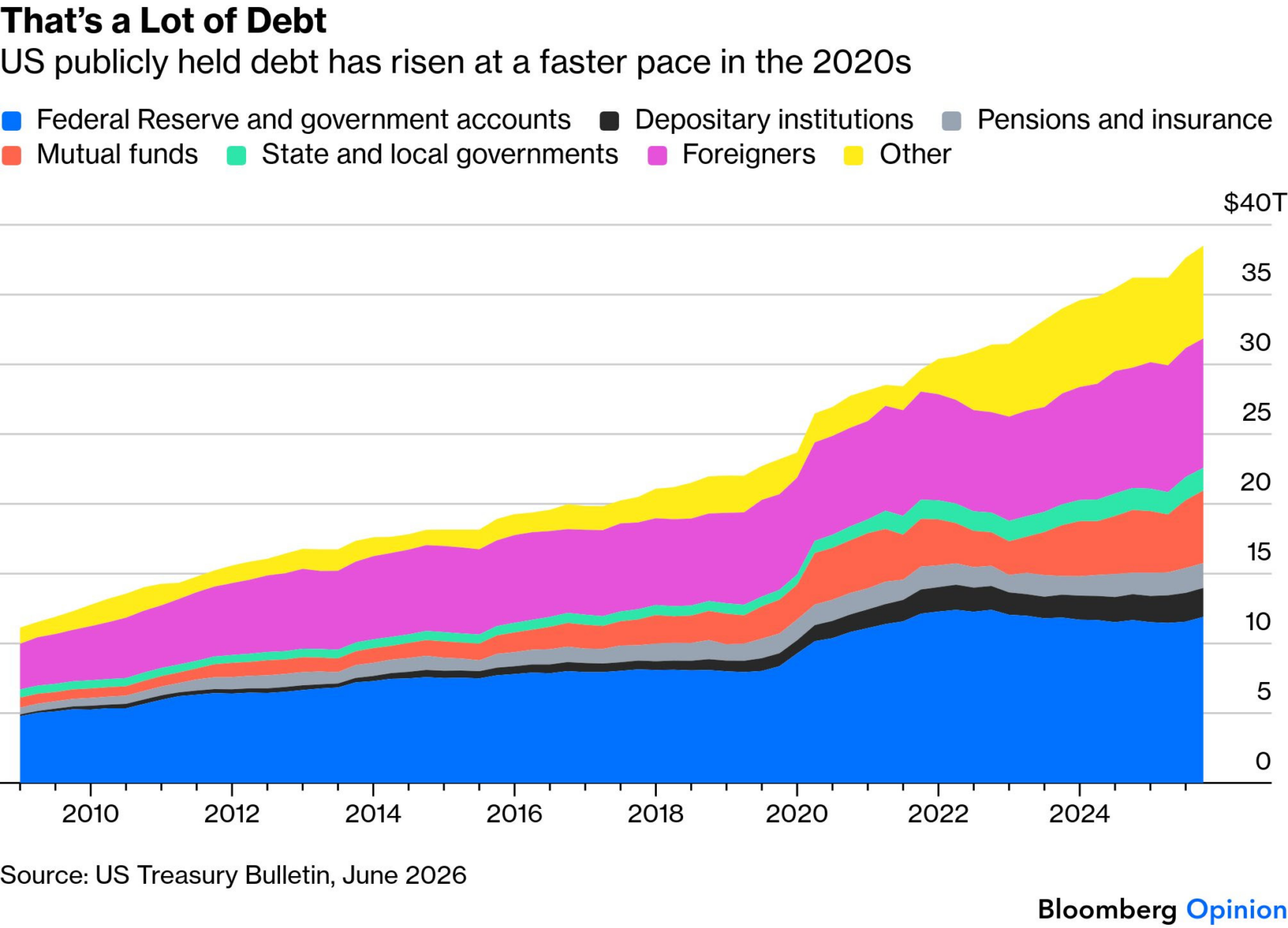
This has been a confusing couple of weeks (years?) for market watchers and bond investors: Yen interventions; announced (but not yet executed) Treasury buybacks; sticky inflation; more (illegal) tariffs; a confusing muddle in the Iran war’s 6th(?) inning; and, a record $40 trillion debt. Perhaps we have even seen the return of the Bond Vigilantes! 1
What’s a bond investor supposed to do?
The short answer is to find ways to take advantage of higher yields – my preference is Munis and TIPs – but your answer will be dependent upon your specific age, income, tax bracket, and residence. While you think about that, perhaps an overview of the five2 biggest crosscurrents currently impacting bond markets might help sort that out.
Inflationary Policies: Everybody has been tiptoeing around this; let’s just say it:
Tariffs + War = Inflation
The Tariffs I (before being struck down as unconstitutional at every level) raised prices on numerous imports, from food to finished goods; this is on top of the increase in grain prices caused by the Russian invasion of Ukraine. Then the U.S. war on Iran hit energy prices hard, followed by Tariffs II.
None of these policies show any signs of abating anytime soon. When inflation is sticky, it is all but impossible for the Fed to cut rates.
Federal Reserve Disruption: Historically, markets seem to challenge the FOMC whenever a new Fed chief takes over. In the current case, Kevin Warsh seems intent on disrupting the way the Fed does its job. From the five task forces Warsh created to review the Fed’s inner workings (!), to changes in how the Fed analyzes economic data, to reducing the number of meetings and dropping forward guidance, the new Fed chief has been antagonizing the bond market.
The tools at the Fed’s disposal include 1) higher federal funds rate, 2) size of the Fed’s balance sheet, 3) tighter financial conditions, or 4) some combination of all three. Now add two new strategies: changing the economic indicators the Fed relies on and dropping forward guidance.
The bond vigilantes’ response? Hitting the sell button on Treasuries, sending yields higher.
What is Neutral?: In case you forgot, the 2% Fed target was a made-up number with no academic or statistical significance that traces back to New Zealand in the 1980s. It made no sense in an era of fiscal not monetary stimulus, and is why I have been saying 3% is the new 2%.
For a variety of silly reasons – Credibility! Legitimacy! Change is scary! – the Fed has refused to revisit this simple truth. Rather than admit the error and move forward the Fed has doubled down on an inflation target that will not be hit until there is a broad deep and painful recession. No thank you.
Bond Buybacks? If you think the financing of AI is circular, then the biggest issuer of sovereign bonds in the world buying back its own debt has to be a head-scratcher. At most, it impacts the short end of the curve; at worst, it is an admission of losing control of the narrative.
James Carville was right: The bond market sets long-term rates—not the FOMC, not the Treasury Department, not Congress…
$40 trillion in Federal Debt: Normally, I don’t pay much attention to deficits. After a half century of warnings, with none of the sky-is-falling dangers ever occurring, I have tuned out what is usually a partisan maneuver. For my entire adult life, as ginormous as the debt seemed, it was innocuous.
Two things make today’s version somewhat different: First, all of the elements discussed above have taken borrowing costs from historically inexpensive to suddenly pricey. On top of that, the profligate spending and tax cuts have accelerated how fast the debt level is increasing. Rapid debt growth and pricier servicing costs are a one-two punch that makes people nervous.
via Bloomberg
The Bottom Line: Pardon me for stating the obvious, but:
Disruption is Disruptive.
Despite clearly stated goals of price stability, lower interest rates, and slowing the growth of inflation, the bond market seems to be bearing the brunt of a series of self-inflicted wounds. From the Fed, there has been a series of questions about a lack of clarity; the Treasury is engaging in gimmickry; White House policies, as enacted, have been counterproductive.
Markets approach all of this from the perspective of Ralph Waldo Emerson, who said, “Your actions speak so loudly, I cannot hear what you are saying…” 3
Previously:
Let’s Talk About Cash… (August 12, 2026)
How Wealth Is Created in America (August 19, 2026)
The Evolution of Alpha (April 3, 2026)
See also:
The Most Hated Asset Class in the World
by Ben Carlson
Wealth of Common Sense August 23, 2026
JPMorgan says Warsh failure to buttress Fed credibility may force a rate hike before year-end
by Dow Jones Aug 3, 2026,
The Government Report That Made Me Stop Trusting Our Statistical Agencies
Jared Bernstein Aug 22, 2026
Forget the bond rout, fund managers are in party mode
Robin Wigglesworth
FT, Aug 18 2026
JPMorgan says Warsh failure to buttress Fed credibility may force a rate hike before year-end
By Jules Rimmer
Marketwatch, Aug. 3, 2026
The Bond Market Is Returning to the Old Normal
Allison Schrager
Bloomberg, Aug 24 ,2026
KING CARNEY ACTIVATES KONG MODE WITH ZERO F*CKS
Carney Reads the Clock Like a Pro Wrestler
I F*cking Love Australia, Aug 22, 2026
__________
1. My friend (and neighbor, one town over) Ed Yardeni coined the term way back in 1983, while he was chief economist at E.F. Hutton…
2. If we wanted to add a 5th, then I would throw in the Private demand for capital. However, I am not (yet) convinced that the buyers of speculative AI capex boom high-yielding data center paper are the same allocators competing with the government for T-bills and Treasuries.
3. The full quote is: “Don’t say things. What you are stands over you the while, and thunders so that I cannot hear what you say to the contrary.” -Letters and Social Aims
