

[Today’s Iran war post went live before completed. Please return or refresh this page at 8:00 AM EDT for the final version]
The big news of the day is the pathetic and desperate US effort to try to pound Iran into the ground economically when the US has already tried that and not subdued Iran. As we will soon cover, not only do economic punishments fail to subdue medium-sized and bigger nations, but despite US sanctions, Iran has been the highest-growing state in the region, when measured on a PPP per capita basis.
In a show of imitation as the sincerest form of flattery, the Bessent speech attempts to depict the new super duper sanctions as potentially global economy wrecking. Recall that Iran explicitly and repeatedly threatened to destroy the global economy by the obliteration of petrostate energy assets if the US hit critical Iran civilian infrastructure. The fact that the US has come to appreciate that Iran really could and would do that, along with all-too-visible US weapons depletion and exhaustion of its sailors, has at least for now held the US back from attempting more self-sabotaging escalation.
Bessent’s hyperbole is a sign of weakness, particularly when contrasted with a slow and perhaps not very well planned rollout of the sanctions. Again, we keep contrasting this effort with the massive shock and awe sanctions that the US, UK and EU had clearly planned extensively and launched in February 2022. And the cute branding, Operation Economic Outcast? Puhleeze.
The full speech:
I cannot say I listened to it so you don’t have to, since I can’t stand to listen to him. But I did read the full machine transcript.
Some commentators have noted that Bessent claims that his bazooka will produce regime change, which means the Administration is returning to regime change as the aim. Not necessarily. We seem to be instead in a phase similar to the Iraq war, when after the WMD justification was exposed as a fabrication, the public was instead subjected to a slough of rationales. There aren’t that many here, so instead the Administration is rotating them.
The main points:
Today we are launching Operation Economic Outcast to foreclose every other option available to the Iranian regime.
Treasury has mapped every node, every facilitator, and every network that Iran has used to smuggle oil and evade
sanctions.
Beginning today, the actions of Treasury and other agencies will tighten the noose and block every potential source of revenue that funds the IRGC and the evil Iranian regime. We are enforcing a zero leakage approach. There will be no minimal breathing space for the regime to rebuild its capacity to inflict terror against America and the world.
The final refuge of this regime is the mistaken conclusion of nations that still finance the Iranian threat in the hopes of evading it. It is no longer acceptable to operate in the gray spaces of this conflict. Countries cannot claim they are blind to enabling this activity. Iran’s enablers purchase transport its petroleum. They facilitate the flow of its finances through exchange houses and free trade zones.
They welcome Iran’s flights and maintain registries on its behalf. They turn a blind eye to seaborn fuel transfers and overland transits. They condone illicit use of their banks, all the while concealing the extent of their complicity.
I welcome comments from experts, but yours truly is extremely skeptical that Treasury can see Iranian trade-related money flows in full. It has no visibility into Russia. It seems hard to think Treasury can track crypto payments. Only about 120 countries have agreed to participate in the OECD Common Reporting Standard, by which tax authorities exchange financial account information. While it cannot handle anything like tanker-payment transactions, a fair bit of small-business-level trade might be able to move through the hawala system.
So on its face, the Bessent claim of comprehensive visibility is farcical, even before getting to reach. We quoted John Mearsheimer pointing out that Iran’s most important trade partner, China, has flatly refused to play ball.1 Will Bessent get in a pissing match and risk additional China blocks on critical materials and end product sales to the US?
The fact that Bessent was not, as Trump has been wont to say, locked and loaded is also telling. Bessent said:
I would expect that you will see a major announcement of a financial institution being sanctioned by the end of this week.
Huh? This is unserious. Why not right away if you mean to be scary bad?
This is just silly:
Reporter: Why not impose the sanctions today?
Bessent: “Why would I want to blow up the global financial system?
So are you imposing them or not imposing them? Are these Schrodinger’s sanctions?
Consistent with the big gap between Bessent’s noise-making and reality, consider this part from the presentation proper:
The new sectoral sanctions determinations issued today target five of Iran’s most vital lifelines that it exploits in other countries. Digital assets, technology, gold, aviation, and shipping. These measures broaden secondary sanctions risk for anyone foolish enough to continue conducting business with this regime and will accelerate the speed with with we pursue them. As I speak, Treasury’s Office of Foreign Asset Control is also sanctioning over 60 entities, individuals, and vessels around the world that enable the Iranian regime to procure illicit nuclear and missile technology, conduct cyber operations, and generate oil revenue.
This is a sustained campaign to collapse every last option for Iran.
60 sanctions targets, particularly when that list included individuals, is a very small number even before considering the number of nations involved.
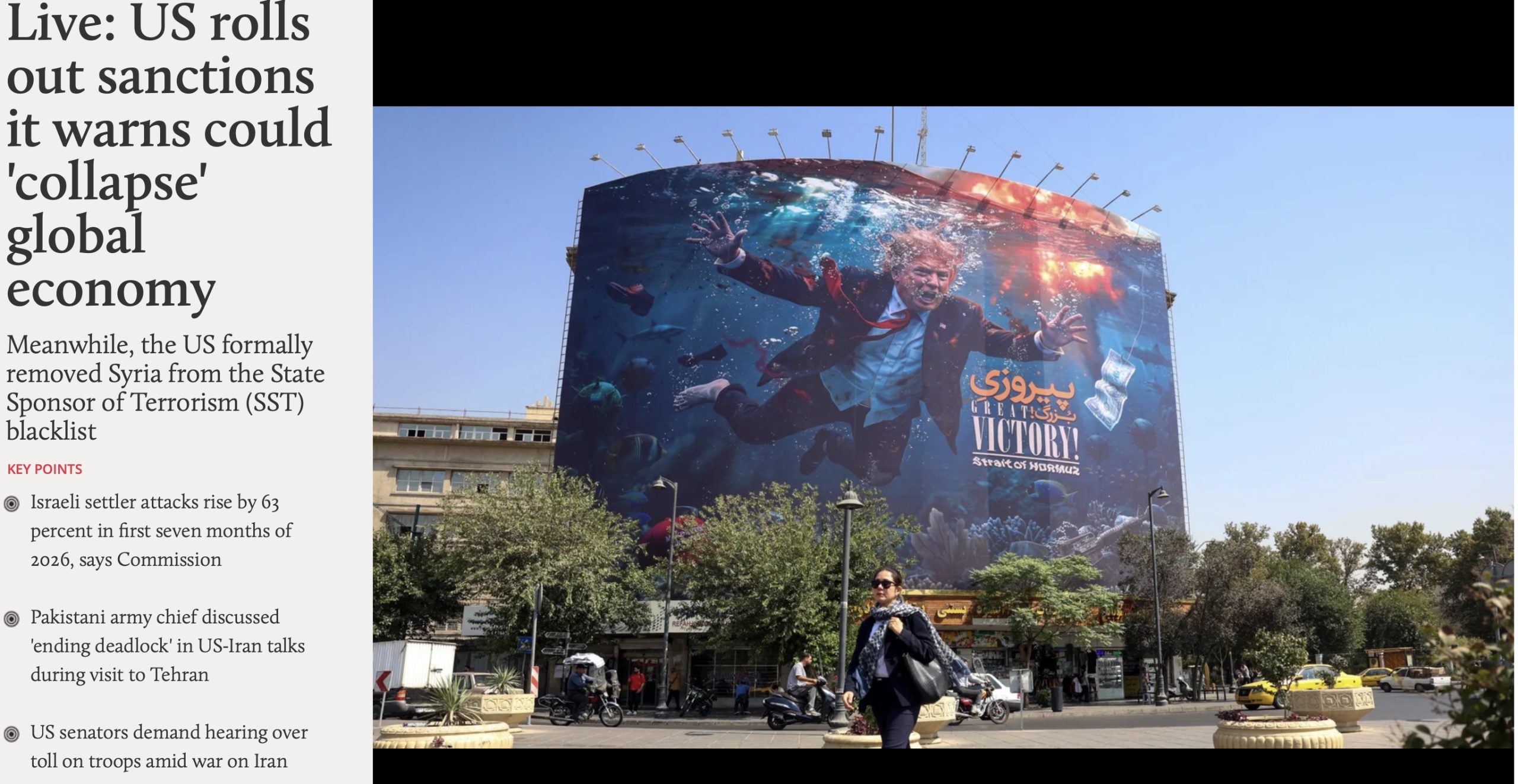
It admittedly does matter Bessent’s patter was received. From Middle East Eye’s landing page:
So what does this amount to, if you cut to the chase? Attempting to shoot the global economy in the head via the dollar system, meaning the parts in which the US participates, shoots the US in the head, a la the famed Blazing Saddles sequence, where townspeople mass to lynch the new black Sheriff Bart, but he deters them by threatening to blow his brains out first:
Needless to say, this sort of thing works only in fiction.
No one less than China’s powerful Foreign Minster Wang Yi had already rejected Bessent’s secondary sanctions threat. The Foreign Ministry had to stoop to clearing its throat again:
‘ECONOMIC WARS and maximum pressure are not the solution’ — China’s FM spox Lin Jian hits back at Bessent
China defended is cooperation with Iran, warning US sanctions could trigger escalation, spillover and disruption to the global economy https://t.co/G7ekc0JKSB pic.twitter.com/CgHphQGGaL
— RT (@RT_com) August 25, 2026
And the lead story in the Financial Times:
From the text:
Any serious increase in US sanctions on China, which buys 90 per cent of Iran’s oil, would risk exploding the relationship only a month before presidents Donald Trump and Xi Jinping are scheduled to meet in Washington.
The summit is seen as crucial to the world economy, with the leaders expected to discuss extending a one-year truce in their trade war that they agreed in October and which was cemented by a cordial visit to Beijing by Trump in May.
“China will take all necessary measures to firmly safeguard its rights and interests,” a Chinese foreign ministry spokesperson said on Tuesday in response to questions about US secondary sanctions on Iran.
“China has made clear on many occasions its firm opposition to illicit unilateral sanctions that have no basis in international law or the authorisation of the UN Security Council,” they said…
While China’s large state-owned refiners largely comply with sanctions on Iranian crude, Beijing allows private sector refiners known as “teapots” to import and process oil from the country….
China has set up an increasingly strident anti-sanctions regime that includes countermeasures against foreign individuals and organisations that assist with foreign restrictions on Chinese companies and supply chains.
Any attempt by the US to aggressively expand a secondary sanctions regime on Iran to Chinese companies would risk retaliation from Beijing, which last year showed that it could bring American manufacturing to a standstill through its control of critical minerals essential to high-tech production.
“We have to wait and see whether this is just bluffing or [the US is] seriously thinking about putting secondary sanctions on China,” said Wang Dong, a senior scholar at Peking University.
Robert Pape pointed out in a new talk on At the Water’s Edge that even if Treasury could make its new sanctions work operationally, they would still fail to break Iran. Pape presents a long-form version in his Substack in The “Economic D-Day” Illusion: Why Massive Sanctions Have Failed to Win Wars Since 1918. But the historical record against the effectiveness of sanctions is so strong that his verbal account is highly persuasive.
From a moderately-edited machine transcript:
Scott Bessent, and I’m choosing my words carefully, is up against the weight of history.
It’s extremely important to understand that since World War I, no major war has ended through economic blockade and economic pressure alone.
These were a thing of an earlier period in world politics that really was quite effective and one of the ways the British ran the world in the 17th, 18th, 19th century and other empires before that.
World War I, there’s a key threshold, key break point in history.
You can see the British blockade in World War I of Germany. Uh you can see the American sanctions, oil sanctions, then blockade of Japan in World War II, the US economic and oil blockade and and tightening blockade on Iraq from 1990 91 to 2003, Iran from 2010 to this very moment. These cases and there’s many more discussed these cases all show high degree of economic pressure. The problem is not there was no pressure, tactical success. They also show economic pressure alone failed.
And in none of those cases did the war end until extraordinary military pressure was brought to bear on the target. Extraordinary military pressure, massive ground forces on the target. Case of Japan, nuclear weapons on the target. In the case of Saddam Hussein, a150,000 ground force invasion of Saddam Hussein. So, I’m not saying that our side, the American side that we didn’t win. I’m saying that this idea that Scott Bessent has put forward last week and has repeated that he has found an offramp to heavy military pressure.
This is not the reality of the pattern.
On top of that, our super-duper sanctions on Iran have not worked as well as we fancy. I have repeatedly cited the data Steve Hanke presents below as part of talks with Mario Nawfal and Nima some time ago, so good for Nima to extract it and highlight it:
OilPrice provides a list of the countries the US will try to browbeat in The Biggest Victims Of Trump’s Economic D-Day On Iran:
- Trump’s “Economic D-Day” puts Iran’s major trading partners under pressure, with China, Iraq, Turkey, India and the UAE facing varying exposure to secondary U.S. sanctions.
- China represents Washington’s biggest test, buying more than 80% of Iran’s seaborne crude, while sanctions against major Chinese banks could trigger significant economic and diplomatic fallout.
- Iraq and Turkey face particularly acute energy risks, while India’s remaining trade is vulnerable and the UAE has already largely cut economic ties with Tehran.
We must point out that the UAE had announced early in the war that it has severed trade with Iran but has done no such thing. Will Bessent try to muscle the UAE? Turkiye does not want Iran to lose since it is next on Israel’s menu. Turkiye also has much stronger legal control over its NATO bases than other states do. Incircik is important to US operations in the Middle East. What happens to the US clever scheme when it encounters pushback?
India has been pretty craven in its US dealings but IM Doc is already reporting drug shortages. Does Bessent really want to be the one responsible for impediments to importing badly-needed Indian generics?
To round out the Bessent news, his former boss at Soros Fund Management, Stan Druckenmiller, lambasted Bessent publicly. Bloomberg amplified a Druckenmiller op-ed in the Wall Street Journal BBessent’s Mentor Druckenmiller Calls Bond Buying a Mistake:
- Stanley Druckenmiller suggested his former pupil Scott Bessent is making a mistake by wading into the bond market to push down yields.
- Druckenmiller argued that policymakers should let the bond market do its job, saying “Governments defending prices against fundamentals always lose”.
- Critics have argued that Bessent’s move makes little economic sense, offering only temporary benefits and not addressing worries about fiscal spending that have pushed up borrowing costs.
From the Drucenkmiller Journal piece proper. Let the Bond Market Speak:
The Treasury Department announced on Aug. 19 that it would double the size of its long-dated bond buybacks, from $2 billion to at least $4 billion per operation, aimed at the 10- to 30-year sector and running from Sept. 9 through Nov. 4. The announcement came after the 30-year yield touched a 19-year high. Yields fell within minutes. By the next afternoon they had round-tripped to levels above where they started. The market’s verdict was swift and correct: This wasn’t liquidity management, it was price management—and a mistake far larger than $4 billion suggests.
Treasury’s announcement gave the game away. It justified the larger operations as liquidity support in sectors with “consistent strong sponsorship from market participants,” but strong sponsorship is the definition of a healthy, working market. There were no failed auctions, no dealer balance-sheet seizure, no forced unwinds, nothing resembling Treasurys in March 2020 or U.K. gilts in September 2022, the sort of genuine dysfunctional episodes that justify official action. Volatility was contained, and trading was orderly—not a malfunction but the machine doing its job.
Consider what the machine was pricing. Inflation is 3% to 4% and has been above the Fed’s target since 2021. Unemployment is 4.1%, full employment by any definition. The deficit is running near 6% of gross domestic product, a number America has never before produced in peacetime at full employment. The national debt crossed $40 trillion the same week Treasury intervened. Net interest will exceed $1.1 trillion this fiscal year, more than the defense budget. The 10-year yield, even after the summer selloff, sits at or below the economy’s nominal growth rate. That means a borrower (federal government) running 6% deficits at full employment, with above-target inflation, still funds itself at roughly the rate its economy grows.
Historically, that configuration is accommodative, not restrictive, of financial conditions. The bond market wasn’t being a vigilante, as some would argue. It was being a pushover that had finally begun to clear its throat, and Treasury moved to quiet even that.
Druckenmiller’s argument is similar to the one made by Rob Urie today: there is no bond market distress. Bessent at best is reacting to Trump hyersensitivity to interest rate increases, when they are simply registering inflation, which Trump is not only not addressing but even making worse by refusing to exit the Iran war and now getting into a huge tariff spat with Canada.
Yet CNBC claims Treasury plans to go much bigger. I don’t yet take this seriously since there is not yet a corresponding story at Blooomberg, the Wall Street Journal, or the Financial Times. Perhaps this is a trial balloon?
BREAKING: The US Treasury is considering using its $950 billion General Account to help fund its increased purchases of long-term government bonds, per CNBC.
Once again, the era of bond market intervention officially began on August 19th.
This is a top priority for the Trump…
— The Kobeissi Letter (@KobeissiLetter) August 24, 2026
And on the actual economic front, as opposed to messaging masquerading as action. It is hard to know how many if any vessels have been transiting on the Oman side. Iran could clearly stop them all if it wanted to; readers have described how Iran can effectively monitor the Oman side due to its close proximity. I have thought Iran could be letting some pass so as not to unduly ruffle Oman and/or not set the tourniquet on the global economy as tight as it could to placate China (which still needs exports and hence does not want a big downdraft) and exposed countries, particularly in Asia.
With the Bessent announcement, the strike on a US-escorted ship may signal that Iran is now delivering on its “no more Hormuz transits” threat:
⭕️ UKMTO confirmed that an Oil Tanker escorted by the US in the Strait of Hormuz was struck and disabled around 20h25 UTC last night. https://t.co/KBOhyTOjvX pic.twitter.com/rYi01IiRwS
— MenchOsint (@MenchOsint) August 25, 2026
And per Middle East Eye’s live feed, Hormuz traffic has been at particularly low levels:
Strait of Hormuz tanker traffic falls to lowest level since May
Only two commodity tankers passed through the Strait of Hormuz on Monday, the lowest daily number recorded since early May, according to shipping data.
Both vessels entered the Gulf from the Gulf of Oman, ship-tracking firm Kpler said. They included one very large gas carrier and one very large crude carrier.
Monday’s total fell sharply below the 10-day daily average of 14 vessels, Kpler data showed on Tuesday.
Preliminary figures from the separate ship-tracking firm Vortexa put Monday’s oil flows through the strategic waterway at five million barrels per day.
The seven-day moving average stood at between six million and seven million barrels per day as of August 23.
This is not cheery news since SPR draws continue:
BREAKING: Crude oil inventories in the US Strategic Petroleum Reserve officially fall below 290 million barrels for the first time since 1982.
Inventories declined by another 3.7 million barrels last week, to 289.7 million barrels.
US oil reserves are at a fresh 40+ year low.
— The Kobeissi Letter (@KobeissiLetter) August 24, 2026
And there are rumors about the salt caverns being at risk even now, when the Administration has acted as if, and perhaps even planned, that it can drain the SPR down to the 70 million barrel level:
For those out there who care, beware that there are some US SPR salt caverns that are already almost empty pic.twitter.com/AFshc8BOAV
— JustDario (@DarioCpx) August 25, 2026
And Ansar Allah is still in there punching. From Bloomberg in Yemen’s Houthi Rebels Attack Saudi Oil Supertanker in Red Sea
Yemen’s Houthi militant group targeted a Saudi Arabian supertanker sailing through the Red Sea.
The group said it fired a ballistic missile at the Amzan, which is capable of hauling two million barrels of crude. Saudi tanker giant Bahri, which owns the vessel, said it suffered a security-related incident but didn’t elaborate.
____
1 From Mearsheimer via Tom Switzer’s podcast:
So the question you have to ask yourself is whether or not you think that the administration can successfully cut Iran off from Chinese trade or Chinese economic intercourse. The same with Russia. And let’s look at the UAE as well.
The Chinese have already said, and by the way, China is Iran’s biggest trading partner. They’re not going to play ball. Period. The Russians are not going to play ball either. And the fact is that we are a mortal threat not only to Iran, but we are a mortal threat to China and Russia. And China and Russia have a vested interest in seeing Iran win this war. So we’re going to fail with those two very powerful trading partners of Iran.
And then there’s the UAE.
There’s no question that if the UAE cuts off all economic relations with Iran, it will hurt. No question. But the fact is the Iranians have a card to play and they’ve already played it. They’ve told the UAE that if you do what the United States says you should do, and you’ve said you’re going to do, the UAE has said they would go along with the United States, but they haven’t done so yet. If you do that, we will wreck you the UAE. We have the capability to wreck the UAE. We have missiles that could destroy your ports, destroy your refineries, and put you back in the stone age. And we will do that. We want you to understand, this is the Iranians talking to the UAE. If you think you’re going to bring us to our knees and you’re going to get away with it scot-free, you’re mistaken because we’re going to bring you to your knees as well.
And I would be very surprised if the UAE uh plays ball with the Americans here and really does cut off all economic intercourse with Iran. But if it does, the Iranians will retaliate. And I wouldn’t be surprised if that didn’t escalate.
We’ll stop here today. See you tomorrow!
