

[Today’s Iran war post launched before complete because reasons. Please return at 8:00 AM EDT for the final version]
While we wait for the unveiling of the promised Bessent “Take Iran back to the Stone Age”1 at 1 PM EDT, let us look at the other problem Bessent has made for himself, calling undue attention to the perceived to be high interest rates at the long end of the Treasury. The Fed has the firepower to do something about that if it really wanted to. Treasury does not and seems to be working at cross-purposes with the Fed, which is inclined to raise interest rates. The Fed and Treasury at odds would at the margin make investors nervous…as in lead to higher interest rates.
Keep in mind that 5% is not high by long historical standards, and investors will demand juicier yields in a higher inflation environment. High interest rates alone are also not an impediment to raising funds. I worked on several bond deal for utilities in my youth where the coupons were 13% to 15%. But as we have said repeatedly, high interest rates kill the value of financial assets, witness the famed “Death of Equities” Business Week cover story in the late 1970s. Very few are old enough to remember the protracted bear market of the 1970s into the early 1980s, or the Great Depression, where it took until the 1950s for stock price levels to return to where they were before the Great Crash.
Again, I am not disputing that the odds of a severe financial crisis, or a very long period of a depressed economy due to zombification to protect critically important financial firms (see Japan post its monster real estate and stock market bubbles) are already high and rising due to Trump failing to cede the Strait of Hormuz to Iran and get commodity flows moving again.3
The issue here is not, contrary to hysteria on YouTube and Twitter, that the Federal government will have a funding crisis.2 When interest rates rise, it is the riskiest companies and bonds that show big price corrections and having to pay big funding premiums first. The safest assets, like Treasuries are last, not first to go.
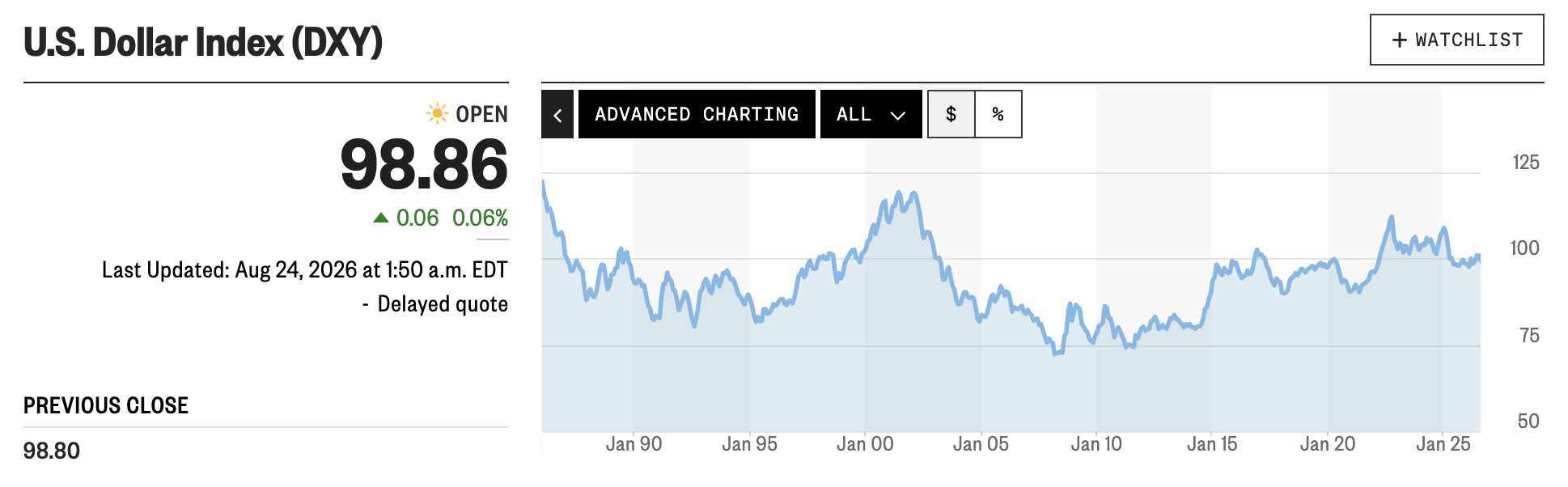
The hysteria over the dollar is also misplaced. From MarketWatch:
Mind you, that does not mean it will not fall if there is a meltdown in the US stock market or in the private credit market that has become essential to funding AI. See the dot-com, then dot-bomb era as an example. The dollar also fell right after Trump announced his Liberation Day tariffs, the US markets fell as investors priced in more inflation and instability and foreign investors pulled back on dollar securities. They got back into the pool to a fair degree after the Trump tariff TACOs.
As an aside, the private credit fund’s market’s total size is $3 to $3.5 trillion, while subprime (depending on whether securities like Alt-As were included) was $1.3 to about $2 trillion. US GDP then was about $14.5 trillion versus $32.5 trillion now. so the level of this type of investment is of similar scale to subprime. However, we explained long-form in ECONNED, the reason the subprime crisis, which by any normal standards, should have produced an only a S&L times at most 1.5 downdraft instead nearly destroyed the global economy was derivatives. Credit default swaps referencing the riskiest subprime tranches were 4x to 6x the real economy value of that debt. And via CDOs, many of those exposures sat at systemically important, overleveraged financial institutions.
There is some evidence of leverage on leverage in private debt. So far, there is no evidence it is as severe as with credit default swaps and CDOs in the crisis (they were a big focus of discussion and debate in the runup to the crisis, so they were a known unknown).
But a private debt fund seize-up would seem destined to move in tandem with an AI bubble implosion. And AI capex had produced nearly 50% of GDP growth in 2025 and early 2026. Again, keep in mind that the Japanese post-bubble era didn’t produce fireworks until 1997 (heavily exposed long-term credit banks finally fell over), due among other reasons to the Asian crisis. So borrowing bubble unwinds can be very destructive yet not produce market upheaval (but given the AI equity bubble, odds seem to favor a pretty nasty plunge when it gets going).
So a cataclysm is entirely possible, but acting as it will be due to the being unable to fund is all wet. Adam Tooze provides a good explanation of how demand for Treasury securities has shifted over time, in The risk of unwind – The US Treasury market in the era of the hedge fund-profit dollar. The big takeaway is that while central banks were once important holders of Treasuries (although domestic buyers were and remain number one), they have been displaced by financial investors, in particular hedge funds. They are much more yield driven than central banks. They also are typically levered. Mind you, even this improved picture is not clear cut. For instance, Brad Setser has reported that sales by the Saudi central bank have been significant and even potentially entirely offset by purchase by the Saudi private wealth fund.
From Tooze:
Whereas once those two deficits were directly linked by their financing mechanisms – trade surpluses with the US accumulated by exporters like China were reinvested by official reserve managers in US Treasury bonds (so-called “Bretton Woods 2.0” recycling), the relationship is no longer so straight forward.
This is brought out by the latest paper by Anusha Chari and Gian Maria Milesi-Ferretti of Brookings. As they show, in the classic era of reserve accumulation under Bretton Woods 2.0, between 2000 and 2009, a very large share of net US Treasury issuance was acquired by foreign official reserve holdings – the “twin deficits” model in action.
Since the 2008-2009 crisis, the twin deficits model has gradually been replaced by a new regime.
In the 2010s, as post-crisis deficits piled up and US Treasury issuance continued at a rapid pace, some foreign official reserve accumulation continued. But it was now increasingly foreign private investors who took over the absorption of new debt, along with domestic private investors (the data are adjusted to allow for the offshoring of US private holding to the Cayman islands)….
Tracy Alloway tells the same story with a graph showing shares of Treasury ownership. The dark turquoise line (for official foreign reserves) peaks around 2008-2009 at over 40 percent and then declines. The ligher blue line for foreign private holdings overtakes official foreign holdings. And the dominant buyers are now domestic private investors.
Though China continues to run huge trade surpluses with the US and it continues to manipulate its exchange rate, this no longer manifests in large-scale official purchases of US Treasury debt. So who are the foreign investors who still buy dollar assets and thus finance US trade deficits? What attracts them? And what attracts both foreign and US private investors into Treasury debt? The simple answer is that it is no longer the imperative of foreign exchange manipulation or export-orientated industrial policy that is driving funds into the Treasury market, but the pursuit of profit.
As much as this is informative, and shows that the greater weight of particularly yield-sensitive investors is set to lead them to seek what they deem to be adequate returns, Tooze is unduly orthodox. The Federal government can always pay its dollar obligations. What it can also do in that process is engage in too much unproductive deficit spending and generate too much inflation. Interest payments are the poster child of “unproductive” but our pork-riddled military and overpriced health care system should get more opprobrium than they do.
The underlying issue is inflation, which is why investors are demanding more returns, and on bonds, higher yields, all over the world, even in economies that had previously had modest inflation.
And yes, an economic implosion is arguably an end-of-an-era event. But it will signify the end, or at least the start of the end, of neoliberalism. Those policies sought to wrest power from labor, which was perceived in the 1970s to have gotten not just too powerful but even uppity, by moving away from rising real worker wages as the primary driver of growth. The new paradigm was for asset price appreciation to spur expansion (and the wealth effect does that, but not as efficiently as wage growth) and to use consumer borrowing to increase their spending power and mask the effect of real wage stagnation.
Recall that the end of the gold standard regime was a protracted and not happy affair. The gold standard broke down in World War I due to the inability to ship gold then. It was revived, with considerable effort afterwards. MIT economist Peter Temin argued in Lessons from the Great Depression that the policies to resort the gold standard were in fact what caused the Great Depression. Temin systematically looked at all the other major explanations and finds they do not line up with empirical evidence.
In ECONNED, we argued that the end game of trying to extend neoliberalism rather than reform it was likely to result in what we called paradigm breakdown:
Recall that starting roughly in the 1870s, major European economies increasingly adopted the gold standard, and a long period of prosperity resulted. The regime was suspended in the UK and the major European powers during the war. Afterward, they moved to restore it, sometimes at considerable cost (England, for instance, suffered a nasty downturn in the early 1920s). But the aftereffects of the war meant the Edwardian period framework was unworkable.
The deflationary forces they set in motion could have been countered by countercyclical measures after the Great Crash. But that was impossible with the gold standard. Indeed, as Temin notes, “Holding the industrial economies to the gold-
standard last was about the worst thing that could have been done.”
Now readers may have trouble with that comparison, particularly since the conventional wisdom is that our policy responses have been so much better than those of the early 1930s. But the key point here is that the institutional framework locked the major actors into a particular set of responses. They were not able to see other paths out because they conflicted with an architecture and a set of beliefs that had comported themselves well for a very long time. It’s hard to think outside a system you grew up with. And remember, the gold standard did not break down overnight; the process took more than a decade.
Let’s use a different metaphor to illustrate the problem. Say a biotech firm creates a wonder crop, the most amazing creation in the history of agriculture. It yields far more calories per acre than anything else, is nutritionally extremely complete, and can be planted and harvested with far less machinery and equipment than any other plant. It is tasty and can be prepared in a wide variety of ways. It is sweet too, so it can be used in place of sugar and high fructose corn syrup at lower cost. We’ll call this XCrop.
XCrop is added as a new element in the food pyramid and endorsed by nutritionists and public health officials all over the globe. It turns out that XCrop also is an aphrodisiac and a stimulant (hmm, wonder how they engineered that in) and between enhanced libido and more abundant food supplies, the world population rises at a faster rate.
Sales of XCrop boom, displacing traditional agriculture. A large amount of farmland is turned over from growing other types of produce to XCrop. XCrop is so efficient that agricultural land is taken out of production and turned to other uses, such as housing, malls, and parks. While some old-fashioned farms still exist, they are on a much smaller scale and a lot of the providers of equip ment to traditional farms have gone out of business.
Twenty years into the widespread use of XCrop, doctors discover that diabetes and some peculiar new hormonal ailments are growing at an explosive rate. It turns out they are highly correlated with the level of XCrop consumption in an individual’s diet. Long-term consumption of high levels of XCrop inter feres with the pituitary gland, which controls almost all the other endocrine glands in the body and the pancreas.
The public faces a health crisis and no way back. It would be very difficult and costly to put the repurposed farmland back into production. Some of the types of equipment needed for old-fashioned farming are no longer made. And with the population so much larger than before, you’d need even more farm land than before. The world population has become dependent on the calories produced by XCrop, so going off it quickly means starvation for some. But stay ing on it is toxic too. And expecting users simply to restrain themselves will likely prove difficult. The aphrodisiac and stimulant effects of XCrop make it addictive.
Advanced economies have become hooked on debt technology, which, like XCrop, is habit forming and hard to wean oneself off of due to its lower cost and the fact that other approaches have fallen into partial disuse (for instance, use of FICO-based credit scoring has displaced evaluations that include an assessment of the borrower’s character and knowledge of the community, such as stability of his employer). In fact, the current debt technology results in information loss, via disincentives to do a thorough job of borrower due diligence (why bother if you are reselling the paper?) and monitoring of the credit over the life of the loan. And the proposed fixes are not workable. The Obama proposal, that the originator retain 5% of the deal and take correspondingly lower fees, is not high enough to change behavior. And a level that would be high enough to make the originator feel the impact of a bad decision would undercut the cost efficiencies that made securitization popular in the first place. You’d have better decisions, but less lending, and higher interest rates. That’s ultimately a desirable outcome, but as in the XCrop situation, no one seems prepared to accept that a move to healthier practices will result in much more costly and less readily available debt. The authorities want to believe they can somehow have their cake and eat it too.
A second set of difficult institutional problems results from the internationalization of capital markets. Effective regulation of global capital markets players requires a consistent regime of rules and enforcement across geographies. This approach is unlikely to succeed in the absence of the establishment of powerful international bodies devoted to that task. That in turn represents a
major threat to national sovereignty. International “harmonization,” the current compromise, is a step forward but is likely to prove inadequate.
Financial firms are masters of regulatory arbitrage, and as their wealth and influence have grown, they are also showing considerable skill at manipulating political processes. A point of leverage has been to play competing financial centers against each other. For instance, one impetus for the strong dollar policy was the desire to bolster New York’s standing as a financial center. Similarly, the UK, to compete with U.S. deregulation, implemented some rules that were even more accommodating than the ones stateside, a regulatory race to the bottom. For instance, in Lehman’s final days, the firm transferred $8 billion from its UK broker-dealer subsidiary to provide funding to the parent company in the United States. It appears Lehman raided UK client accounts, something prohibited under U.S. law. If the broker-dealer does not go bankrupt, its customers should come out more or less whole. Even though Lehman collapsed, its U.S. broker-dealer subsidiary did not. Neither did Drexel’s in that firm’s implosion.
But the Lehman example illustrates a broader point: that the pressures on legislators and regulators to grant waivers, to assure the “competitiveness” of their respective financial centers, lead to a pressure to lower standards. Thus even if effective new regimes were to be implemented, the banking classes are certain to set them against one another.
It would be better if I were wrong, but the assessment above suggests that we will not get effective reforms until the financial system is so badly damaged that the influence of financiers weakens considerably.
To return to the other situation Bessent is not managing well, in a discussion with Tom Switzer and Rosemary Kelanic, John Mearsheimer provides a fine one-stop takedown of the latest Trump doomed-to-fail attempt to pressure Iran:
From a lightly-edited machine transcript:
Switzer: Now, let’s just start with John. John, President Trump um has this week pledged to intensify the US campaign to strangle the Iranian economy. These are Trump’s words. The most crushing economic operation ever taken against any country on any nation or entity that does business with the regime. So, the question here, John, is will economic D-Day work?
Mearsheimer: No, I don’t think it’s going to work. I think the first point you want to keep in mind is that the United States and Israel clearly present an existential threat to Iran. So to get Iran to surrender, you’re going to have to inflict unbelievable amounts of pain on them because again, they’re fighting for their life here. And the inclination when you face an existential threat is to fight to the death. So the bar here is very high. That’s the first point.
The second point is we’ve had two blockades on Iran so far, one that ran from April 13th to June 17th. Then that ended and then we started another one on July 14th which continues up to the present. And the blockade didn’t work. And because we have no other military option, President Trump has decided to up the ante on the economic side.
So what he’s doing here, and we want to be very clear, is he’s going beyond the blockade. And he’s basically saying that what I’m going to do is I’m going to isolate the Iranian economy almost completely by cutting off economic intercourse with countries like China, Russia, Pakistan, and the UAE. That’s the name of the game here, to isolate the economy of Iran. And that coupled with the blockade will cause Iran to surrender.
So the question you have to ask yourself is whether or not you think that the administration can successfully cut Iran off from Chinese trade or Chinese economic intercourse. The same with Russia. And let’s look at the UAE as well.
The Chinese have already said, and by the way, China is Iran’s biggest trading partner. They’re not going to play ball. Period. The Russians are not going to play ball either. And the fact is that we are a mortal threat not only to Iran, but we are a mortal threat to China and Russia. And China and Russia have a vested interest in seeing Iran win this war. So we’re going to fail with those two very powerful trading partners of Iran.
And then there’s the UAE.
There’s no question that if the UAE cuts off all economic relations with Iran, it will hurt. No question. But the fact is the Iranians have a card to play and they’ve already played it. They’ve told the UAE that if you do what the United States says you should do, and you’ve said you’re going to do, the UAE has said they would go along with the United States, but they haven’t done so yet. If you do that, we will wreck you the UAE. We have the capability to wreck the UAE. We have missiles that could destroy your ports, destroy your refineries, and put you back in the stone age. And we will do that. We want you to understand, this is the Iranians talking to the UAE. If you think you’re going to bring us to our knees and you’re going to get away with it scot-free, you’re mistaken because we’re going to bring you to your knees as well.
And I would be very surprised if the UAE uh plays ball with the Americans here and really does cut off all economic intercourse with Iran. But if it does, the Iranians will retaliate. And I wouldn’t be surprised if that didn’t escalate.
And all of this has to be married to the fact that the US economy is in trouble. And we have got to solve this problem quickly. Not only for economic reasons, but for political reasons.
But the fact is economic strangulation never happens quickly. It takes time. And again, to go back to where I originally started, Iran is facing an existential threat. So, it’s going to take a lot of time, if it ever works, to bring the Iranians to their knees. But the fact is, it’s not going to work for the reasons I just laid out.
One wonders what new bloviation tricks Bessent will trot out in trying to sell old sanctions wine that has gone to vinegar as Château de Chasselas.
And Iran has pre-positioned its response:
Tomorrow will see important developments in the Middle East war.
In fact, in the next 24 hours, U.S. Treasury Secretary Scott Bessent will impose new sanctions against the Islamic Republic of Iran, the so-called economic D-Day announced by President Trump, which he claims will… pic.twitter.com/ut1LxV08Fh
— MoloMonitor 🇮🇹 (@MoloWarMonitor) August 23, 2026
To other sightings. One is a telling in not a good way. The Financial Times’ prominently featured Are America’s vast Gulf bases worth rebuilding? contains remarkable omissions. It does not even consider that the Gulf states have a vote. It does not acknowledge that Iran will control the Strait of Hormuz and will never never never let any military vessels into the Gulf, which means they cannot resupply ships. I will leave it as a reader critical thinking exercise to take apart other spin and gaps in this article.
From the Bloomberg landing page:
From the text:
- Saudi Arabia is overhauling how its oil gets to customers around the world due to Yemen’s Houthis making it harder to use a backup route.
- The kingdom is sending oil tankers thousands of miles around Africa to collect cargoes, with its oil moving in the opposite direction on the arduous route, and is offering Middle East shipments for collection just outside the Persian Gulf.
- The logistics revamp is adding to the strain on Saudi Arabia as it attempts to keep the global market supplied, with the kingdom’s overall exports remaining below pre-war levels and the logistics challenges increasing the cost of delivering barrels.
Saudi Arabia’s ability to switch crude exports to its west-coast facilities has been critical in blunting an oil price surge and shielded economies from an inflation spike as Iran effectively shut the Strait of Hormuz. Now, with Yanbu also under threat from the Iran-backed Houthis, the kingdom and its customers are having to make new arrangements…
After the militants announced a blockade of Saudi ports in July, many tankers collecting barrels at the country’s Yanbu installations on the Red Sea began avoiding the waterway, choosing instead to sail north through the Suez Canal to the Egypt’s Mediterranean port of Sidi Kerir.
For those then sailing onward to Asia, it’s meant going all the way around Africa — more than doubling voyages to roughly 17,000 miles.
That’s still a popular option among many Asian buyers. Over the past week, several of the continent’s refiners pushed back against a Saudi Aramco request that they collect cargoes from Yanbu, citing the difficulty of finding ships willing to go there, and asked to pick them up at Sidi Kerir instead.
To facilitate that, Saudi Arabia needs to get its crude across the Red Sea and through Egypt — either via the Suez Canal or a pipeline that crosses the country. However, the waterway is too shallow to take fully laden supertankers, while the pipeline can’t handle all the Saudi oil that Asia would normally buy, compounding the logistics headache.
Since this post is a bit long, we’ll stop with Antiwar, where the headline tells the story: US Claimed 40 Tankers Exited Strait on Single Day, Tracking Agency Recorded Zero. Admittedly, in the talk with Tom Switzer embedded above, Rosemary Kelanic said no one really knew how much oil was exiting covertly via the Oman route, but that the Administration’s claims were clearly exaggerations. She guesstimated 3 to 5 million barrels a day, enough to slow the arrival of an acute oil supply crunch but not stop it.
Done for today! See you tomorrow!
____
1 Trump made an explicit version of that threat, militarily, before, which Iran ridiculed,. so Trump and Bessent have resorted to formulations that say pretty much the same thing:
The U.S. President’s explicit threat to “bomb Iran back to the Stone Age” reflects ignorance, not strength, and constitutes evidence of intent to commit war crimes under international humanitarian law and the Rome Statute.
Iran’s civilisation spans more than 7,000 years, whereas…
— I.R.IRAN Mission to UN, NY (@Iran_UN) April 2, 2026
2 I am assuming that the self-sabotaging Trump team does not blow its economic brains out via a voluntary default. Even then, there would be enormous upheaval but the US government can alway fund in its own currency because issuing bonds is a convention, a legal holdover from the gold standard days. Proving that, operationally the Fed credits Treasury’s account, as in Treasury spends, and then squares up by issuing bonds. Spending regularly preceded bond sales.
The other market-freakout-inducing action Trump could take is open and aggressive interference in the midterms, or outright trying to prevent voting from taking place.
3 Troublingly, there are economists who are Trump opponents who insist that the concern about oil supply is overdone. I had an argument with one who used to work in an oil producing state, says he knows “all the analysts” and maintains that production has increased and there are no supply stresses coming, ex on refined products, and that futures would be higher if a crunch was looming. The fact that this sort of thinking exists outside the Trump bubble suggests that complacency is more widespread that I wanted to believe. As I have been saying, normalcy bias is not your friend in times like these.
