

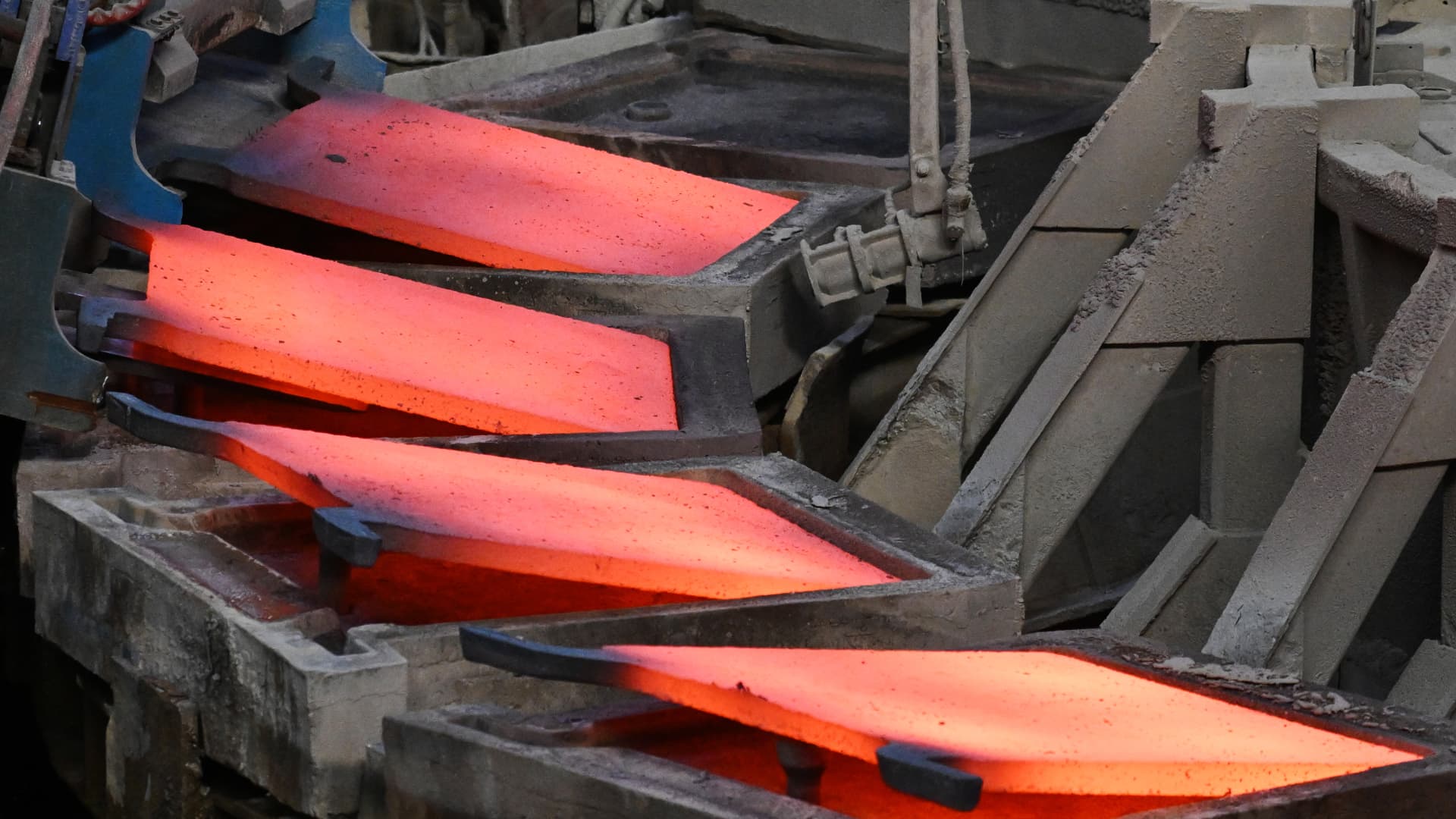
Copper anodes come out of a furnace at the Glencore Canadian Copper Refinery (CCR) in Montreal, Quebec, Canada on Tuesday, Aug. 12, 2025.
Bloomberg | Bloomberg | Getty Images
Copper is on track for its biggest annual price rise in more than a decade, driven by supply disruptions, a weakening U.S. dollar, improving expectations for Chinese economic growth — and blockbuster spending on artificial intelligence.
Analysts say the red metal’s rally could continue next year, particularly amid supply fears and a rapidly expanding global data center footprint.
Three-month copper prices on the London Metal Exchange (LME) traded up 1.5% at $12,405 per metric ton on Tuesday, paring recent gains after notching a record high of $12,960 in the previous session.
The benchmark contract, which is up around 41% this year, is on pace for its best year since 2009, when it gained over 140% as countries emerged from the global financial crisis.
In New York, copper prices have soared more than 40% since the start of 2025, also putting it on track for its biggest annual jump since 2009, when the contract rose 137.3%.
Demand for copper is widely considered a proxy for economic health. The base metal is critically important to the energy transition ecosystem and is integral to the manufacturing of electric vehicles, power grids, and wind turbines.
Indeed, electrification, grid expansion, and data-center buildouts all require large amounts of copper for wiring, power transmission, and cooling infrastructure.
Ian Roper, commodity strategist at Astris Advisory Japan KK, singled out a global boom in AI demand as the latest driver for copper prices, with “very tight” markets likely to mean the red metal could rally even further next year.
“The story for copper of the last few years has been green energy, right? Even though China has had a huge property downturn [and] that’s hit things like steel demand, iron ore prices, it’s not really affected copper so much,” Roper told CNBC’s Dan Murphy on Dec. 23.
“Copper has been a big beneficiary of the buildout of renewable energy, EVs, and now, of course, data centers is the big growth story,” he added.
AI and defense
Analysts at JPMorgan said in a research note published in late November that LME copper prices could have further room to run next year, predicting an average of $12,500 per metric ton in the second quarter.
The Wall Street bank said it expects copper to average $12,075 through 2026, citing data center demand growth as an “extremely topical” upside risk.
“All in all, we think these unique dynamics of disjointed inventory and acute supply disruptions tightening the copper market add up to a bullish set up for copper, and are enough to push prices above $12,000/mt in the first half of 2026,” Gregory Shearer, head of base and precious metals strategy at JPMorgan, said in the note.
Coils, coiled copper wires, lie on pallets in the wire plant (coiler) at Aurubis AG. After a casting and rolling process, hot copper wire is wound through the coiler into a coil weighing up to five tons and measuring around twelve kilometers in length.
Picture Alliance | Picture Alliance | Getty Images
Not everyone is as bullish on the copper price outlook, however.
Analysts at Goldman Sachs Research expect copper prices to decline from their recent record highs, even as growing demand for the metal gradually pushes up prices in the longer term.
In a research note published on Dec. 11, analysts at Goldman Sachs Research said LME copper prices were poised to remain in a range of $10,000 to $11,000 as robust global demand growth from the grid and power infrastructure sector, “backed by investment in strategic sectors such as AI and defence,” keeps prices from dipping below $10,000.
The analysts said they expect LME copper prices to average $10,710 in the first half of 2026. Looking much further ahead, they projected LME copper prices to climb to $15,000 in 2035, noting that this is above the consensus of industry analysts.
