

On Wednesday night, Venezuela’s strongman interior minister Diosdado Cabello sat at a desk adorned with a statue of ex-leader Hugo Chávez and a giant Flintstone-like club. He stared icily into the camera and demanded that the US return captured President Nicolás Maduro.
“The president has been kidnapped and is a prisoner of war in a New York cell — we demand for them to be returned to us alive,” Cabello said. “Sooner rather than later, this decision by the US government is going to come back to bite them.”
“Venezuela,” he continued, “does not surrender.”
The tone differed from that of interim president Delcy Rodríguez, who has said she would “work together” with the US. But Cabello, an army officer who first tried to take power alongside Chávez in a failed 1992 coup, is seen as the fiercest, most anti-imperialist ideologue in Venezuela.
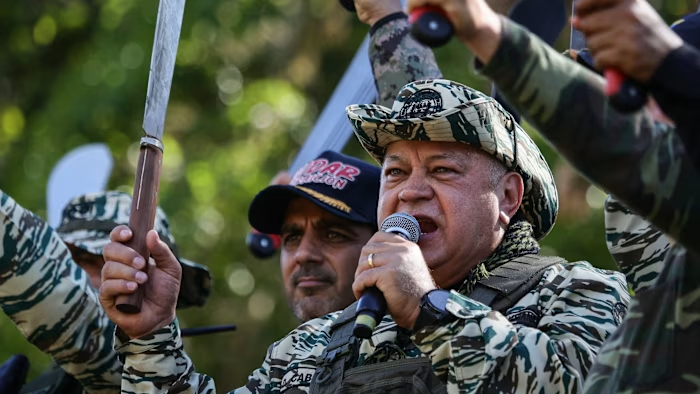
He wields enormous power, commanding the nation’s police, intelligence services, some army units and the much-feared colectivo militias who are roaming the streets on motorbikes, checking citizens’ phones for subterfuge. In recent days, Cabello has posted videos of himself commanding men on the streets of Caracas, with rifles raised and fists clenched, chanting: “Always loyal, never traitors!”
Diosdado Cabello: ‘The president has been kidnapped and is a prisoner of war in a New York cell — we demand for them to be returned to us alive’ © Con el Mazo Dando
Keeping Cabello, who heads a different faction to the more business-focused political operator Rodríguez, onside is one of the thorniest tasks facing the interim president.
“Diosdado is a very powerful figure in Venezuela, and he commands a different sector of Venezuela that Delcy doesn’t. So it’s critical to the survival of Delcy’s regime now,” said Eva Golinger, a lawyer who was close to Chávez.
His colectivos could quickly throw the country into chaos, and it is unclear how long he will tolerate her moves to make oil deals with the US, which wants him on charges — which he denies — of drug trafficking, money laundering and corruption.
“Cabello has not abandoned his anti-imperialist and confrontational rhetoric and it is unlikely that he will adopt a negotiating stance with the US,” says a senior Venezuelan military officer who knows the 62-year-old.
A Venezuelan government spokesperson denied that Cabello poses a threat to Rodríguez. “That is so false that you shouldn’t even give it oxygen, there’s perfect unity here,” the spokesperson told the FT.
He has displayed particular vitriol towards secretary of state Marco Rubio, a longtime Venezuela hawk who has spearheaded the Trump administration’s campaign against Caracas.
In 2017, the Miami Herald and CBS Miami reported that US law enforcement believed Cabello may have put out an assassination order on Rubio, then a senator. The Miami Herald reported that US authorities were unable to corroborate the threat’s validity but Rubio was given extra security.
The two men have publicly traded barbs, with Cabello dubbing the Floridian “Narco Rubio”, while Rubio has called him “the Pablo Escobar of Venezuela”.
Cabello did not respond to the Miami Herald’s requests for comment at the time, and the FT was unable to reach him for comment.
After a failed coup, Hugo Chávez, right, took power democratically and made Diosdado Cabello his vice-president © Juan Barreto/AFP/Getty Images
His disdain for the US goes back a long way.
After their failed coup, Chávez took power democratically and, for a time, made Cabello his vice-president. In 2002, the two men themselves faced a business-led putsch that had tacit US support, with Cabello briefly running the country before Chávez was reinstated.
The event is believed to have cemented the Americans in their minds as an intractable enemy. Cabello has for more than a decade railed against the gringos on his television programme Con El Mazo Dando, or “Wielding the Club”, which was once described by an opposition website as a “verbal diarrhoea of incoherencies”.
Cabello is widely believed to have coveted the presidential chair he occupied for a few hours during the failed putsch. Before Chávez’s death from cancer in 2013, he vied to replace his mentor but ultimately lost out to Maduro.
He has now seen the presidency turned over to Rodríguez. Keeping Cabello, whose first name means “god-given”, in check while placating US President Donald Trump “will be very tough for her”, a person close to the Venezuelan government said.
Carrie Filipetti, former US deputy assistant secretary for Cuba and Venezuela in the first Trump administration, said Rodríguez “and Diosdado didn’t have the greatest relationship. They were at odds with each other.”
So far, he has stayed loyal. On Wednesday, Cabello gave his “absolute, total support” to “our beloved sister Delcy Rodríguez” and praised her “bravery, strength”.
Juan Contreras, a former socialist lawmaker close to Cabello, said he was “loyal to the revolution” and was, at least for now, “closing ranks” behind Rodríguez.
But Cabello “has red lines”, said Phil Gunson, an International Crisis Group analyst in Caracas. What is “completely unacceptable” to him is “any kind of political opening”.
This week he has been seen sporting a cap emblazoned with, “To doubt is to betray!” The message has been interpreted as a warning that too many concessions to the US or the opposition could be seen as a betrayal of Chavismo, the Venezuelan socialism named after the regime’s founder.
“For now, it looks like they’re holding things together, but I can foresee it would be difficult in the long term to sustain that as Delcy co-operates more explicitly with the United States because that’s not been an acceptable type of relationship for many in Venezuela including Diosdado,” said Golinger.
A person close to the government says keeping Diosdado Cabello in check while placating Donald Trump will be very tough for Delcy Rodríguez © Miraflores press office/AFP via Getty Images
An indictment filed in New York during the first Trump administration accuses Cabello of working with Colombian guerrillas to ship cocaine to the US. The charges give Cabello little incentive to co-operate with the US, said Golinger and Andrés Izarra, a communications minister under Chávez now based in Spain.
Recommended
“This guy has a $25mn bounty on his head, and he appears on the Maduro indictment as well. What does he have left? He’s got a gun against his head,” said Izarra. “He’s the interior minister, and the head of state was taken under his nose without even causing any casualties to the invaders. So he’s been totally outmanoeuvred.”
A senior opposition leader who is in contact with US officials said Cabello had “better watch his back, all the time — even when he goes to the toilet he could be blown up by a drone”.
