

By Michael Every of Rabobank
The RBA rates hold decision generated two notable headlines from the Australian Financial Review: ‘RBA is worried it cut interest rates too far’; and ‘RBA is caught in Ray Dalio’s Doom Loop’.
The Bank of England says Chancellor Reeves’ budget will lower inflation by 50bps in 2026, backing the view that they will give the public an Xmas rate cut next week. Of course, note that the Australian government used similar state spending deliberately targeted at certain sections of the CPI index to help persuade the RBA to cut three times… only for it to then worry it went too far and get caught in a ‘doom loop’.
The RBNZ ‘s new Governor Brennan stated rates are not on a preset course, implying that they could go either up or down. Who knew? Not those who think they can’t go back up, for one.
Today, sees the Bank of Canada, the Fed, and the BCB in Brazil – which in Asia means a day of fiddling. The BCB is seen on hold at 15%. So is the BoC at 2.25% (see here for more from our cross-asset strategists Molly Schwartz and Christian Lawrence). At the Fed, a 25bps cut to 3.75% is priced in (see here for the take from our US Strategist Philip Marey) – but so is disagreement on what next. As Reuters headlines it, ‘Investors warm up for long spell of discordant Fed’. That’s putting it mildly.
The Financial Times reports Trump and Treasury Secretary Bessent will start final interviews for the new Fed Chair this week, with a trio of names still in the ring alongside favorite Kevin Hassett. He just said he wouldn’t bow to pressure over cutting rates, but he agrees with Trump there’s “plenty of room” for cuts in the coming months. So, that’s one tricky interview question in his pocket. However, ‘Where do you see yourself in five years?’ might be harder given the FT claims Hassett could be appointed for a shorter than usual term, allowing “Bessent to move to the Fed later.” Moreover, at a campaign-style rally, Trump just stated “It could be” that all four Biden-era Fed appointments, including “too late” Powell, “may have been signed by the autopen”, so are “maybe” invalid, “but we’ll take two.”
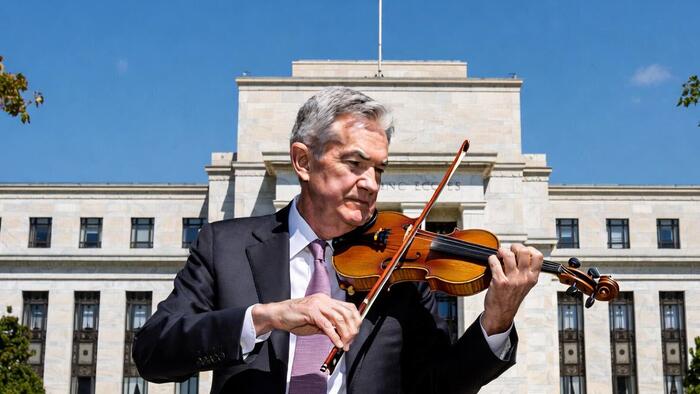
The RBA fiddled. The BOE may fiddle. The RBNZ may fiddle. The BoC are taking a rest from fiddling. The Fed is still fiddling – and the Fed is being fiddled with. Yet Nero-liberal markets don’t fret about getting burned as the music deafens them to what’s going on.
Trump just gave Ukraine’s Zelenskyy “days” to respond to his peace proposal: he reportedly wants things wrapped up by Xmas having failed to do so for Thanksgiving. Ukraine is preparing to unveil its updated peace proposal to the US, and Zelenskyy also claims to be “ready for elections.”
Trump thrashed EU leaders, stating “I think they’re weak,” and their countries are “decaying” – the accompanying article states “The Most Influential Man in Europe Thinks Europe is Full of Losers.” Trump also denied pledging any Argentina-style bailout for Hungary’s embattled leader Orbán, even if he praised central and eastern Europe vs the west.
European leaders have, typically, responded weakly for fear of losing US support. Indeed, the US denied a German request to integrate American artillery rockets into its armed forces, which could make it more difficult for the German military to cooperate with the US and other NATO allies. For an overview of the geostrategic dilemma Europe is in, see ‘A Grand Strategy for Europe in the New Cold War’. For now, there is Romanesque rhetoric but Nero-style fiddling going on.
Against this backdrop, the FT also argues ‘Why the world should worry about stablecoins’, concluding that “Dollar-based digital currencies offer benefits for the US, but Britain and the EU are better off resisting them.” Really? How? Is that also fiddling as things get hotter?
The Politico interview also touched on the “Trump Corollary” to the US Monroe Doctrine, where he refused to rule out boots on the ground in Venezuela, or moves vs Colombia or Mexico. That’s as CNN reports the Trump admin is quietly building plans for what would happen if Maduro were ousted – as if this is in the passive rather than active sense.
In geoeconomics, Trump’s controversial decision to allow Nvidia to sell H200 AI chips to China is seen by Bloomberg as spurred by Huawei’s AI Gains; the Wall Street Journal states those chips will have to undergo an unusual US security review before being exported to China; and the FT claims China will (again) limit access to them anyway, as it aims for its domestic production. That’s what a push for strategic autonomy looks like – not lots of grand speeches about strategic autonomy.
The EU has announced stricter food import controls to reassure EU farmers and address French conditions for supporting the EU-Mercosur deal: will it therefore replace tariffs with non-tariff barriers? It’s also considering further tariffs on China. Meanwhile, EU Industry Commissioner Séjourné admitted: “Last month, I was supposed to go to Brazil to discuss a rare earth mine. Three days beforehand we were told that the Americans had come, put money on the table, and bought all production until 2030.” By contrast, China claims to have pulled off a critical mineral production tech revolution in 10 months, leaving it further ahead. And in the UK, a token vote in favor of rejoining the customs union with the EU passed Parliament.
The FT also reports July’s US-Indonesia trade deal is at risk of collapse, with D.C. believing that Jakarta is reneging on terms of agreement. Watch this space to see how the US reacts when a country doesn’t stick to a deal.
In political economy, France’s National Assembly narrowly approved a contentious 2026 social security budget. At the same time, the leading French (presumed) presidential candidate Bardella claims “Together, Nigel Farage and I will restore Europe’s borders” via a ‘patriotic alliance’ between the National Rally and Reform UK to reshape Europe. Not coincidentally, the UK’s PM Starmer, a former Human Rights lawyer, urged Europe’s leaders to curb (or can we say, ‘fiddle with’?) the European Court of Human Rights in order to halt the rise of the far right.
In key data, China’s CPI inflation was unchanged y-o-y at 0.7%, but PPI deflation deepened further to -2.2% from -2.1%. Of course, that shows some economic problems, even if the West would kill for 0.7% CPI. So do reports that major Chinese EV firms are losing money on every vehicle that they sell. But when the quid pro quo is global domination of supply chains now close the point of no return for other countries’ established industries such that no future recovery is then possible, it’s arguably still a tune worth squeezing out of all the instruments of economic statecraft… even if Neo-liberalism burns.
Against that kind of backdrop, the Fed meeting today is just one little note.
Loading recommendations…
