

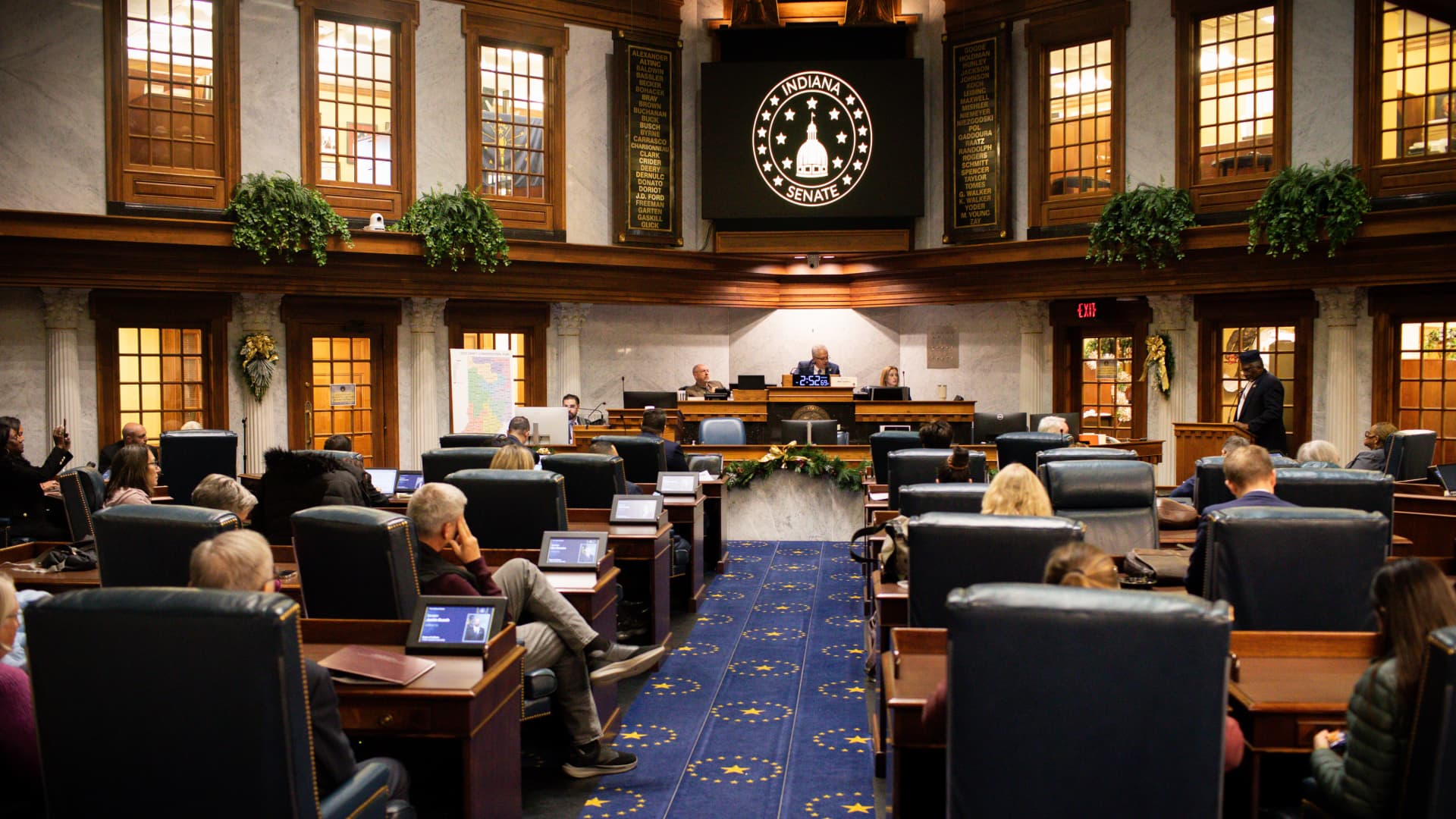
The Indiana Senate on Thursday overwhelmingly voted down a bill to redraw the state’s congressional districts to favor Republicans, in a major blow to President Donald Trump.
The bill failed in a 19-31 vote, with most Republicans joining Democrats to oppose the measure that Trump had aggressively lobbied for. The GOP has a 40-vote majority in the 50-member Senate.
Republicans were expected to gain two additional seats in the U.S. House of Representatives if the redistricting bill had been approved by the Senate. The state’s House of Representatives voted in favor of the bill last Friday.
Trump had threatened the state’s Republican lawmakers with primary challenges if they did not support the bill.
His failure to convince them is a rare loss in his effort to redraw congressional maps in red states.
Trump had successfully pushed partisan gerrymanders in Texas, North Carolina, Missouri and Utah, as the GOP tries to retain it razor-thin majority in the U.S. House in the 2026 midterm elections.
Republicans hold 220 seats in that chamber, with Democrats holding 213 seats.
Redistrictings are normally done after a new U.S. Census. The last census was done in 2020.
The president and his top aides had launched a pressure campaign to pass the new Indiana district map, which included visits from Vice President JD Vance.
In a post on X on Thursday morning, the right-wing group Heritage Action said, “President Trump has made it clear to Indiana leaders: if the Indiana Senate fails to pass the map, all federal funding will be stripped from the state.”
“Roads will not be paved. Guard bases will close. Major projects will stop,” the group said in the tweet. “These are the stakes and every NO vote will be to blame.”
Trump took to social media on Wednesday night to blast Indiana House Speaker Rod Bray for opposing redistricting.
“He is putting every ounce of his limited strength into asking his soon-to-be very vulnerable friends to vote with him,” Trump wrote on Truth Social.
“By doing so, he is putting the Majority in the House of Representatives, Washington, D.C., at risk and, at the same time, putting anybody in Indiana who votes against this Redistricting, likewise, at risk,” Trump wrote.
Sen. Greg Goode, a Republican and a key swing vote who would not disclose his position on the bill despite immense pressure from the White House, voted against the measure.
“We have to redirect our focus to what really matters, I believe, to Hoosiers,” Goode said in a speech on the floor before the vote.
“The forces that define this vitriolic political affairs in places outside of Indiana have been gradually and now very blatantly infiltrated the political affairs in Indiana,” Goode said.
He cited instances of misinformation, pressure campaigns and threats of primaries and violence.
Goode was swatted earlier this year after Trump accused him of “not wanting to resdistrict” in a Truth Social post.
Supporters of the new map argued that it was critical to safeguarding the Republican House majority.
States across the country have pushed redistricting for partisan advantage after the Supreme Court barred maps drawn for partisan advantage to be challenged.
“If we fail to secure a governing majority in the House that supports this agenda, we risk handing the keys back to the very people who destabilized the world in the first place,” said Sen. Chris Garten, a Republican who supported the gerrymander.
Trump’s brazen push for gerrymanders that benefit Republicans has kicked off a nationwide war between states controlled by Republicans and Democrats.
The maps that create each state’s congressional districts are typically only drawn once every 10 years by state legislators after a census.
Republican-controlled Texas adopted a map in August to net the Republicans five additional seats. Democrat-controlled California then responded, adopting a new map in a November referendum that would net Democrats five additional seats.
Florida, Maryland and Virginia have pending redistricting measures.
