

Stay informed with free updates
Simply sign up to the Electric vehicles myFT Digest — delivered directly to your inbox.
Brussels is to propose special privileges for a “Made in Europe” small car class, which will benefit from preferential parking, lighter rules and more generous subsidy arrangements to keep out Chinese competition.
The new all-electric category will be presented as part of a package of measures aimed at easing pressure on Europe’s car industry, which is under heavy pressure from the influx of affordable Chinese EVs, US tariffs and sluggish demand.
It will grant eligible cars — which are built in Europe and under a certain weight — access to reserved parking spaces and charging infrastructure as well as a 10-year exemption to incoming regulations such as safety rules and the EU’s Euro 7 emissions standards that are due to come into force in 2026. By doing so the commission hopes to keep the price lower since frequent changes in standards contribute to rising costs for carmakers.
The weight is still subject to negotiations but will probably be no more than 1.5 tonnes, according to people with knowledge of the plans. In the commission, the car category has been nicknamed the “Sejournette” after the diminutive French industry commissioner Stéphane Séjourné overseeing the proposal.
Recommended
Small cars are one area where European manufacturers still have an edge over their Chinese counterparts, which have focused on larger car segments for their EVs and plug-in hybrids.
Carmakers such as Stellantis and Renault have argued that there should be a new category for even smaller cars that are more affordable, with lighter regulations so that compact electric cars can be built profitably.
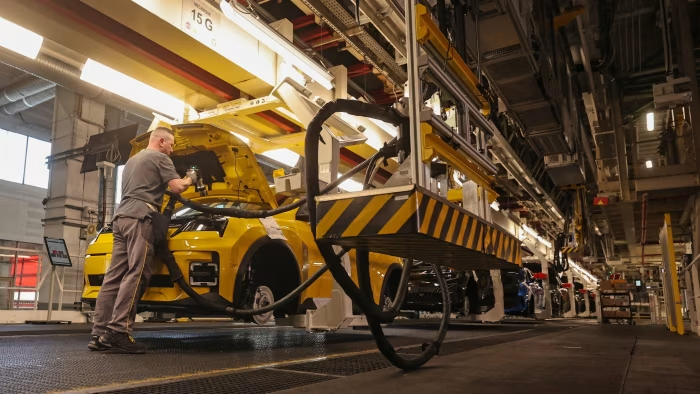
But at the same time, the manufacturers have lobbied for the definition of the new category to allow similar support for existing smaller sized models such as the new Twingo for Renault, Citroën ë-C3 for Stellantis or the Golf for Volkswagen.
Proposals for the small car class, loosely inspired by Japan’s Kei car, will accompany a heavily lobbied review of the EU’s 2035 combustion engine ban. First proposed in 2021, the law will outlaw sales of new combustion engines in the bloc from 2035 and was seen as a totemic part of the EU’s ambitious climate laws.
But it has come under heavy pressure from the car industry and rightwing politicians who argue that it is too stringent in forcing the sector to rapidly switch to electric vehicles. Heated discussions are ongoing in the commission ahead of the announcement of the review on December 16.
Among several options under negotiation is whether to allow plug-in hybrids and range extenders, which have a fuel unit that kicks in to extend the battery power, for potentially another five years, according to officials involved.
Another option being discussed was to require an emissions reduction of 90 per cent by 2035, leaving a small gap for combustion engine sales to continue, two officials said. “It’s not a done deal,” one said.
The commission was also weighing allowances for biofuels and “carbon neutral” e-fuels, made with carbon dioxide and renewable power, officials said, while cautioning that no final decision had been made.
Some officials have argued against the inclusion of plug-in hybrids, warning that the Chinese are already further ahead in this technology than their European counterparts.
The commission declined to comment on the upcoming proposals.
