

Unlock the Editor’s Digest for free
Roula Khalaf, Editor of the FT, selects her favourite stories in this weekly newsletter.
When Dario Amodei left OpenAI in 2020, chief executive Sam Altman wished him well, anticipating that the project Amodei, his sister Daniela and other departees were planning would probably focus “less on product development and more on research”.
“We look forward to a collaborative relationship with them for years to come,” Altman wrote in a blog.
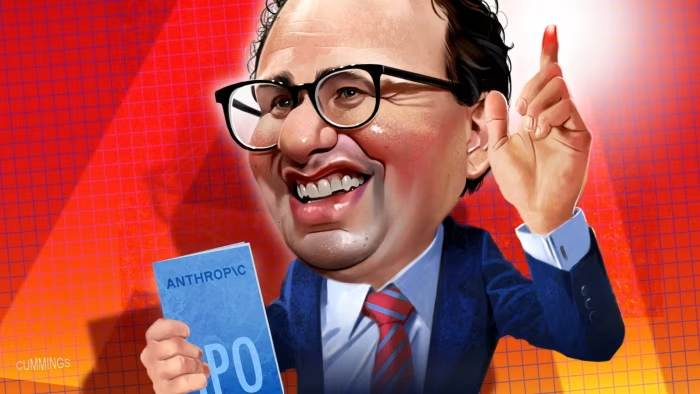
Instead, Amodei has become the sharpest thorn in Altman’s side. Anthropic, the artificial intelligence start-up he co-founded, will end the year with around $10bn in annualised revenue and is growing fast. It is in talks to raise funds at a valuation of over $300bn and is now laying the groundwork for a blockbuster initial public offering.
Amodei’s decision to leave OpenAI, and the work he has done since, is underpinned by two convictions, according to multiple people who know him. One, that he is more capable of building all-powerful AI than his former boss; and two, that the world would be safer if he does.
“He has a strong view on where he’s going. Dario understands you have to have a good business to pursue the mission,” says Matt Murphy, a partner at Silicon Valley investment firm Menlo Ventures, which led a funding round for Anthropic last year.
Investors in the company describe Amodei as someone whose evangelism for “safe AI” is wedded to keen commercial instincts. “Founders are either technical, good at product or sales. Dario is one of the few CEOs I’ve met in my life who does all three,” says Divesh Makan, founder of Iconiq Capital, which led Anthropic’s last funding round.
Amodei was born and raised in San Francisco by a mother who renovated libraries and a leathersmith father. The 42-year-old studied physics at Stanford and gained a PhD in biophysics before embarking on a career as an AI researcher. He joined Chinese internet giant Baidu in 2014 before a brief stint at Google Brain.
In 2016, he was among the earliest employees of OpenAI, founded by Altman, Elon Musk and nine others as a place to pursue AI research without the commercial pressures of a corporate tech parent. Amodei was instrumental in developing the large language models behind chatbot ChatGPT.
But after five years, Amodei left following disagreements with Altman over OpenAI’s direction and with concerns about AI’s potential for harm if appropriate guardrails were not put in place. In 2021, he co-founded Anthropic with his sister.
“What he thought was important was developing a company where these things could be deployed safely and transparently in the world,” says Ravi Mhatre, co-founder of VC firm Lightspeed Venture Partners, which invested over $1bn in Anthropic this year. “He felt he needed a clean slate.”
But this focus on safe AI development has earned him criticism in both Washington and Silicon Valley. David Sacks, Trump’s AI tsar, claimed in October that Anthropic was running a “sophisticated regulatory capture strategy based on fear-mongering”. Investor Marc Andreessen argues that extra AI regulation will impede US start-ups.
Critics cast Amodei as a “doomer” influenced by the effective altruism movement, which believes AI poses an existential threat to humanity. The Amodei siblings deny they are effective altruists or doomers. But the company’s early funding came from investors with ties to the movement, including Facebook co-founder Dustin Moskovitz and FTX co-founder Sam Bankman-Fried, who was later convicted of fraud.
There are also concerns from some in the AI sector that Anthropic’s rapid growth is now testing Amodei’s ability to balance the pursuit of “safe” AI with the needs of his shareholders.
“At the early stage of Anthropic, they very much said ‘we don’t want to fuel the AI race, we want to be just behind the frontier and do AI safety research.’ That’s clearly not the case now. Some people in the AI safety community are pretty unhappy with that,” said a person who works in AI safety.
Anthropic has received the backing of Google, Amazon, Microsoft and Nvidia, and earlier this year changed its stance on accepting funding from the Middle East. “Unfortunately, I think ‘no bad person should ever benefit from our success’ is a pretty difficult principle to run a business on,” Amodei told staff.
To articulate his strategic shifts and view of the world, Amodei likes to write lengthy public essays (the last one exceeded 13,000 words). During a five-hour podcast interview last year, he also took a brief diversion from discussing programming languages to hold forth on the meaning of life.
His earnest messages have been well received by the public. And his ebullience about his company’s mission is popular among employees, helping Anthropic retain top researchers in a competitive market. “He has cult leader status,” says the person in AI safety.
The company is now in the earliest stages of preparing for a public listing. There is strong demand from investors to own a slice of what Amodei has built.
“I can’t imagine the company without Dario. He is the person who spearheads the key technical challenges and motivates everyone,” says Lightspeed’s Mhatre. “What’s Apple without Steve Jobs or Microsoft without Bill Gates?”
george.hammond@ft.com
Additional reporting by Cristina Criddle and Tabby Kinder
