

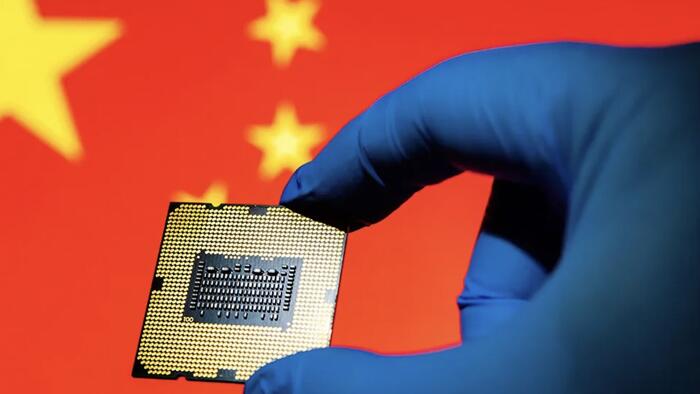
Chinese scientists have built a prototype extreme ultraviolet (EUV) lithography machine in a high-security Shenzhen lab, a milestone Washington has long sought to block, according to a new report from Reuters. The machine, completed in early 2025 and now in testing, occupies nearly an entire factory floor and was developed by former ASML engineers who reverse-engineered the Dutch firm’s technology, two sources said.
EUV machines are central to advanced chipmaking, using extreme ultraviolet light to etch ultra-fine circuits. China’s prototype can generate EUV light but has not yet produced working chips. In April, ASML CEO Christophe Fouquet said China would need “many, many years” to develop the technology, but the prototype suggests Beijing may be closer to semiconductor independence than expected.
Speculation on Twitter this morning suggests China may have simply “stole the source”…
My sources on the ground says:
They stole the source… literally. Apparently they tried using a bunch of other versions for past decade could never get enough power out of it.
It’s hard to actually just rip one out of a functioning machine without being caught. So they think… https://t.co/1PR2DKGw49
— bubble boi (@bubbleboi) December 18, 2025
Reuters comments that China still faces major hurdles, especially in precision optics. Parts from older ASML machines sourced on secondary markets enabled the prototype, with an official target of producing chips by 2028, though insiders say 2030 is more realistic. Chinese authorities did not comment.
Reuters notes that the secret project caps a six-year push for semiconductor self-sufficiency under President Xi Jinping and is described by sources as China’s version of the Manhattan Project. Huawei coordinates thousands of engineers across companies and research institutes. “The aim is for China to eventually be able to make advanced chips on machines that are entirely China-made,” one source said. “China wants the United States 100% kicked out of its supply chains.”
Until now, only ASML has mastered EUV technology. Its machines cost about $250 million, took decades to commercialize, and have never been sold to China due to U.S.-led export controls. “It makes sense that companies would want to replicate our technology, but doing so is no small feat,” ASML said.
Those controls slowed China’s progress but did not stop aggressive recruitment of overseas talent, including retired, Chinese-born former ASML engineers working under aliases in secure facilities. Dutch intelligence has warned China uses extensive espionage and recruitment to obtain Western technology.
China’s prototype is much larger and cruder than ASML’s but operational. Progress has been limited by difficulty sourcing advanced optics from suppliers like Zeiss. Research institutes such as the Chinese Academy of Sciences’ CIOMP helped integrate EUV light into the system in early 2025.
Analyst Jeff Koch said China will have made “meaningful progress” if the light source proves powerful and reliable. “No doubt this is technically feasible, it’s just a question of timeline,” he said. “China has the advantage that commercial EUV now exists, so they aren’t starting from zero.”
Obviously would be very racist to suggest that when EUV light sources are one of our last 3 technical advantages over China, hiring “Lin Nan” as “head of light sources” might not be the greatest idea https://t.co/qOcAQQggHD pic.twitter.com/FolTvVUteU
— Curtis Yarvin (@curtis_yarvin) December 18, 2025
China has sourced components from older ASML systems, Japanese suppliers, and secondhand markets, sometimes using intermediaries. Around 100 young engineers are reverse-engineering parts under constant surveillance, with bonuses for success.
Huawei is deeply involved across the chip supply chain. Some staff sleep on-site with restricted phone access, and teams are isolated to protect secrecy. “The teams are kept isolated from each other to protect the confidentiality of the project,” one source said. “They don’t know what the other teams work on.”
Loading recommendations…
