

Stay informed with free updates
Simply sign up to the War in Ukraine myFT Digest — delivered directly to your inbox.
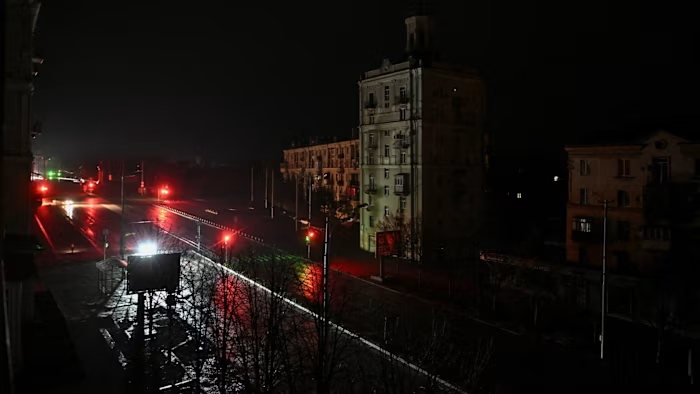
Two entire Ukrainian regions were plunged into darkness in freezing temperatures late on Wednesday, leaving more than 1mn households without power, after Russian drone strikes triggered one of the biggest energy blackouts of the war.
Strikes in the Zaporizhzhia and Dnipropetrovsk regions in south-eastern Ukraine instantly triggered cuts to water and heating supply. Temperatures have dropped across the country and could reach minus 20 this week.
“This is the first total blackout for the entire region in recent years,” the head of the Zaporizhzhia military administration Ivan Fedorov wrote on Telegram on Thursday morning.
Valerii Osadchuk, a spokesperson for the state grid operator Ukrenergo, said the attack on the energy infrastructure in the Dnipropetrovsk region was “among the largest since the onset of the full-scale invasion”.
“The disconnection of equipment happened unexpectedly and without control,” he added.
Deputy prime minister Oleksiy Kuleba said on Thursday that power had been largely restored in the Zaporizhzhia region, with work ongoing to reconnect more than 1mn households in the Dnipropetrovsk region. The outage ground Dnipro’s trolleybuses to a halt on Thursday morning and forced Ukrainian railways to deploy diesel locomotives to keep trains running.
The aftermath of a drone strike in Dnipro © Mykhailo Moskalenko/Reuters
Moscow has since autumn sought to methodically destroy Ukraine’s energy infrastructure. Regular attacks have used hundreds of drones and dozens of missiles to overwhelm struggling Ukrainian air defences and hit power plants, substations and transmission nodes across the country.
The strikes have forced Ukrainians to shape their daily lives around scheduled power outages designed to lighten the load on a struggling electricity grid. Attacks are also often followed by emergency power cuts as repair crews rush to reconnect power plants and substations to the grid.
Region-wide blackouts have remained exceptional, and the cut-off highlighted the toll of months of unrelenting bombardment.
Ukrenergo had warned shortly before midnight on Wednesday that the drone attack had left “most consumers” in the two regions without electricity.
Andrii Kiselov repairs damage from Russian shelling at his house in Tavriiske, Zaporizhzhia © Andriy Varyonov/Suspilne Ukraine/JSC/Global Images Ukraine/Getty Images
“There is absolutely no military rationale in such strikes on the energy sector and infrastructure that leave people without electricity and heating in wintertime,” Ukrainian President Volodymyr Zelenskyy said on X.
“This is an emergency situation on a national level,” Dnipro mayor Boris Filatov declared on Thursday. He said in a video address that the attack had cut power to the boilers supplying heat to the city’s buildings, and that there remained problems with water supply on the city’s right bank.
Even when infrastructure is repaired, damage can have a “cumulative effect”, said Andrian Prokip, an energy expert with the Ukrainian Institute for the Future think-tank.
“Some substations may be destroyed, some may be damaged or being repaired and operating at decreased capacity,” he said, reaching a threshold where “hitting just one substation may be enough to trigger a blackout.”
Residents charging devices at a ‘resilience centre’ during a four-day blackout in Vyshhorod, Kyiv in December © Tetiana Dzhafarova/AFP
In Zaporizhzhia, a major industrial centre sitting on the banks of the Dnipro river just 30 kilometres from the frontline, the attack also shut off the sirens warning of a possible imminent drone or missile strike.
Russian forces control the majority of the Zaporizhzhia region. The regional capital, which Ukraine controls, as well as the neighbouring region of Dnipropetrovsk, are home to nearly 1mn internally displaced people who fled the Russian advance.
Recommended
“In the event of an air raid, the Zaporizhzhia region patrol police will inform citizens via loudspeakers,” the head of the region wrote overnight. Water and heating were restored overnight, authorities said.
Even before temperatures dropped in early January, repeated Russian attacks had increased the frequency and length of power cuts. In late December, the head of the Odesa region Oleh Kiper made a plea for “patience” after exasperated locals blocked a road to protest against lengthy power cuts.
A major Russian strike in the Kyiv region on December 27 left locals without electricity for nearly four days in Vyshhorod, a residential suburb of the Ukrainian capital.
The attacks have hit Ukraine’s frontline and border regions particularly hard, but their effect is being felt across the country. In western Ukraine, the mayor of Lviv Andriy Sadovyi complained on Wednesday that two medical institutions in the city had been affected by scheduled power outages, pushing prime minister Yulia Svyrydenko to insist on Telegram that the government had “explicitly banned the disconnection of healthcare facilities during scheduled power outages”.
