

Unlock the Editor’s Digest for free
Roula Khalaf, Editor of the FT, selects her favourite stories in this weekly newsletter.
The Bank of Japan’s governor has said the country’s economy has weathered the shock of US tariffs, supporting market expectations of an interest rate rise at the central bank’s crucial meeting next week.
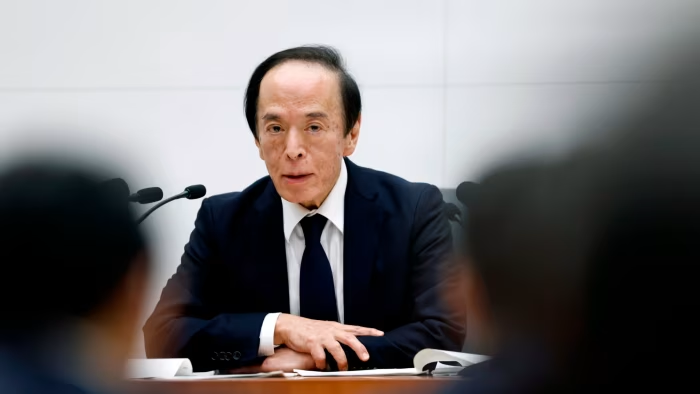
In what is likely to be his last public appearance before the central bank’s December monetary policy meeting, Kazuo Ueda told the Financial Times in an interview that underlying inflation continued to rise towards his 2 per cent target.
His remarks broadcast at the FT’s Global Boardroom on Tuesday come as the BoJ is expected to consider raising rates from the current level of 0.5 to 0.75 per cent, their highest level in 30 years.
The governor has previously said that the BoJ would consider the “pros and cons” of a rate rise at its December meeting — which market participants have interpreted as signalling a likely move.
Trading in interest rate swaps suggests that investors put a 91 per cent likelihood on the BoJ raising interest rates at the conclusion of its two-day meeting on December 19.
The central bank governor’s comments did nothing to dispel those expectations. Though Ueda did not repeat the “pros and cons” language, he said that “the real side of the economy is doing OK” and underlying inflation is “continuing to rise towards our 2 per cent target”.
Fears that US tariffs would hammer the Japanese economy had made the BoJ cautious on rate rises earlier this year, but Ueda said the impact of the levies had been less than expected.
“So far, US corporates have swallowed the burden of tariffs without fully passing [them] through to consumer prices,” he said.
On the Japanese side, Ueda said car exporters have cut prices to absorb the tariffs, which had “stabilised the volume of auto exports” and avoided unemployment in Japan.
Japan’s finance minister Satsuki Katayama told reporters in Tokyo on Tuesday morning that she was “very closely” monitoring market trends, as yields on the benchmark 10-year government bond edged closer to 2 per cent.
Japanese government bond yields have risen steadily in recent months and have climbed more sharply since mid-November, when Prime Minister Sanae Takaichi unveiled plans to stimulate the economy through higher government spending. Those plans will include $75bn of new bond issuance.
Recommended
The yield on the 10-year JGB, which moves inversely to price, reached its highest level since before the 2008 global financial crisis on Monday, while yields on 30- and 40-year notes have hit all-time highs this year.
Ueda said it was the government’s job to deliver on medium-to-long-term fiscal sustainability.
The yen has firmed somewhat against the US dollar since last week. Investors are betting that a rate move by the BoJ is aimed, in part, at preventing any further depreciation of the yen. The Japanese currency has dropped more than 10 per cent against the dollar since April.
