

Traders Are Fairly Certain the Fed Will Cut Rates
24 minutes ago
Traders are pricing in a 89% chance that the Fed will cut interest rates in Wednesday’s decision.
That’s according to the CME Group’s FedWatch tool, which forecasts rate movements based on fed funds futures trading data. Traders are more sure about the cut than they were a month ago, when they were pricing in only a 62% chance of a cut.
They’re less sure about future cuts. Currently, traders are betting that the most likely scenario is the next cut won’t come until next June, followed by only one more in September.
Economic Projections May Not Shed As Much Light As Usual
55 minutes ago
Fed officials will also make their leanings clear through their forecasts, where their individual views on where rates should be by year-end are represented as anonymous dots.
Their most recent projections, released in September, showed the median Fed official was penciling in one more cut in 2026 and another in 2027.
Barclays Economist Marc Giannoni doesn’t expect a major change in the dot plot, which he wrote will “again reveal considerable disagreement” at the FOMC on whether lower rates are necessary.
Bank of America economist Aditya Bhave expects the 2027 cut to get pulled forward to next year, with a median dot suggesting two cuts in 2026 and “an extended hold at 3.0%-3.25% thereafter.”
What Happened at the Last Fed Meeting?
1 hr 45 min ago
In October’s meeting, the Fed’s policy committee voted to cut the fed funds rate by a quarter point to a range of 3.75% to 4%.
The most recent decision was not unanimous, with two Fed governors dissenting from the other 10 voters in opposite directions. Stephen Miran, President Donald Trump’s appointee to the Fed’s governing board, voted to lower rates more steeply, by half a percentage point, while Jeffrey Schmid, president of the Kansas City Fed, preferred to hold the rate steady.
The Fed also announced that it was halting its quantitative tightening program, which had been removing money from the financial system.
Fed officials made the interest rate move despite lacking crucial information about inflation and employment.
-Diccon Hyatt
The Divisions Could Trigger Dissents
2 hr 28 min ago
Disagreements may show up in Wednesday’s vote count, with analysts expecting dissents in both directions.
Fed Governor Stephen Miran voted for a larger 50 basis point cut at October’s meeting—and is expected to do so again. Miran, who is President Donald Trump’s latest Fed appointee, says rates are overly high and tamping down growth.
At least a couple of more FOMC officials may also vote against Wednesday’s action, though from the opposite direction. Kansas City Fed President Jeffrey Schmid dissented in October and favored keeping rates unchanged. A few other Fed officials seem to be leaning in that direction, but it’s unclear how many would vote against a rate cut.
Barclays Economist Marc Giannoni expects at least three dissents, which would be the most since September 2019. If a fourth FOMC official votes against the decision, it would be the largest dissent tally since October 1992, Giannoni wrote.
It’s also possible that the Fed, which tends to operate on consensus, ends up in closer alignment with the FOMC’s public vote even if the debate is heavy inside the room.
“The committee will try to present a united front amid the disagreements,” Oxford Economics’ Pearce wrote.
-Polo Rocha
What Is the Fed Expected to Do Today?
3 hr 3 min ago
The Federal Reserve is widely expected to cut its key interest rate Wednesday to give a boost to the faltering job market, despite concerns that lower borrowing costs could stoke inflation.
The 12 members of the central bank’s policy committee have been sharply divided over whether to cut rates to encourage spending and stabilize the faltering job market, or to keep them higher for longer to fight inflation that is still well above the Fed’s target of a 2% annual rate.
Recent data on the labor market has shown a hiring slowdown, giving the upper hand to those advocating for rate cuts. The Fed has a dual mandate from Congress to maintain price stability while preventing unemployment from rising excessively.
To read more about the pull between jobs and inflation, click here.
-Diccon Hyatt
What Happens At a Fed Meeting?
3 hr 46 min ago
The Federal Open Market Committee is the body that sets the fed funds rate for the Federal Reserve System, the United States’ central bank.
It holds eight regularly scheduled meetings each year, which are not open to the public. The Fed’s use of interest rates to influence the economy is called monetary policy.
The FOMC consists of 12 voting members: the seven board governors, the Federal Reserve Bank of New York president, and four other regional bank presidents who serve rotating one-year terms.
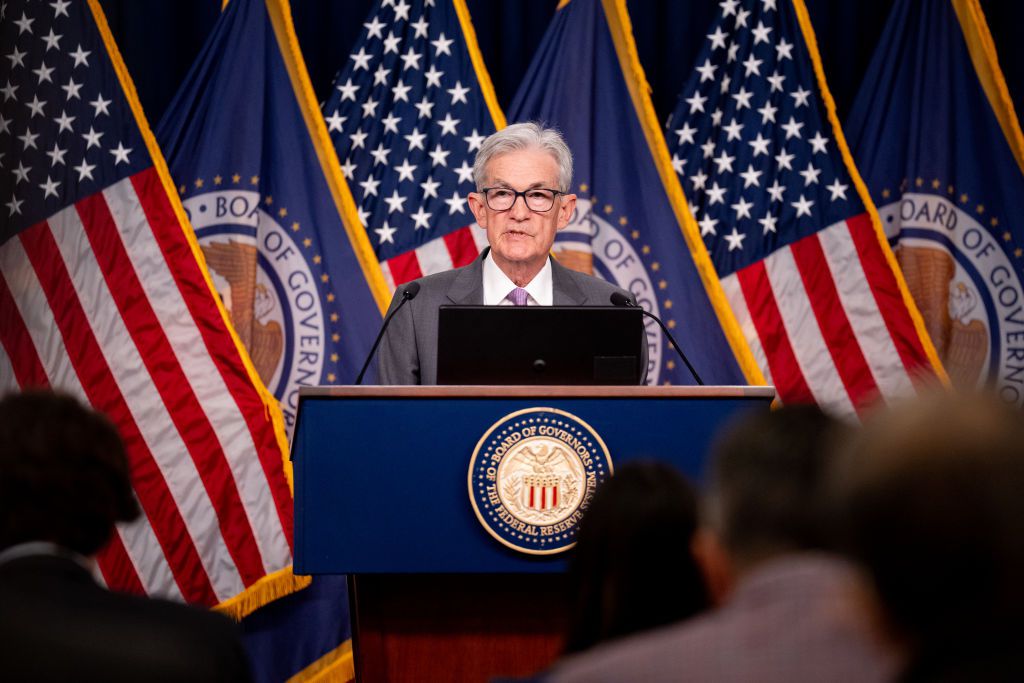
At each FOMC meeting, the committee members discuss economic and financial conditions and decide whether and how much to change the fed funds rate. The FOMC issues a public statement about its decision at 2 p.m. on Wednesday when the meeting concludes. The Fed chair, currently Jerome Powell, typically hosts a press conference afterward to explain the decision.
To read more about what goes on behind FOMC meetings’ closed doors, click here.
-Diccon Hyatt
