

BBC
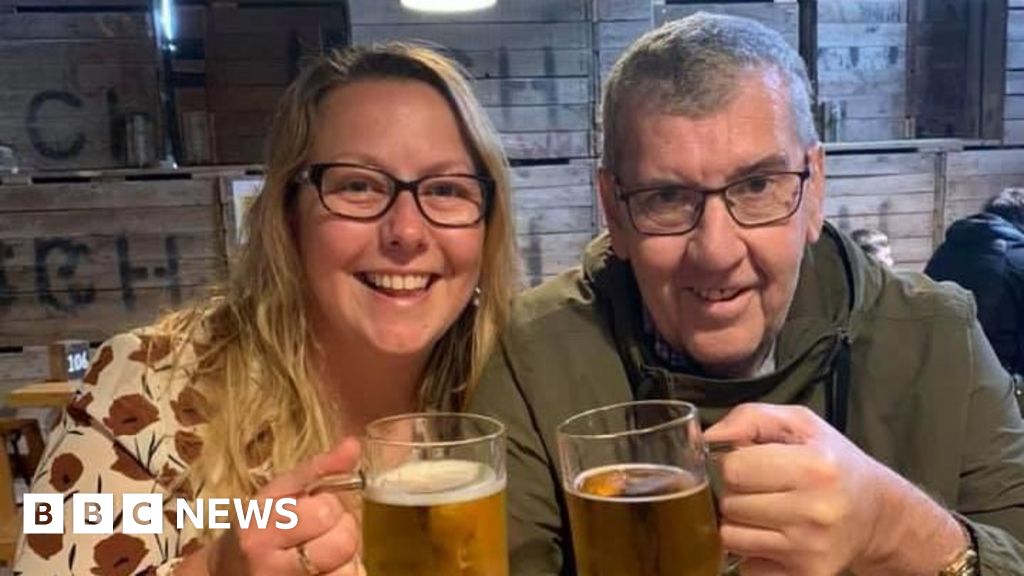
Maureen Dynes’ husband Tony contracted two infections during his cancer treatment at the QEUH and died in 2021
Families of patients who suffered or died after they caught infections in Scotland’s largest hospital say they were “lied to”, “demeaned” and “smeared”.
The Queen Elizabeth University Hospital (QEUH) complex opened in Glasgow in 2015, but NHS Greater Glasgow and Clyde (NHSGGC) has since said that it opened too early and faced design flaws.
It admitted infections of some cancer patients were probably linked to issues with the hospital water system.
NHSGGC offered a “sincere and unreserved” apology to the patients and families affected, and said the hospital was now safe.
In closing submissions to the Scottish Hospitals Inquiry, NHSGGC said it was likely there was a “causal connection” between infections suffered by patients and “the hospital environment, in particular the water system”.
But it stressed that there was no definite link between the hospital environment and specific individual cases of infection.
Thompsons Solicitors represents the majority of the affected families and issued a statement from them.
They said that major flaws in the water and ventilation system at the hospital “killed and poisoned our loved ones”.
The statement goes on: “We were all lied to by GGCH [Greater Glasgow and Clyde Health Board]. We were all disbelieved by GGCH.
“We were all demeaned and smeared by GGCH. We have all had our families devastated and our lives traumatised by GGCH.”
It adds: “We cannot overstate the level of deceit and conniving cowardice displayed by GGCH during the whole unfolding of this awful scandal.
“As men, women and children fell ill and died, we were all told there is nothing to see here.”
Kimberly Darroch
Milly Main died after contracting an infection at the Royal Hospital for Children, which is part of the QEUH campus
The families called for “those past and present who have presided over this despicable incompetence” to be held to account and stripped of their pensions accrued during their time at the hospital.
They have also urged political leaders to act.
“The QEUH is not a safe hospital,” they said. “The current leadership of GGCH cannot be trusted to make it safe.”
The families thanked the “many brave and decent clinicians and staff” who tried to speak out but were “silenced” by the health board.
“We will never forget that they stood with us,” they added.
In response, the health board said: “Comprehensive steps have been taken to address past physical defects in the building and a significant programme of maintenance and monitoring is in place.
“Our staff are committed to providing safe, high-quality care.”
The Scottish Hospitals Inquiry, which has been looking at the planning, design, construction and maintenance of hospitals, is hearing final submissions before publishing a report later this year.
It was prompted by concern about patient safety following a series of infections and several deaths, including that of 10-year-old Milly Main.
The inquiry will hear closing statements from the families later on Thursday.
On Wednesday, the chair of the inquiry, Lord Brodie, asked why the health board had changed its position after alleging unprofessionalism and malevolence on the part of the medics who raised concerns.
The health board’s lawyer, Peter Gray, acknowledged that several criticisms made about the whistleblowers were neither helpful nor fair.
He said the people running the hospital should not be criticised as the failure to listen to the whistleblowers was an organisational failure, adding that changes have since been made.
Earlier this week, Scottish Labour leader Anas Sarwar called for First Minister John Swinney and former First Minister Nicola Sturgeon to be investigated over failures at the hospital.
NHSGGC has already been named by prosecutors in a corporate homicide probe which is looking into the deaths of Milly Main, two other children and a 73-year-old woman at the hospital campus.
The death of Molly Cuddihy last year is also being investigated by the Crown Office.
The Queen Elizabeth University Hospital replaced three older hospitals when it opened in 2015
The Glasgow hospital campus, which includes the QEUH and the Royal Hospital for Children, opened to patients in 2015.
It had been built at a cost of £840m and replaced three older hospitals in the city.
But within a few years, a number of patient deaths and infections led to concerns about the water and ventilation systems.
Former Health Secretary Jeane Freeman ordered a public inquiry in 2019, with its remit also including problems at Edinburgh’s Royal Hospital for Children and Young People (RHCYP).
The opening of the Edinburgh site had been delayed at the last minute over safety concerns about its ventilation system.
The public inquiry’s interim report on the RHCYP has already been issued, saying a spreadsheet error by the health board led to the system being wrongly specified.
