

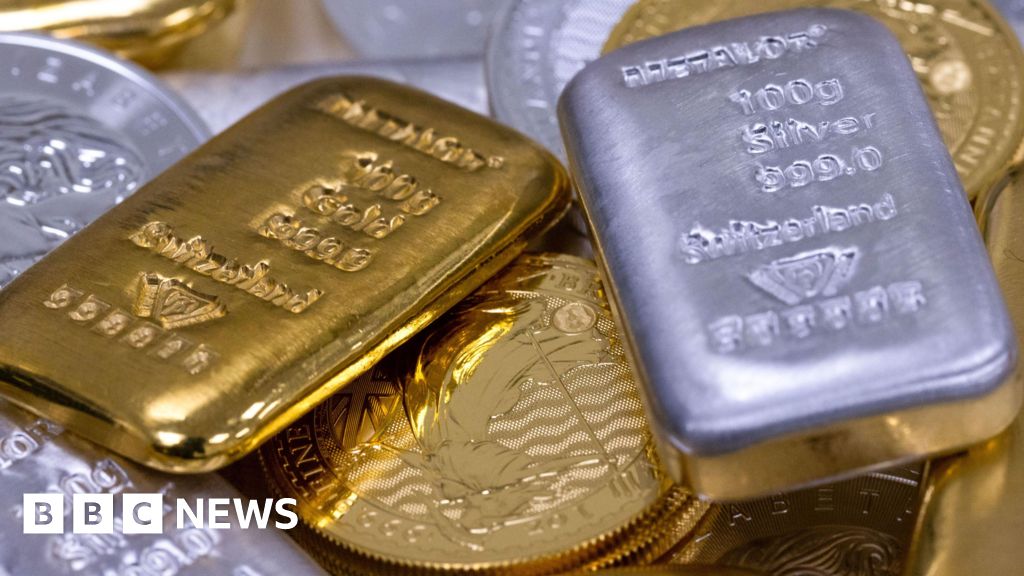
Gold and silver have seen a rollercoaster end to a year in which their prices are on track to record their biggest annual gains since 1979.
The price of gold soared by more than 60% this year to hit a record high of more than $4,549 (£3,378) an ounce before falling after Christmas to stand at about $4,330 on New Year’s Eve.
At the same time, silver was trading at about $71 an ounce after hitting an all-time high of $83.62 on Monday.
This year’s gains were driven by several factors including expectations of more interest rate cuts, but experts warned sharp increases over the year could lead to a drop in gold and silver prices in 2026.
“Gold and silver prices are experiencing a notable rise due to the interplay of several economic, investment, and geopolitical factors,” said Rania Gule from trading platform XS.com.
The main driver of the price rises of precious metals, she added, are expectations that the US Federal Reserve will cut interest rates again in 2026. Prices of gold and silver were also buoyed by gold purchases by central banks and investors buying so-called “safe haven” assets due to concerns about global tensions and economic uncertainty.
Dan Coatsworth, head of markets at investment platform AJ Bell, said soaring gold and silver prices had been driven by investors “latching onto precious metals in response to concerns over inflation” as well as volatile stock markets.
“The market backdrop looks unchanged as we move into 2026,” he added.
Mr Coatsworth said high government debt in the UK and US, as well as Donald Trump’s tariffs and nerves over a potential AI bubble, would encourage investors to “stay bullish on gold and silver”.
But he warned sharp gains for the assets in 2025 make them vulnerable to a sharp pullback next year.
He said: “If financial markets go through a difficult patch, investors looking to liquidate positions might first reach for assets that have delivered strong gains in the past year or so, or ones that are easy to sell. Gold ticks both boxes.”
Ms Gule said she expects gold to continue to rise in 2026 but “at a more stable pace compared to the record highs observed in 2025”.
Also this year, central banks around the world added hundreds of tons of gold to their reserves, according to the World Gold Council trade association.
Daniel Takieddine, co-founder of investment firm Sky Links Capital Group, points to “supply tightness and industrial demand” for helping to push up the price of silver.
China, which is the world’s second biggest producer of silver, has said it would restrict the export of the precious metal.
In October, China’s Ministry of Commerce announced new restrictions on exports of silver as well as the metals tungsten and antimony to “to step up the protection of resources and the environment”.
Responding to a post on social media about Chinese government restrictions on silver exports, Tesla boss Elon Musk said: “This is not good. Silver is needed in many industrial processes.”
Mr Takieddine also highlighted the large amounts of money that have flowed into the precious metals market through investments like exchange-traded funds (ETFs).
ETFs are baskets of investments that trade on a stock exchange like a single stock. They can be seen as a convenient way to trade precious metals as investors do not have to take possession of physical bullion.
Silver also has the potential to rise again in the coming year, said Mr Takieddine. But he warns “rallies may be followed by sharper corrections.”
