

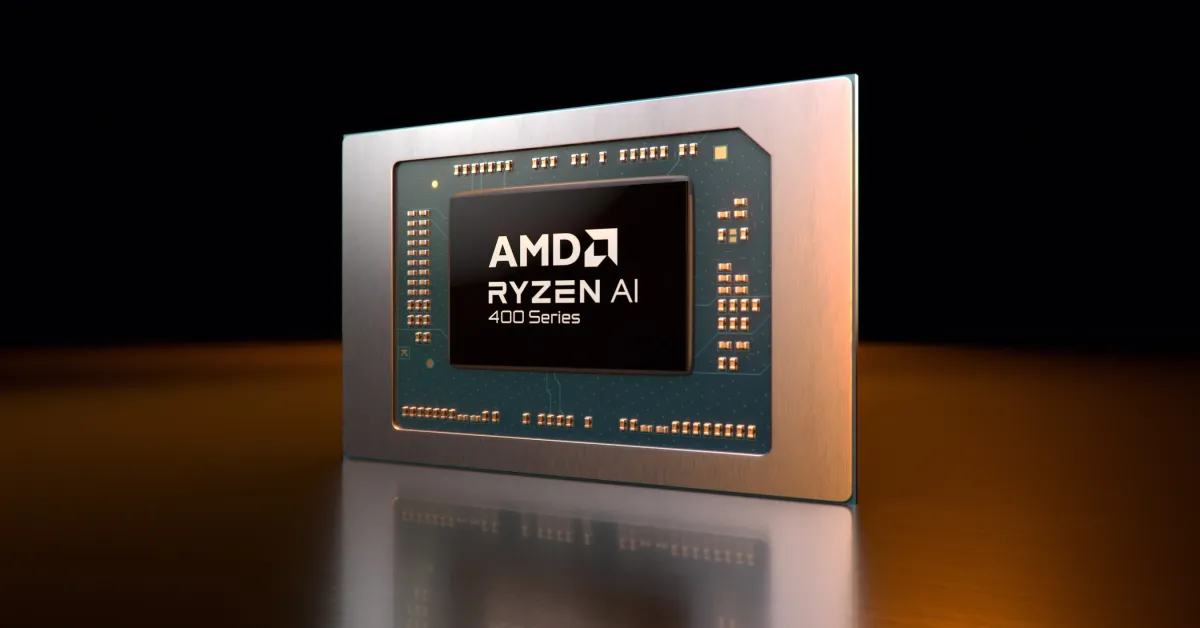
Today at CES, AMD is announcing its successor, the Ryzen AI 400 line — but there’s nothing particularly next-gen about “Gorgon Point.”
They’re based on the exact same Zen 5 and Zen 5c CPU cores, with the same RDNA 3.5 graphics, and have the same exact number of cores as their predecessors, too — a “475” has 12 cores, 24 threads, and 16 graphics CUs like a “375” did, and so on down the stack.
The main differences are a slight boost to CPU and GPU frequency, more memory bandwidth, and a faster NPU for AI tasks in the top two models. The HX 475 now offers 60 TOPS, while the HX 470 offers 55.
They’re similar enough that AMD largely dodged a question about how much faster they are when we asked, instead comparing them against Intel’s Lunar Lake (not the new Panther Lake) chips:
But AMD client CPU boss Rahul Tikoo claims AI 400 is somewhat faster than AI 300, and that improvements in manufacturing, firmware, software, and frequency and memory bumps should make a performance difference.
With AMD’s AI 300 chips already doing well, it’s possible that any improvement will be enough. But when laptops ship this quarter (Q1 2026) from all the usual suspects (including Acer, Asus, Dell, HP, and Lenovo), these chips will start going up against Intel’s just-unveiled Panther Lake and Qualcomm’s new Snapdragon X2 line. All three sets of laptops will begin shipping in the same time frame.
AMD isn’t really talking price today amid the RAM crunch, though, beyond suggesting that Ryzen AI systems typically start as low as $499 and Ryzen AI Max ones are more in the $1,000-to-$1,500 range.
