

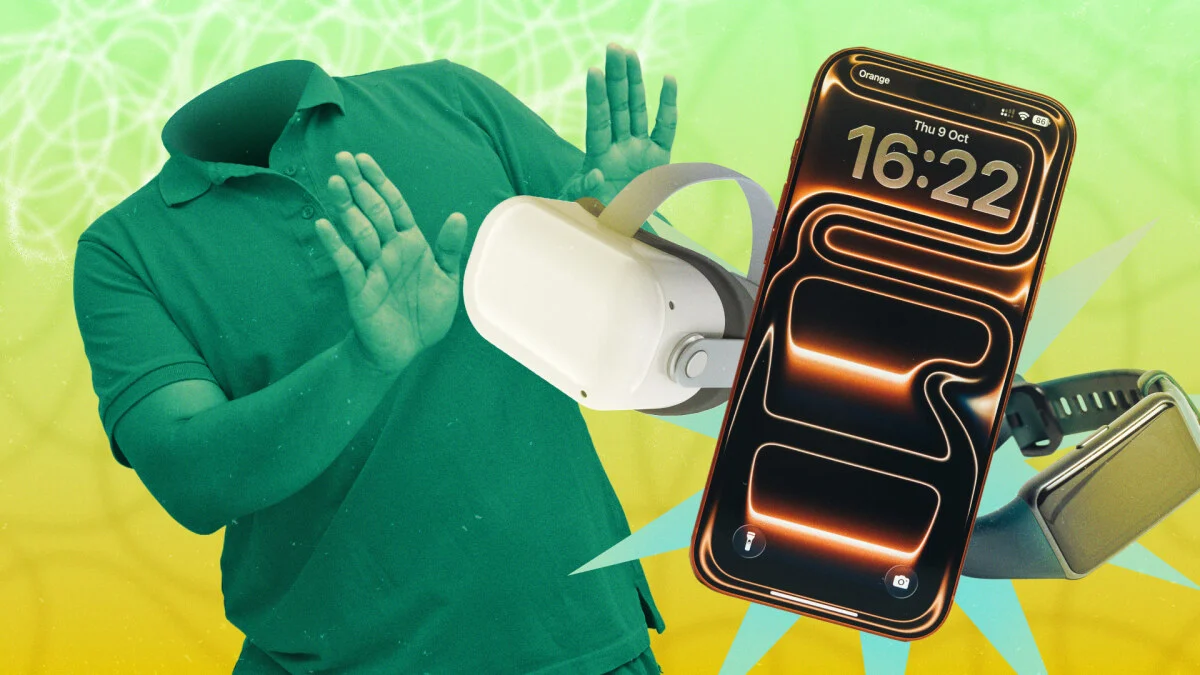
Credit: René Ramos/Lifehacker/Ahmade Studios/martin-dm/natatravel/Wirestock/iStock/iStock Unreleased/Getty Images
You can pinpoint the exact minute of the high-water mark for tech-based enthusiasm: January 9, 2007, 9:41 AM PST, the moment Apple CEO Steve Jobs introduced the iPhone to the world.
Cell phones weren’t new—neither were cellphones with touch screens—but this one was different: so high-tech it seemed like it couldn’t be real, but so perfectly designed, it felt inevitable. And people were hyped. Not just tech nerds: normal people. The crowd at the 2007 Macworld Conference & Expo broke into rapturous applause when Jobs showed off the iPhone’s multi-touch—an ovation for a software feature!—because it seemed like Jobs was touching a better future.
The iPhone, people said, was like something out of Star Trek. But unlike communicators or tri-corders, it was obtainable (if you had $500) evidence of a future where technology would finally free us from the drudgery of our lives so we could boldly go—wherever, it doesn’t matter.
The science fiction fathers of modern tech
Steve Jobs mentioned Star Trek as an inspiration for the iPhone all the time; apparently the show is quite popular among tech people. Gene Roddenberry created Star Trek, and thus was the spiritual father of the iPhone. He spent the 1960s lounging poolside in Los Angeles, dreaming of a post-scarcity tomorrow where the wise, brave men of The Federation kept the Romulans at bay and there were hot alien chicks on every Class-M planet. At the same time, the future’s real prophet, Philip K. Dick, was huddled in a dank Oakland apartment, a stone’s throw from Silicon Valley, popping amphetamines like breath mints and feverishly typing dystopian visions of corporate surveillance states and nightmare techno-realities into his Hermes Rocket typewriter.
Roddenberry’s Federation promised technology would help humanity evolve beyond its baser instincts. Dick saw technology amplifying our worst impulses.
So what happened? How did we go from a Roddenberry future where each new product release seemed like another step closer to collective utopia to our Dick-esque present, where the first question we ask of any new technology is “How is this going to hurt me?”
Where does tech excitement come from?
Visionary heads of start-ups like to blather about “paradigm shifts” and “world-changing technology” but people don’t get excited for tech products that are going to, say, cure cancer. Most of life (for pampered Westerners, anyway) is dealing with routine annoyances, and tech promises a way out. Remember printing MapQuest directions before leaving the house? It was a pain in the ass. People were excited for the iPhone because it solved the MapQuest problem and so many other small, intimate problems, like “I can’t instantly send a photo to my friend” or “I get bored while I’m riding the bus.” Products that do this flourish, and ones that fail are discarded like a Juicero.
It’s hard to overstate how great the iPhone was back in 2007 in terms of solving annoyances. Buying one meant you no longer had to carry a notepad, camera, laptop, MP3 player, GPS device, flashlight, or alarm clock. It was all crammed into a single black mirror. But speaking of black mirror …
Excitement turns to boredom
“We’re in an era of incremental updates, not industry-defining breakthroughs,” says Heather Sliwinski, founder of tech public relations firm Changemaker Communications. “Today’s new iPhone offers a slightly better camera, marginally different dimensions or AI features that no one is asking for. Those aren’t updates that go viral or justify consumers shelling out thousands of dollars for a device that’s only slightly better than what they already own.”
In economics, “marginal utility” is the additional satisfaction or benefit a consumer gets from consuming one more unit of a good or service. The marginal utility leap between a flip phone and the first iPhone was huge. But economics teaches us that marginal utility diminishes with each additional unit consumed. Each new iPhone release provided progressively less additional satisfaction compared to what users already had. Slightly faster chips, slightly better cameras, USB-C instead of Lightning, titanium instead of aluminum—who cares?
If we were merely bored with tech products, it would be one thing. But increasingly, devices that were desired because we want to make our lives easier or more enjoyable are making them harder and worse.
The great technological hassle
“When you buy a new tech product today, you’re not just buying one physical product. You’re committing to downloading another app, creating another account and managing another subscription,” Sliwinski says. “Consumers are exhausted by the endless management that comes with each new device.”
In economics, you’d call that “diseconomies of scale”: what happens when a business becomes so large its bureaucracy costs outweigh efficiency gains. In personal terms, it’s when the time and energy it takes to sync, charge, and coordinate your “time-saving” device makes you the middle manager of your own life.
Then there’s the kipple. In Do Androids Dream of Electric Sheep?, Philip K. Dick defines “kipple” as useless objects that accumulate: ”junk mail or match folders after you use the last match or gum wrappers or yesterday’s homeopape.” That drawer full of orphaned power cords and connectors, your broken earbuds, the extra game controllers, the Roku, Chomecast, and old Fitbit are physical kipple, but the virtual kipple is worse. “Personally, I have at least four different apps that I need to download and manage just to live in my apartment complex—smart lock system, community laundry, rent payments, maintenance requests,” Sliwinski says.
What do you think so far?
According to Dick, kipple doesn’t just accumulate; it metastasizes, growing constantly until the Star Trek lifestyle you envisioned becomes a Dick-esque swamp of dependencies, and The future goes from being a place you want to live to somewhere you’re trapped.
The enshittiffication of everything
The door refused to open. It said, “Five cents, please.”He searched his pockets. No more coins; nothing. “I’ll pay you tomorrow,” he told the door. ― Philip K. Dick, Ubik
“Corporations have spent years trying to manufacture excitement around relatively low-importance features instead of genuinely useful developments, and consumers have learned to recognize that pattern,” says Kaveh Vahdat, founder of RiseOpp, a Fractional CMO and SEO firm based in San Francisco.
Nowhere does this consumer indifference seem greater than with AI. “Consumers are testing Sora or testing Grok and all of that, but there’s really not been a single use case or product for AI that I think consumers are excited about,” says Sliwinski.
This will not stop tech companies. Even without excitement, artificial intelligence is everywhere in tech, from toothbrushes to baby strollers (I think PKD would have found the AI stroller darkly funny: it’s self-driving, but it won’t work if you put a baby in it.) “There’s a lot of buzz around AI but we’re missing the ‘so what?'”
Beyond indifference and toward dread
Beyond “so what?” consumers have started asking “How will this hurt me?” “Is AI going to encourage my child to take their own life? Is it going to steal my job? Is it destroying everything pure about humanity?”
Tech companies don’t seem like they’re scaling back on AI or doing an effective job of explaining its benefits, and if the recent past is an indicator, if they can’t make our lives easier, they’ll try to imprison us instead, employing psychologists, neuroscientists, and “growth hackers” specifically to make products harder to put down. The innovation isn’t in new products that make life easier, but in encouraging addiction through variable reward schedules, social validation metrics, parasocial relationships, and other dark arts until eventually we end up like the half-lifers in Ubik, husks in cryopods, living in a manufactured reality where we still have to pay for the doors to open. That’s the PKD take, anyway.
“Maybe 10 to 20 years down the road we will have another huge step change like the iPhone that can condense all these different devices that we’re using or apps that we’re using —but the tech isn’t there yet,” Sliwinski says.
In Star Trek, humanity doesn’t abandon scarcity. Technology eventually makes scarcity indefensible, and that’s only possible after a planet-wide war. From that Roddenberry-esque perspective, enshittification is what happens when old economic systems try to survive in a world where technology keeps eroding their justification, and each tiny “I don’t care” iteration to tech products is a small step closer to Star Trek‘s promised land of holodecks, abundance, and hot aliens.
