

Hanukkah (or “Chanukah,” if you prefer; it’s a transliteration, so there is no “correct” spelling) is an annual eight-day Jewish religious festival that usually takes place in late November or early December. In 2025, Hanukkah begins on the evening of Sunday, December 14, and continues through Monday December 22.
Why does Hanukkah fall on different dates each year?
While Hanukkah falls on different dates every year on the Gregorian calendar you’re probably familiar with, it begins on the same day every year on the Hebrew calendar: 25th of Kislev. The Hebrew calendar is based on the moon, and Hanukkah falls on the 25th day after the new moon that marks the beginning of the month of Kislev.
What is Hanukkah about, anyway?
Hanukkah celebrates the anniversary of the beginning of the Maccabean revolt against the Seleucid Empire and the re-dedication of the Second Temple that happened in the 2nd century BCE. That’s the strict definition of the holiday. In practice, in present day America, Hanukkah is the “festival of lights,” a winter celebration usually marked by gift-giving, delicious foods, candle-lighting, and the boring game of dreidel (more on that below).
Religiously, Hanukkah is a comparatively minor holiday, not nearly as significant as the Jewish High Holy Days of Rosh Hashanah and Yom Kippur, but it is a favorite among children, particularly American children. These days, the holiday is marked in Jewish communities all over the world, but Jewish kids in the U.S. are the undisputed Hanukkah kings and queens.
The origins of Hanukkah: A Hebrew rebellion brought to you by Cincinnati rabbis
There are two ways to think about the origin of the Festival of Lights. You could say Hanukkah began around 200 BCE when Greek leaders prevented Jews from practicing their religion, leading the Maccabees to rise up in defiance. Or you could say Hanukkah began in Cincinnati.
Before a couple hundred years ago, there’s no record of how anyone celebrated Hanukkah—maybe it was done, but it seems that no one made too big of a deal about it. That all changed in the mid-to-late 1800s, when a couple of Cincinnati rabbis, Isaac M. Wise and Max Lilienthal, put Hanukkah on the holiday map. They popularized, promoted, and Americanized the holiday, introducing celebrations of Hanukkah to their congregations and promoting it in national Jewish publications.
Wise and Lilienthal were leaders of Reform Judaism, a more modern, less orthodox form of the religion, and to some extent, the holiday they popularized reflects that set of values. It was meant to help Jewish children in America honor their heritage by presenting an exciting, relatable historical event featuring Jewish heroes. it was also meant to be Christmas-like—a family holiday that’s fun.
Lilienthal noted the rising popularity of Christmas celebrations in the U.S. in the 1800s, and was impressed with the way Christian churches used the secular aspects of the holiday to teach their faith, so he borrowed the gift-giving and lighthearted nature of non-religious Christmas celebrations and put a Jewish spin on ‘em. Thus modern Hanukkah was born.
“We must do something, too, to enliven our children… [They] shall have a grand and glorious Chanukah festival nicer than any Christmas festival.” Lilienthal wrote in 1876.
The traditions of Hanukkah: You’ve been wrong about the menorah your whole life
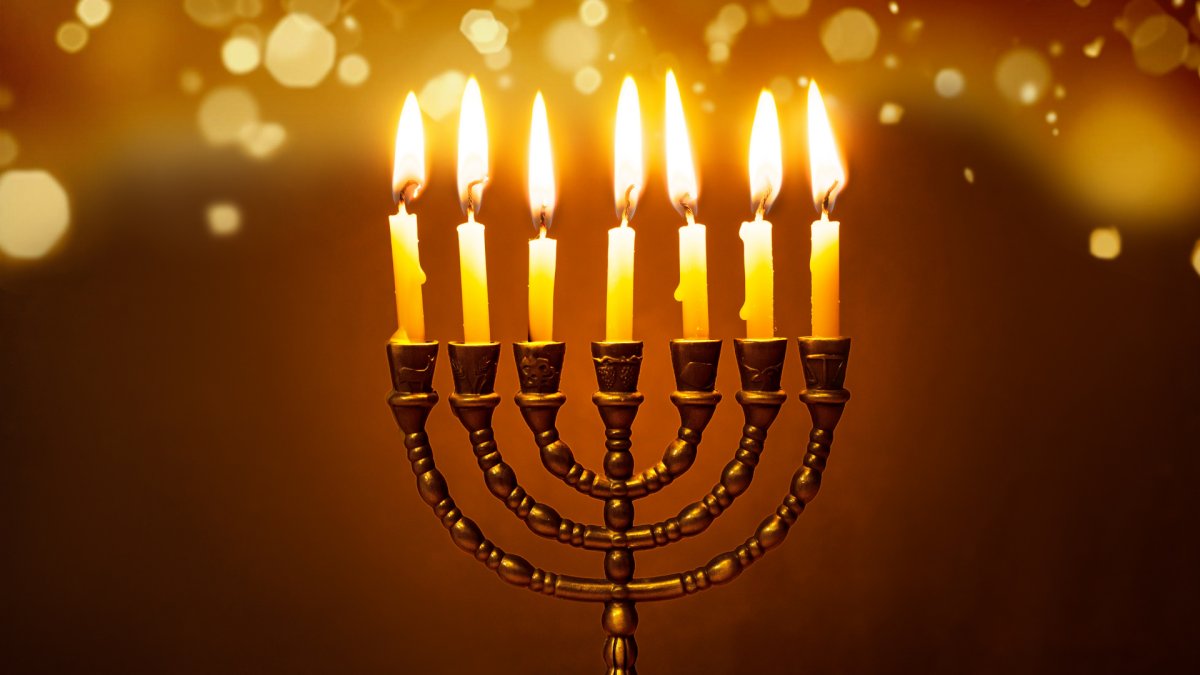
The main event of Hanukkah among most who celebrate is the lighting of candles before dinner, one more for each successive night of the festival. When the Maccabees rebuilt the temple back in the olden times, they re-lit the menorahs—candle holders for seven candles—but they only had enough oil for the candles to burn for one night (or so the story goes). Miraculously, the lights stayed on for eight nights.
Technically, most people don’t light menorahs on Hanukkah. Menorahs have eight lights. Hanukkah candles are usually in a “hanukkiah” which holds nine: eight main candles and the helper candle that lights them all.
Foodwise, you can eat whatever you like—this isn’t a fasting holiday. Fried foods, particularly latkes (fried potato pancakes), are popular and delicious, especially if served with sour cream and/or apple sauce. Jelly doughnuts are another favorite. But like I said, you can eat whatever you like.
What do you think so far?
Many Hanukkah-heads give gifts too—one for each night.
Why aren’t there many classic Hanukkah songs like there are Christmas standards?
Hanukkah carols have never really caught on because golden age Jewish songwriters were busy writing “Let it Snow,” “Chestnuts Roasting on an Open Fire,” “Silver Bells,” “White Christmas,” “Rudolph the Red-Nosed Reindeer,” and almost every other Christmas song that isn’t a hymn. But there’s “I Have a Little Dreidel,” a folksong with English lyrics attributed to Samuel E. Goldfarb, but that’s not explicitly about the holiday. This all leaves Adam Sandler’s “Hanukkah Song” as the most well-known tune commemorating the Festival of Lights.
Speaking of dreidels, though…
How do you play dreidel?
Many households break out dreidels (spinning tops with Hebrew characters on them) and play with them for a few minutes after dinner. Dreidels are marked with Nun (נ), Gimel (ג), Hey (ה), and Shin (ש), which form an acronym for “Nes Gadol Hayah Sham” (A great miracle happened there). Here’s how the game is traditionally played: Everyone starts with the same amount of something “valuable,” usually chocolate coins. At the start of a round, everyone antes up, then they takes turns spinning the dreidel, following the directions of which character it lands on.
-
נ (Nun) means “nisht” or “nothing.” Player does nothing if Nun comes up.
-
ה (Hey) means “halb” or “half.” The player gets half of the pot. (If there is an odd number of pieces, the player gets the extra.)
-
ש (Shin) means “shtel” or “put in.” The player adds a chocolate coin to the pot.
-
ג (Gimel) means “gantz” or “everything.” The player gets everything in the pot. Jackpot!
(It’s not a very good game: all luck; no skill.)
It’s widely believed that dreidel is the most popular Hanukkah game, but this is a lie. The most popular (and best) Hanukkah game is “guess which candle will be the last to go out,” a much more nuanced and exciting game played by everyone who has ever fired up a menorah (sorry, a hanukkiah) before dinner. Do darker candles burn faster than lighter ones? Does placement matter? How about wick length? All of this and more must be considered and discussed if you’re going to master this exciting game.
Is it cool to celebrate Hanukkah if you’re not Jewish?
You can celebrate any holiday you want; it’s a free country. Hanukkah is generally seen as a “fun” holiday, without the deep religious significance of other Jewish holidays. While I don’t speak for anyone else, none of the Jews I know take offense if non-Jews want to light some candles and watch 8 Crazy Nights to capture some of that Hanukkah magic. Some of the traditions of the holiday were partly inspired by Christmas anyway, and much of Christmas was (maybe) appropriated from pagan solstice celebrations itself, so go nuts—it’s the holidays.
