

We may earn a commission from links on this page.
Left to right, top row: WiRobotics, Sumbu, Dephy. Bottom row: Ascentiz, Skip, Hypershell.
Credit: Beth Skwarecki
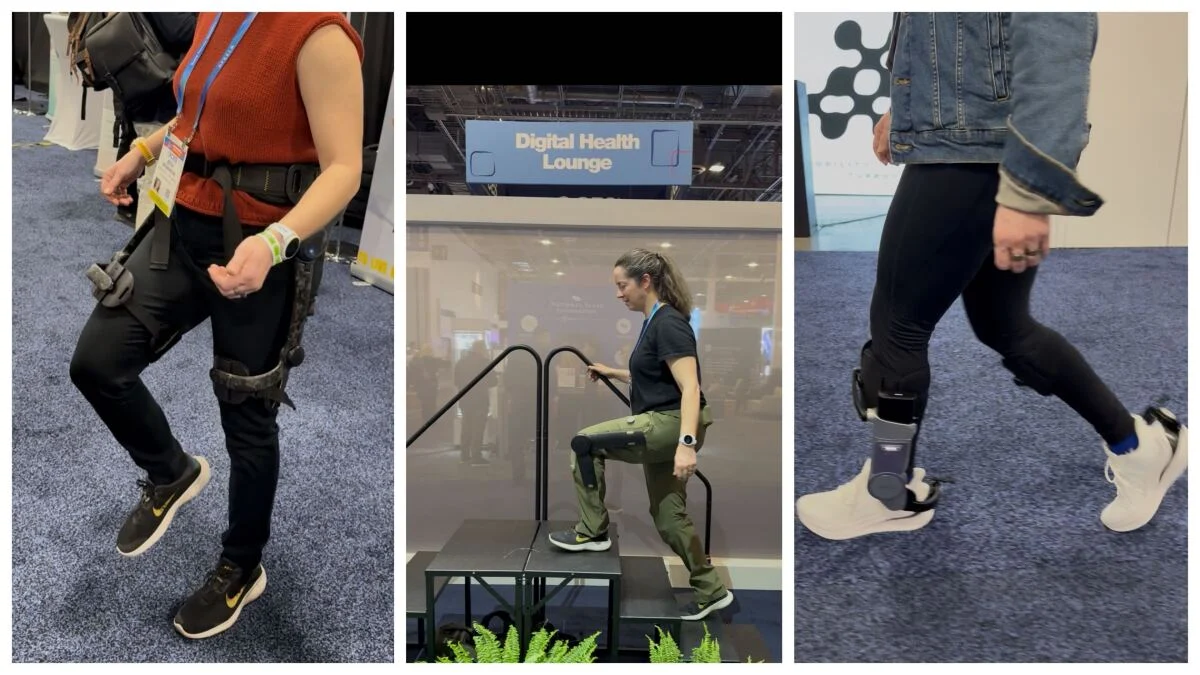
While I was covering CES, the big consumer electronics show in Las Vegas, I gave myself a side quest: try on every exoskeleton I could find. I kept seeing them at booths and events, promising to help me walk farther without fatigue, or reach my athletic potential as I’m (judging from their marketing videos) sprinting up a mountain. I ended up testing six of them—four assisted me at the hip, one at the knee, and one at the ankle.
Exoskeletons first landed on my radar as I was considering products for the Best of CES awards. I was helping to judge “age tech”—devices designed to help people as they age—and devices that assist with mobility were potentially in the running. But I was skeptical about whether consumer exoskeleton technology was mature enough to be safe and reliable, and whether people would realistically find exoskeletons convenient enough to use. Those are still open questions. In the end, we didn’t include any exoskeletons among our finalists, although I wouldn’t rule out the possibility for future years.
Many of the exoskeleton companies positioned their products as fitness tech, with companies like Ascentiz and Hypershell using images of hikers and athletes in their marketing. My colleague James Bricknell from CNET took a Hypershell exoskeleton for a hike on a nearby canyon trail during CES, and said that it helped him easily keep up with more experienced hikers. (I borrowed that exact exoskeleton from him when we ran into each other in CNET’s newsroom and took it out for some impromptu sprints in the hallway.)
First, since I know you all want to see what they looked like and hear how they felt, I’ll give you a tour of the ones I tried, ranked from my least to most favorite. Then, below, I’ll give some thoughts on whether I think exoskeletons are worthwhile, and what I learned after talking to an expert who uses medical grade exoskeletons for physical therapy in rehabilitation facilities.
Unimpressive: WiRobotics WIM-S ($1,905)
Credit: Beth Skwarecki
This minimalist unit from WiRobotics was the last one I tried before leaving CES, and I’m sorry to say it comes in last place in my ranking as well. By this point, I’d tried several other hip-based exoskeletons that fit well and provided a significant boost to my walking and stepping. I loved the slim profile and simple design of the WIM-S—that is, until I turned it on. I was led up and down a mini staircase in the WiRobotics booth a few times before it was time to hand over the device to the next person in line. The WIM-S just didn’t feel like it was doing much.
Credit: Beth Skwarecki
WiRobotics’ design keeps the device fully in front of your hips, pushing down on the front of your leg. It feels a bit like when you push your hand against your knee to help you stand up. The WIM-S isn’t available for sale in the U.S. yet, but goes for the equivalent of $1,905 in South Korea.
I’m definitely feeling something: Sumbu ($1,199-$1,999)
Credit: Rena Goldman
I first tried a Sumbu exoskeleton at CES Unveiled, a media preview event that occurs a few days before the show officially opens. For the first time that week, but not the last, I had people help me strap a belt around my waist and then they tightened cuffs around my legs just above my knees. Walking around, I could feel the device helping to move my legs; jogging in place, I commented that it would be nice if I could try these on stairs. Good news! The company’s real booth would have stairs.
I visited the booth later on, in CES’s “Eureka Park” area dedicated to startups. I walked up and down the provided mini stairs, and felt the exoskeleton helping me easily step up, even when I took the stairs two at a time. I also stepped up onto the top of the stair unit when I was standing next to it—three stairs tall, I think—slightly surprising the people at the booth. But the exoskeleton made it feel easy.
To be totally honest, this exoskeleton and the next two I list (Ascentiz and Hypershell) all had a similar fit and feel. It’s tough to rank them against each other based on just a few minutes of testing for each, so take my conclusions with a grain of salt.
Sumbu sells three models of exoskeletons: the lightweight S3 ($1,199), the more powerful S3 Pro ($1,499), and the “maximum power” S3 Ultra ($1,999).
Helping me run: Ascentiz ($1,499 and up)
Credit: Beth Skwarecki
Ascentiz makes a modular exoskeleton that can assist you at both the hip and the knee, but only the hip module was available for me to try. Hip exoskeletons seemed to be more popular; including Ascentiz, I tried four hip exoskeletons this week, and only found one each of knee and ankle exoskeletons (not including Ascentiz—you’ll see the knee exoskeleton I did try below).
Each exoskeleton basically treats a joint of your body as a hinge. Your knee is a natural hinge joint; your hip can move in different directions, but when you’re wearing an exoskeleton, it only assists you in forward and backward motion—hip extension and flexion, to put it in terms a physical therapist or fitness trainer would recognize. Hip-based exoskeletons assist your glutes in straightening your hip and/or assist your hip flexors in raising your leg in front of you.
Credit: Beth Skwarecki
Ascentiz wisely set up its booth at the edge of the show floor, near a set of steps and also near a not-too-crowded area where I could walk and jog. The exoskeleton helped me climb stairs, and then I took it back and forth for a couple of jogs and even attempted a sprint. It felt smooth and my movements felt natural, with the power assisting me at just the right time during each stride.
Ascentiz is currently running a Kickstarter for funding, and lists prices on its website. The H1 (hip) module is going for $699 to $999, and will have a suggested retail price of $1,499 to $1,999 depending on whether you go for the “Pro” or “Ultra” model. The knee module (K1) covers both knees and costs about $100 more. The full set, with both hip and knee assistance, will sell for $2,499 to $3,399.
Sprinting around the hallways like a goofball: Hypershell X Ultra ($1,999)
Credit: Rena Goldman
As I mentioned above, I borrowed my CNET colleague James Bricknell’s Hypershell X Ultra unit for a quick spin around the conference halls. I was impressed at how much its “beast mode” helped me do step-ups onto a chair, so then I decided to see if it could help me jog…and then run…and then sprint. And then attempt some quick turns and stops to see if it could keep up. (This was the first hip-based exoskeleton I tried to run in.)
Credit: Beth Skwarecki
To my surprise, it felt great. To be fair, the Ascentiz felt pretty good to run in, too. I didn’t have space to run in the Sumbu one. The Hypershell kept up with my movements and assisted seamlessly. The others would sometimes think I was taking a step when I was actually standing still; the Hypershell wasn’t as prone to these missteps.
Unlike some of the other exoskeletons on this list, the Hypershell is already on the market, and that’s probably why its technology feels a bit more mature. (It claims to be the first consumer outdoor exoskeleton.) The Hypershell X Ultra goes for $1,999 and the company’s lowest-price model is the Hypershell Go, at $899.
Going easy on my knees: Skip Mo/Go ($4,999)
Credit: Beth Skwarecki
I found the Skip booth in the AARP’s AgeTech Collaborative section. There, I tried a version of its Mo/Go exoskeleton, which is built into a pair of pants and operates at the knee. The pants hide leg cuffs, which feel a bit like a medical knee brace. The motorized unit snaps onto the outside of the pants, so it looks like you’re wearing normal hiking pants but with a robot’s joint at the side of your knee.
I had to change out of my jeans and into the special pants, and then I could snap on the motor and start climbing stairs and squatting. The feeling is different than on the hip exoskeletons, as you might imagine. The motor essentially acts as an extra quad muscle, helping to straighten my knee, and slowing me down as I’m descending stairs.
I went up and down the stairs. I did some squats in place. I sat down on a low seat and stood back up again. Having been through knee pain and knee surgery in the past, I instantly understood why this product would be in demand (and why it was one of AARP’s picks). The other exoskeletons try to decelerate you on the way down stairs, but this one really works. Sitting down, the robot knees helped me gently settle, rather than having that “plop” at the end of the motion that we all probably do without thinking about it.
I only ran a few steps, but the running didn’t feel great—you can tell it’s not meant for that motion, at least not yet. I didn’t find these as comfortable as the other exoskeletons I tried, because the cuffs were inside the pants. That meant I had them contacting my bare skin, where they got sweaty and seemed like they might chafe. It also wasn’t particularly easy to get the pants on—if I had mobility issues, I’d probably want help with that. The Skip representative mentioned that the exoskeleton can be removed from the pants and worn without them, which is probably what I’d do if I owned a pair.
Skip’s Mo/Go isn’t available yet, but you can place a pre-order on the device now, which will eventually cost $4,999.
Putting a spring in my step: Dephy’s Sidekick ($4,500)
Credit: Beth Skwarecki
This was both the first and nearly the last exoskeleton I tried at CES. I took it for a quick spin at Unveiled and visited the booth in Eureka Park for a longer try-on later in the week.
Dephy calls its exoskeleton “powered footwear.” The Sidekick has two parts: a shoe with a carbon plate, and a robotic arm that hugs your shin just below the knee. Dephy worked with Nike, and both companies came up with their own version of the exoskeleton; you can see Nike’s version here, branded as “Project Amplify.”
The shoes can be worn on their own, and they’re cushy—I kept hearing people compare them to Hokas. They were certainly more comfortable than my own beat-up Nikes that I was wearing to get around the show halls. There’s a connector on the back, and the robotic arm hooks into it. If the arm were to detach while you’re wearing it, it would fall behind you, rather than in front.
Credit: Beth Skwarecki
The Dephy Sidekick assists your calf muscles in helping you walk. They don’t start to assist until you’ve walked several steps, but then I felt them lift my heel on every step. The device doesn’t help you lift your foot, but it does help you to flex your foot downward, pushing you forward as you walk. Dephy says it targeted this movement since the calf muscles are “unsung heroes” of walking, providing most of the energy.
I took a few steps at Unveiled, and even did a sprint through the crowd. Running felt weird, but not necessarily bad. Later, taking a longer walk through Eureka Park, I could definitely believe that Dephy’s ankle-based exoskeleton would save me more work and fatigue than the hip-based models I mentioned earlier.
What do you think so far?
Overall this design felt the best thought-out and most comfortable of all the exoskeletons I tried. The places where it attached to my body were the shoe and a pad on the front of my shin—both very comfortable, and easily worn over my normal socks and pants. The device hooks on quickly, and the battery packs slip in and out without any fuss.
I worried about the quick motion of the motor pulling me (or, hypothetically, an older person with mobility issues) off balance, but the way the device is programmed, that seems a lot less likely than I assumed. The motor only kicks in while you’re walking forward, and stops assisting when it detects a sideways, backward, or otherwise unexpected step. At one point I dodged around somebody’s dog in a cramped corner of the show floor, and the Sidekick stopped assisting for those few steps, then went right back to helping me move forward.
The Sidekick starts shipping later this month, and the starter pack, including the shoes, batteries, and a charger, costs $4,500.
How useful are exoskeletons, really?
Before I can say that exoskeletons are useful in the real world, I’d have to know that they work, that they’re worth the cost, and that they make sense for the people who are most likely to want them.
Trying them on convinced me that they do, in fact, work. Five out of six (sorry, WiRobotics) gave assistance that felt helpful and useful. I wasn’t sure that they’d pass even this low bar, so I’m already impressed.
Cost is a problem, though. Who is going to spend $1,000 to $5,000 for a little assistance in walking or hiking? Serious hikers and runners would probably rather train harder to handle tough terrain and spend the money on gear or coaching. People who don’t normally hike might enjoy keeping up with their friends, but what non-hiker is going to spend that kind of money on a hiking exoskeleton?
I could definitely see exoskeletons in a rental market—borrow a Hypershell unit to hike up a scenic mountain on vacation, or wear Dephy’s powered footwear to stay on your feet longer in a theme park (remembering that you’d need to swap out the batteries once or twice during the day).
After trying the devices and frowning at the cost, my biggest question was whether exoskeletons could be useful for people with mobility issues due to disability or chronic health conditions. And to get a better sense of that, I talked to someone who has been working with exoskeletons in a medical setting for years.
How these consumer exoskeletons compare to medical devices
Amanda Clark, director of Good Shepherd Creates, is a physical therapist by training. Good Shepherd is a rehabilitation network that has been using exoskeletons in physical therapy for over 10 years, including the Ekso Bionics robotic suit used for physical therapy sessions, the Trexo Plus for children, and the ReWalk personal device that people can take home.
These exoskeletons can help people to walk who may not have been able to walk on their own before, or who are recovering from strokes or brain or spinal cord injuries. The more steps you get in, the better your nervous system gets at learning how to balance and walk.
Clark told me that the models that are used in rehab may cost a facility around $250,000, plus another 10% of that per year for maintenance. Typically a person needs a device like a walker or crutches to use them, and must have a person assisting them—such as a physical therapist at a rehab facility, or a family member in the case of the few personal exoskeletons that are now on the medical market.
Getting an exoskeleton approved as a medical device takes a lot of time and money for the manufacturer, Clark explained. Medical devices need to undergo a type of FDA approval similar to that for drugs. The manufacturer has to show that they use good manufacturing processes, and they have to run clinical trials showing that the device is safe, and then that it is effective for a specific medical condition.
That explains why the company reps I talked to were very careful to say that they made a “consumer” or “recreational” or “athletic” device, and not a medical device. But consumer devices can’t usually be covered by insurance, which puts a pretty big barrier in the way of access. People with disabilities and chronic conditions—especially if they have trouble working—usually don’t have a thousands of dollars to drop on devices like these.
With the particular models I saw being so new, if I were in that position, I’d also be nervous about whether the devices work as promised, whether they’re safe, and whether the company would stay in business over the years to provide support in case anything goes wrong.
But as a technology with room to grow, there’s definitely a possibility that these devices could become useful and worthwhile for people with mobility issues. Clark said she’s happy to see the technological progress that has been made to get these devices small and light enough to be wearable outside the clinic.
Still, she sees cost as a major barrier. “My challenge to these companies is: how do you create something that is user friendly, that is slim profile, that could really promote these changes in independence and quality of life—but at a price point or in a way that is accessible to them?”
That’s where I land as well. The technology is promising, but at the current price point, I’m not sure that they’re accessible to enough people with mobility issues, or worthwhile enough for athletes. But since the devices I tried are new to the consumer market, I’m looking forward to seeing if there are improvements in price and technology in the years to come.
