

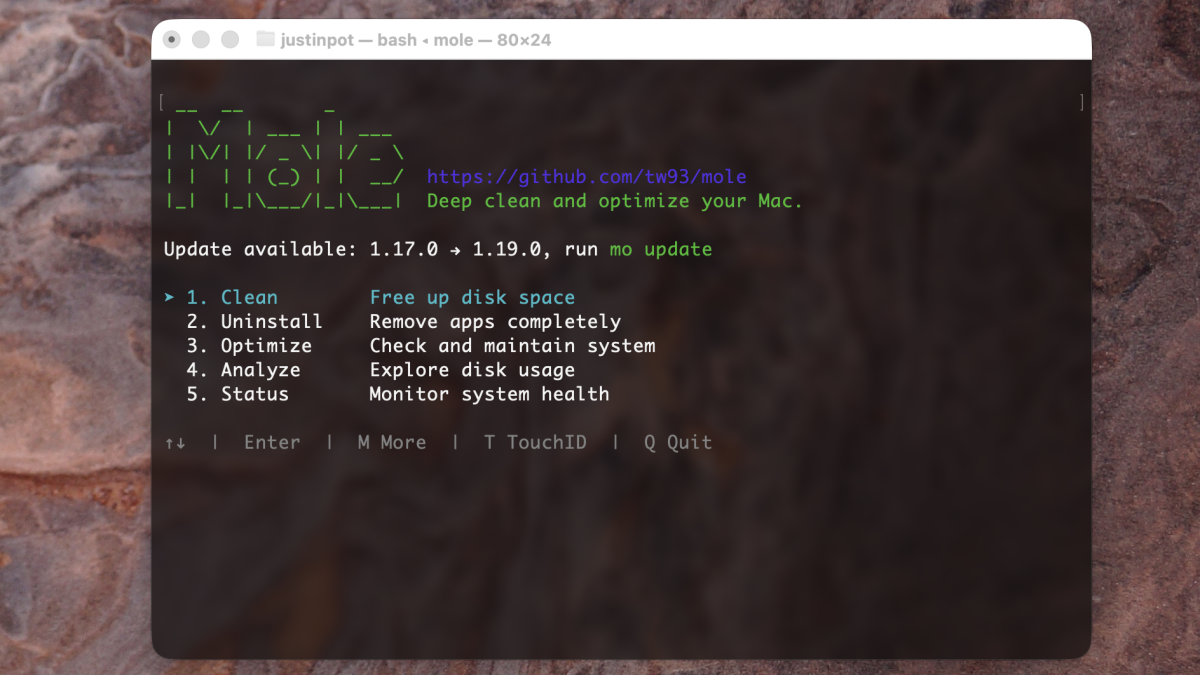
There are a lot of apps on the market that claim to “clean up” your Mac—for a price. Some offer subscriptions, some cost a lot up front, but for the most part, they offer the same few features—wiping things like caches and logs, completely uninstalling apps, and monitoring system health. These apps all tend to be a little on the bloated side, with a lot of animations and graphics.
The free, open source, Terminal-based Mole is the opposite of those applications. Running entirely from the command line, Mole couldn’t possibly look less flashy, but it combines a number of different tools that can free up hard drive space on your Mac while also keeping things running smoothly.
To get started, you’ll need to install Mole. The simplest way to do this is by using Homebrew, which any Mac user interested in a Terminal-based application should probably do anyway. There is, alternatively, a script you can use to install Mole on the download page.
To use the application, just type “mole” in the Terminal and hit enter—you’ll be presented with the five main tools offered: Clean, Uninstall, Optimize, Analyze, and Status. (You can, alternatively, type “mole” followed by the tool you want to use—more on that later.)
Credit: Justin Pot
The first, Clean, scans your hard drive for caches and temporary files, then deletes them. The application explains what it’s doing every step of the way, and you can always do a dry run using the command mole clean –dry-run if you’d like to see an overview before affecting any system files.
Credit: Justin Pot
The second tool, Uninstall, presents you with a list of applications installed on your computer and lets you know how much storage space they’re using. You can select as many applications as you want with the spacebar, then hit enter in order to completely remove them. This doesn’t just uninstall the application itself—it also removes all associated files, including settings.
The third tool, Optimize, performs a number of routine maintenance tasks such as flushing the DNS cache, optimizing databases, and refreshing the Finder. I find this useful when my Mac is hanging for seemingly no reason.
What do you think so far?
Credit: Justin Pot
The fourth tool, Analyze, lets you see which folders are taking up the most space on your hard drive—useful if you’re trying to free up disk space on your Mac. You’ll see a list of folders alongside how much space they’re taking up. Open a folder to see a breakdown of the folders and files inside it. I was able to find a number of large files using this tool, some of which I didn’t need anymore.
Credit: Justin Pot
The final tool, Status, is a simple dashboard with stats including CPU, memory, and hard drive usage alongside an animated ascii-art cat. It’s simple.
It’s all very straight forward to use, and there are generally instructions on the screen telling you what to do next. One thing I do want to point out is that you can run most of these tools directly from the Terminal, without the initial menu. You can, for example, type mole clean to run the cleaner or mole status to open the dashboard. You can read more on the project’s Github page.
