

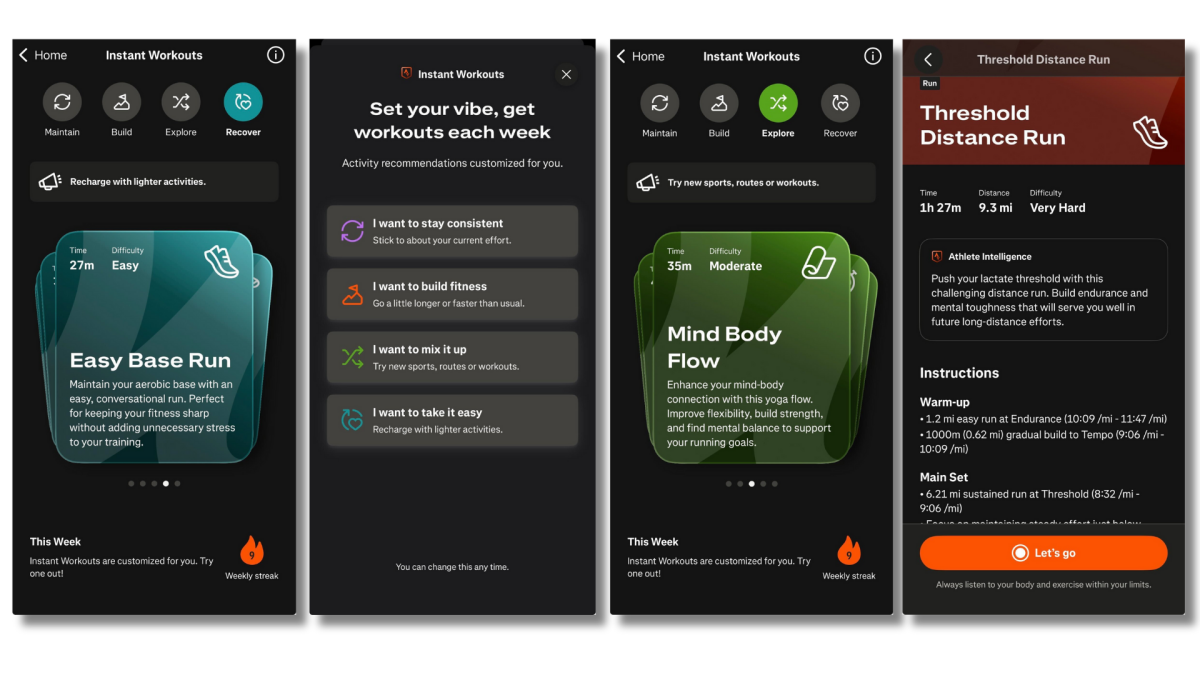
Earlier this month Strava unveiled its new Instant Workouts feature, a subscriber-exclusive tool that seems like a natural way to leverage its acquisition of Runna. In a Reddit post, Strava said this feature builds upon Runna’s already successful Instant Workouts feature.
Instant Workouts uses your activity history to generate personalized workouts across four intents (“Maintain,” “Build,” “Explore,” or “Recover”). The idea is that the more you upload, the more personalized your recommendations become. Another major selling point is the automatic route generation feature, which draws on Strava’s massive database of billions of historical activities to suggest optimal paths for each workout.
The timing of this rollout seems deliberate as the company positions itself for its anticipated IPO. And on paper, it sounds like exactly the kind of innovation that would indeed justify a Strava subscription. In practice, however, the execution leaves a good bit to be desired.
A half-baked launch
Unfortunately, the feature’s current implementation falls far short of its potential. The most glaring issue: You cannot actually view your workout details once you’ve started the activity in the app. Strava generates solid, complex, multi-interval workouts—but provides no way to reference them on your watch during your run or ride. You’d have to screenshot the workout beforehand or print it out.
For the majority of us athletes who rely on our devices to guide interval training, pace targets, and recovery periods, this renders the feature practically useless. Strava has acknowledged this limitation in a Reddit post, promising that device integration for Garmin and Apple watches is “coming soon.” But the timeline for that “soon” is questionable at best.
The relationship between Strava and Garmin has reportedly grown frosty following a lawsuit last fall, and there’s little incentive for Garmin to prioritize features that primarily benefit Strava’s subscription revenue and investor appeal. Without Garmin’s cooperation and swift implementation, a significant portion of Strava’s serious athlete user base remains locked out of the feature’s full utility.
Solid workout design
On the bright side, in my opinion, the workouts themselves show promise—though others disagree. The training plans generated appear to take into account individual fitness levels reasonably well. From my testing, the prescribed intervals, pacing, and progression made sense given my current training status and recent activity history.
These all make sense for me.
Credit: Meredith Dietz
That said, user experiences vary considerably. Some athletes report receiving workouts that seem disconnected from their actual fitness or goals, while others note that the workout descriptions use non-standard terminology that doesn’t align with how most training plans communicate intervals and pacing.
What do you think so far?
Then there’s the route generation. In a well-traveled area with dense activity heat maps like New York City, my suggested routes tend to be solid and sensible enough. As always, my personal preferences are to avoid extra crowded streets or sketchy areas, which Strava never seems to take into account. Ultimately, the algorithm benefits from years of crowdsourced data showing which streets, paths, and loops are actually popular with runners and cyclists.
However, users in less densely populated areas or regions with sparser Strava usage report wildly inconsistent results. Some routes make no logical sense, sending athletes on inefficient paths or suggesting roads that aren’t suitable for the prescribed workout type. The feature’s quality appears directly tied to the richness of local Strava data, creating a drastic two-tier experience.
And once again: Until I can push the workout and corresponding map to my watch, this feature doesn’t mean much to me.
The bottom line
If you ask me, Strava’s Instant Workouts feature feels rushed to market, likely timed to generate positive press ahead of the IPO rather than to actually serve athletes. Basic functionality that should have been present at launch—like being able to see your workout in the app or send it to your watch—is mysteriously absent. The wonky workout descriptions and inconsistent route quality only compound the sense that this needed more time in development.
