

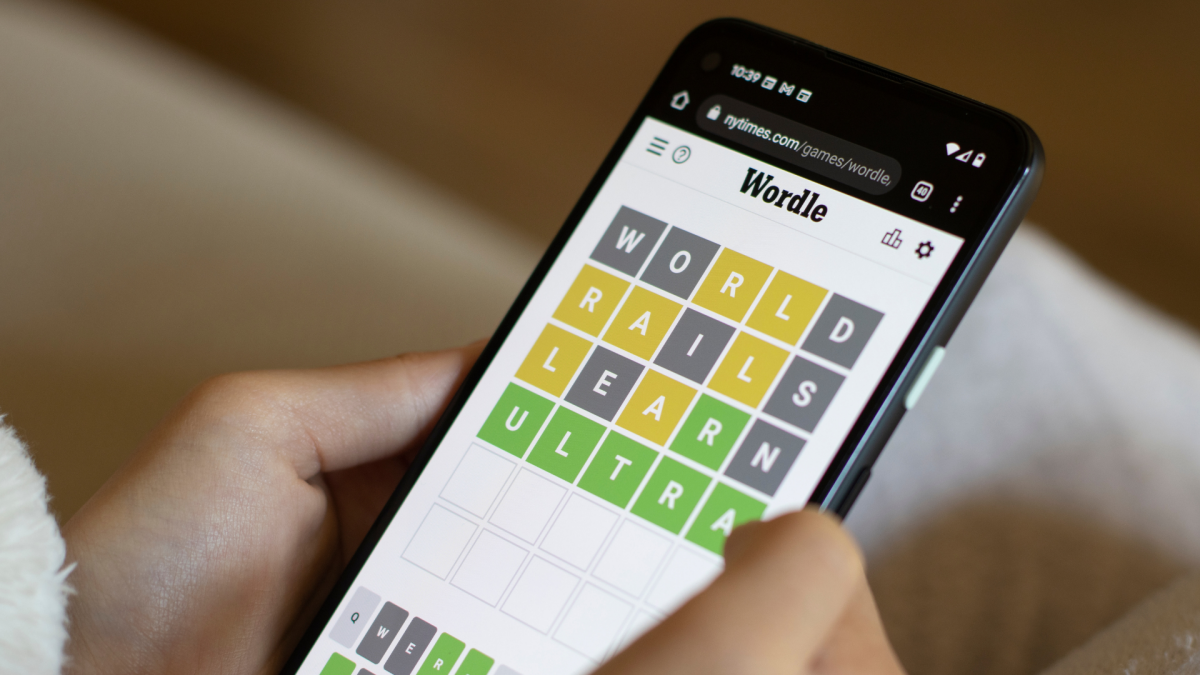
There’s an art and a science to picking a good starting word when you play Wordle. And now that the New York Times has announced it will start repeating previously used words, it may be time to rethink your strategy. While previous solutions used to be off-limits for future puzzles, that rule has changed. As of February 1, 2026, they’re fair game again.
That rule change matters because every word choice in Wordle has to be split between two jobs—gaining information about what to guess next, and trying to solve the puzzle with your guess. If you don’t care whether your starting word might be a solution, then the rule change may not affect you. But some solvers prefer to use words that are fair game for solutions, giving them a chance of a one-guess solution. If you tend to retire a starter after it’s been used, you may want to rethink that strategy and be open to some recycling.
That said, there’s no need to change your starter. My trusty starter of ARISE turned up as a solution a few months ago—but I still use it, even though it’s unlikely to be repeated anytime soon. Emily Long, who writes our daily Wordle hints, has a similar starter: RAISE. (That one was a solution in 2024.)
Vowels are important, but not that important.
Computer analyses have highlighted other words as ideal starters, and longtime Wordle players each have their own opinion. One thing most of us can agree on, though: ADIEU sucks. Sorry.
That’s not to say ADIEU is the worst word you could play first, but according to a 2023 New York Times analysis, ADIEU is the worst out of the 30 most popular starters. But in that ranking of the top 30 starters, based on how effective they are at revealing letters in any given puzzle, showed that the the best five are SLATE, CRANE, LEAST, STARE, and RAISE, with ADIEU landing at number 30. (My personal favorite, ARISE, ranks seventh.) A different computer analysis once suggested that CRANE is the best starter; another landed on SALET.
I’m going to teach the controversy here. The argument in favor of ADIEU is that it contains four vowels, and you know the solution will have to contain at least one vowel. Thus, knocking out four of them in your first guess is pretty smart. (O and sometimes-vowel Y are the only ones not included.)
But there’s an argument to be made that vowels don’t narrow down your options enough to be useful. Most words in English remain perfectly legible with all the vowels eliminated. If all you know is a vowel or two, you don’t know much about the word. Here’s what I mean: If you play ADIEU and A lights up in yellow, yes, you know that there’s an A in the solution somewhere. But that tells you very little about what the solution actually is! There are tons of words with a letter A in them somewhere.
A better strategy may be to go with a consonant-heavy word at first, and worry about the vowels later. According to one local Wordle expert, “there are only five [vowels], and it’s almost never going to be a U.”
Do you want your starter to be a possible answer?
One of the computer analyses suggested SALET was the best starter. Not only does it have a good mix of common letters, but the position of the letters will give you the most information compared to, say, SLATE or STALE. Only one problem—what the hell is a salet? (OK, it’s a helmet that was used in European warfare in the 1400’s, but I had to look that up.) Similarly, TARSE is supposed to be another good one. But it’s unlikely the human editor of the Wordle puzzles will ever choose SALET or TARSE as the solution for the day.
So do you want your starter to be a possible answer? If the answer is yes, you’ll also want to skip the obscure words. You’ll also want to skip any words that have been used in recent memory. For years, Wordle never repeated a solution, but as of February 2026 that’s no longer a rule. Previously-used words may turn up, but so far we don’t know how old of a word is considered fair game. You can look up lists of past Wordle solutions, but so far—as of Februrary 2, 2026—the following strong starters haven’t yet been used as solutions, but totally could be (in my opinion). Take your pick:
If you’re hoping for a one-guess solution, maybe you do want to play ADIEU. If you’re open to previously-used starters, SLATE and STALE last appeared in 2022, while STAND and CRATE were last seen in 2021.
What do you think so far?
Your starter should mesh with your solving style
Scientific analysis aside, I don’t think there’s much point to picking the theoretically best starter word; you need to find your best starter word. The human brain does not narrow down the problem space in the same way as a computer. I like when I find vowels early, because having the vowels helps me sound out the words in my head. If I know there are vowels in the second and fourth places (say, _A_E_) I know it is probably a two-syllable word. I run through the available letters, trying them out in each position in my head. (SABER? CARET? LAYER?) For me, a vowel-heavy starter is helpful. For you, it might not be.
When choosing a starter, consider the way you think through the possibilities when you’re halfway through the puzzle. What starters will set you up for success with your preferred solving style? If your brain works best when you know the initial letters of the word, maybe choose a starter like TRASH, which gets a lot of common beginning consonants into the mix right away.
My own approach splits the difference: I think about my starters as a pair. When I follow ARISE with TOUCH, I get intel on all five vowels and five of the most common consonants. If you play ADIEU, I think you need to be prepared to follow it up with THORN.
Don’t forget about Y, the sometimes vowel
Should you include Y in your starter? Most of us don’t, but there’s a good argument to be made for getting it in the mix fairly early in the game.
Y flies under the radar since it’s an end-of-the-alphabet letter. The tendency is to think it must be as rare as X and Z. But Y is fairly common (worth 4 points in Scrabble to X’s 8 and Z’s 10), showing up in words like FUNNY and JAZZY (JAZZY being perhaps the hardest word that has ever appeared as a Wordle answer). Words that end in Y also often have a double letter—like the N and Z in those examples—so make sure to consider that as you’re narrowing down the possibilities.
You may recall from grade school that the vowels are “A, E, I, O, U and sometimes Y.” (You may even have learned “…and sometimes Y and W.”) That’s because Y really can stand on its own as a vowel! The ending Y in FUNNY is an example: U is the vowel for the first syllable, and Y is the vowel for the second. There are also words that contain a Y as their only vowel, like GLYPH, NYMPH, and TRYST.
So if you’re working through a Wordle and you don’t seem to have enough vowels to make a word, stick a Y in a guess somewhere—preferably at the end. LANKY or HORNY might be good picks for when you’re stumped.
Not the day you’re after? Here’s the solution to today’s Wordle.
