

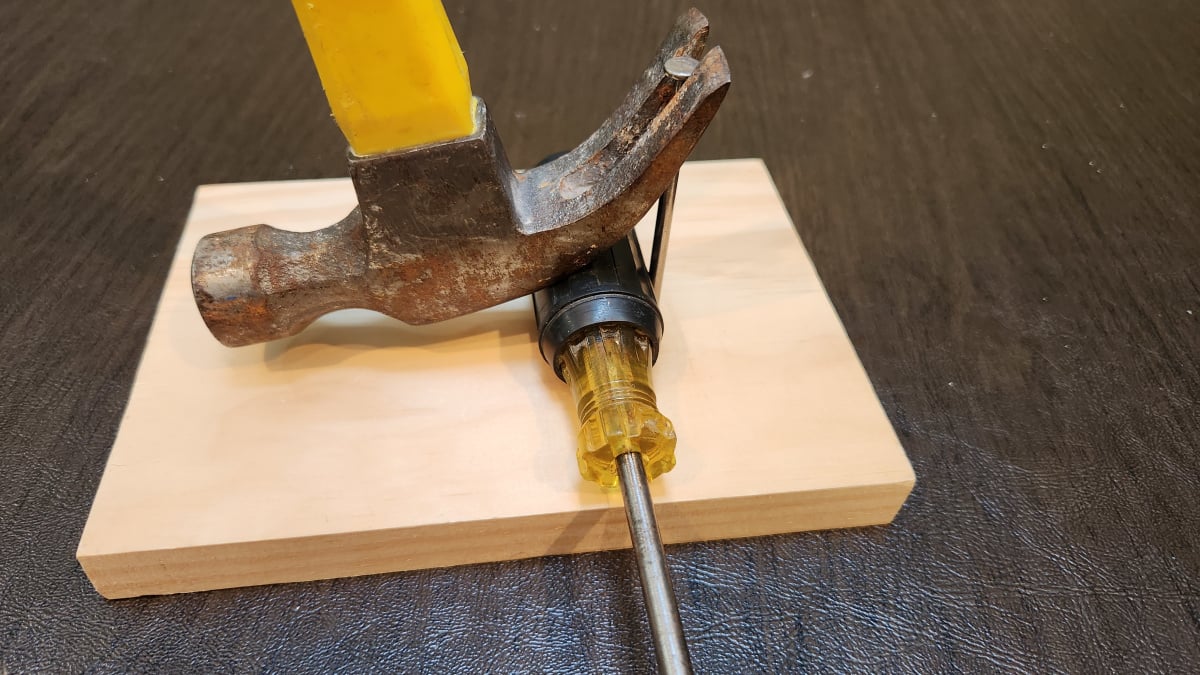
Hammer and screwdriver being used to extract nail.
Credit: Jeff Somers
One of the best lessons I’ve learned across years of DIY projects is the fact that, whether powered by hand or by electricity, your tools can can serve more than the purpose for which you purchased them—provided you get creative with how you put them to use. Often, you can use two tools together to improve their performance, make them more versatile, make them easier to use, or even to to replace a tool you’re missing.
Here are 10 unexpected ways to combine your hand tools and power tools to make DIY work a little easier.
Stick an Allen wrench into your drill
Power drill and Allen wrench being used to extract eyehook
Credit: Jeff Somers
Eye hooks serve a wide range of uses, but if you’ve ever had to drive a bunch of them into wood, you know how frustrating they can be. The usual move is to either slip a screwdriver through the hook and twist, which is slow and awkward, or to clamp a wrench or pair of pliers on top and twist, which is…also slow and awkward.
This works better: Place an Allen wrench in your power drill’s chuck, slide the end of the wrench into the eyehook, and let the drill do the work. It’s faster, it saves your elbows and wrists the strain, and you’ll wonder why you never thought of it before.
Use a shop vac to inject wood glue
Wood glue can be a lifesaver when you have a damaged piece of lumber—but only if you can actually get the glue inside the crack. If you’ve ever tried, you know that you wind up with glue smeared everywhere, but only a small amount seeps into the crack, leading to a pretty quick failure.
By combining a shop vac with your gluing efforts, you can make this much more effective. Position the shop vac up close against one end of the crack and turn it on. Then apply the glue from the other end, moving toward the shop vac. The suction will pull the glue into the crack, filling it up and resulting in a stronger bond.
Use a sander to clean your putty knives
Orbital sander cleaning knife
Credit: Jeff Somers
Drywall knives and putty knives can develop a thick, lumpy buildup of drywall mud, paint, and anything else they’re used to scrape. Eventually, they’re almost useless because their flat surface has developed its own topography.
You can try cleaning them, but water will rust them and it’s often a laborious process, especially if they’re covered in cement or thinset. If you’ve got an orbital sander, however, cleaning your putty knives and drywall knives is pretty easy. Using a moderate grit (120 works well) pad, just sand down your blade with gentle pressure—don’t overdo it; just let the sandpaper do its work. You’ll have shiny, clean blades in no time.
Use a carpenter’s square and a chalk line as a makeshift level
Getting things level is surprisingly challenging—at least for me. I can measure things five times and still somehow wind up slightly off. That makes a spirit level an essential part of my toolbox for any project (and even then, I am level-challenged, somehow).
If I forget my level, I’m in trouble—unless I happen to have a carpenter’s square and a chalk line. Place the bottom of the square on the surface you’re checking, and loop your chalk line over the top at the 90° mark so it dangles down. Then adjust until the line is directly over the 45° mark on the bottom. That’s means it’s level.
Use a screwdriver and hammer to remove stubborn nails
Hammer and screwdriver extracting nail
Credit: Jeff Somers
Trying to remove a stuck nail can be an entire project in itself. Your progress freezes while you sweat and strain, and eventually you start to damage the surface as your attempts to pull that nail get wilder and more violent.
To protect a surface you don’t want to damage and give yourself a little extra leverage on the nail, place a screwdriver under your hammer. This will give your pull a little more oomph while stopping your hammer from gouging the surface beneath.
What do you think so far?
Use a vise grip with a putty knife to remove a headless nail
Got a stubborn nail and don’t have your hammer or prybar? Or dealing with a nail that’s lost its head? You can get it free with the help of a vise grip and a putty knife. Lock the vise grip onto the nail and slide a putty knife onto the surface behind the nail. Rotate the vise grips like a lever, and the nail will slowly pull free, while the putty knife blade protects the surface underneath from damage.
Combine a wrench or pliers and a screwdriver for more torque
Screwdriver and pliers extracting screw
Credit: Jeff Somers
When dealing with a screw that seems to be frozen in place, your hand screwdriver often can’t deliver enough torque, and using a power drill with a screwdriver bit is often overkill, stripping the screw in no time. To increase the torque your screwdriver can provide, combine it with a wrench or pair of adjustable pliers. Lock the pliers onto the screwdriver at a 90° angle, push down, and turn with the plier handles. Even the most stubborn screws will work themselves free.
Use locking pliers and a flat prybar to remove nails
Another way to tackle a nail that just won’t work itself free (or that’s lost its head) is to combine a vise grip and a flat prybar. Lock the grips onto the top of the nail to act as the head, then angle the prybar underneath and apply pressure. You can also slide a putty knife under the prybar blade if you want to protect the surface you’re extracting the nail from.
Use a hammer and driver bit to remove painted over screws
Hammer and drill bit cleaning screw head
Credit: Jeff Somers
When I used to rent, I was always infuriated by the “landlord special” repairs that covered screw heads with multiple layers of paint, often to the extent that I couldn’t get a screwdriver or bit to bite. That meant a lot of slow effort scraping paint out of the grooves until I got them clean enough to extract.
Instead of doing that, combine a hammer and a screwdriver bit: position the bit on the screw head and give it some solid taps with the hammer. The crusted paint will fall right out, and you can get on with your work.
Use an adjustable wrench to find the right drill bit
How much time do you think you’ve wasted trying to eyeball a drill bit when driving bolts? You estimate the bit size, you drill the hole—nope, too small. So you grab the next-largest bit and do it again. Or, worse, you estimate the drill bit and the hole is too big, and now you’ve got a problem.
If you’ve got an adjustable wrench, spare yourself the drama. Tighten the jaws of the wrench onto the bolt, then see which drill bit matches the wrench’s opening. You’ll never have to drill three times for one bolt ever again.
