

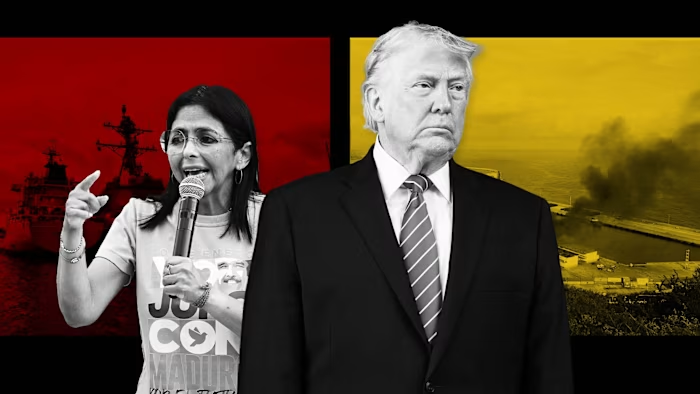
After decapitating Venezuela’s government, President Donald Trump is betting that the US can bend Caracas to its will, secure lucrative oil contracts for American companies, eject hostile powers and end drug trafficking.
But other scenarios for the South American nation also beckon, such as internal strife and conflict with Washington, after Saturday’s unprecedented strike by US commandos to snatch strongman leader Nicolás Maduro from a military base in the dead of night.
Weakened by the surprise US operation — believed to be the first ever by US military against a nation in South America — the revolutionary socialist government’s initial task is to stay united under new leadership.
Trump appears to favour Maduro’s former deputy Delcy Rodríguez running the country for an unspecified period, in return for delivering on US demands. If she fails to comply, Washington has threatened to use its naval task force in the Caribbean to cut off oil exports, Venezuela’s economic lifeline.
But Rodríguez, who is now interim president, faces an awkward dilemma: if she complies fully with Trump’s demands, she could be toppled as a traitor by hardliners within the ruling revolutionary socialist party.
Interior minister Diosdado Cabello, left, and defence minister Vladimir Padrino, both under US sanctions, control most of Venezuela’s hard power © Pedro Mattey/AFP/Getty Images
If she chooses confrontation, Trump has already threatened her with a fate worse than that of her predecessor Nicolás Maduro, now imprisoned in a New York jail with his wife. The pair await trial on drug trafficking charges.
“Whatever you say about Maduro, he held things together and managed the different power centres of chavismo well for 13 years,” said Michael Shifter, senior fellow at the Inter-American Dialogue in Washington. “That’s no mean feat. Can Delcy do that? . . . she’s very untested in that role.”
Some demands, such as giving US oil companies a bigger role in extracting Venezuela’s natural riches, would be relatively easy for Rodríguez to deliver on. As vice-president, she was involved in negotiating many of the current contracts.
But others, such as cutting ties with longtime allies Russia, China and Iran, ejecting Colombian Marxist guerrillas from Venezuela and ending its role as a transit country for cocaine, could set her against powerful military factions who profit from the illicit activities that dominate the sanctions-bound economy.
Long-serving defence minister Vladimir Padrino and interior minister Diosdado Cabello, both under US sanctions, control most of Venezuela’s hard power. Cabello runs the colectivos, a much-feared national force of gun-toting paramilitaries who ride in motorcycle groups to intimidate opponents and snuff out dissent.
Washington is “not going to get anywhere on drugs and democracy with [Rodríguez] in charge,” said Elliott Abrams, former US special envoy to Venezuela in the first Trump administration. “She is not going to reform anything because the reforms would hurt Padrino and Cabello.”
With the backing of the security forces, the hardline duo could in theory move against Rodríguez and put Venezuela back on a collision course with the US if their interests were threatened. But the history of chavismo, the revolutionary movement named after its founder Hugo Chávez, suggests it is more likely to stay united in times of crisis, particularly if its survival is at stake.
“If the military were to go to Diosdado and say ‘We’re not having Delcy as the leader’ and you had solid armed forces and security service support for somebody else, then I could see Delcy maybe being removed,” said a former senior US official who has had dealings with Venezuela. “But otherwise I really think that these guys are going to try to hold together.”
Whatever Trump or Rodríguez might want, the country’s democratic opposition may take matters into its own hands. Many Venezuelans are dismayed that Maduro’s ousting has led, at least initially, to a government that looks identical to the previous one they despised, minus the leader. They could take to the streets and invite the military and security forces to join them in a popular uprising to topple chavismo.
So far, however, there have been no stirrings of protest. The streets of Caracas were largely deserted over the weekend. Many say they fear reprisals from the regime, whose security forces are deployed across the capital, but that situation could change.
People look at a burnt truck on a highway in north-east Colombia, near the border with Venezuela. According to the authorities, Colombian militant groups Farc and the ELN operate in the region © Schneyder Mendoza/AFP/Getty Images
María Corina Machado, the Nobel peace laureate who heads the Venezuelan opposition, has called for her ally Edmundo González to be allowed to take power in the wake of the US strike. Washington and several other nations have recognised González as the real winner of 2024’s presidential election, in which Maduro fraudulently claimed victory.
But Machado has so far stopped short of calling out her supporters in Venezuela, telling them only to “be ready” for what comes next and staging demonstrations in Australia and Europe. She has vowed to return to Venezuela, a move that could galvanise mass protests against the government, but has not said when.
Trump disappointed opposition supporters by focusing heavily in his Saturday news conference after the strike on the need to develop Venezuela’s oil, apparently endorsing Rodríguez as a potential partner and dismissing the possibility of Machado taking over. He did not mention fresh elections or the release of political prisoners.
Some Venezuelan opposition figures and former US officials, however, warned that it was too early to judge what Trump’s endgame might be. They counselled patience, arguing that it was not realistic to expect their country to jump straight from Maduro to an opposition-led government and pointing to more nuanced comments by Marco Rubio, US secretary of state, in Sunday interviews.
Recommended
Rubio told CBS he had “admiration” for both Machado and González but there had to be a “little realism” about Venezuela holding new elections. “Of course we want to see Venezuela transition to a place completely different than what it looks like today,” he said. “But obviously we don’t have the expectation that’s going to happen in the next 15 hours.”
With so much uncertainty, few are risking bets on what happens next in Venezuela.
“The Trump people seem to be betting that Delcy and company can hold things together and carry out their dictates,” said Shifter. “I think that’s their preferred scenario.
“I’m just not so sure that really takes into account the complexities and the risks on the ground and the realities in Venezuela. So things could easily get very complicated.”
