

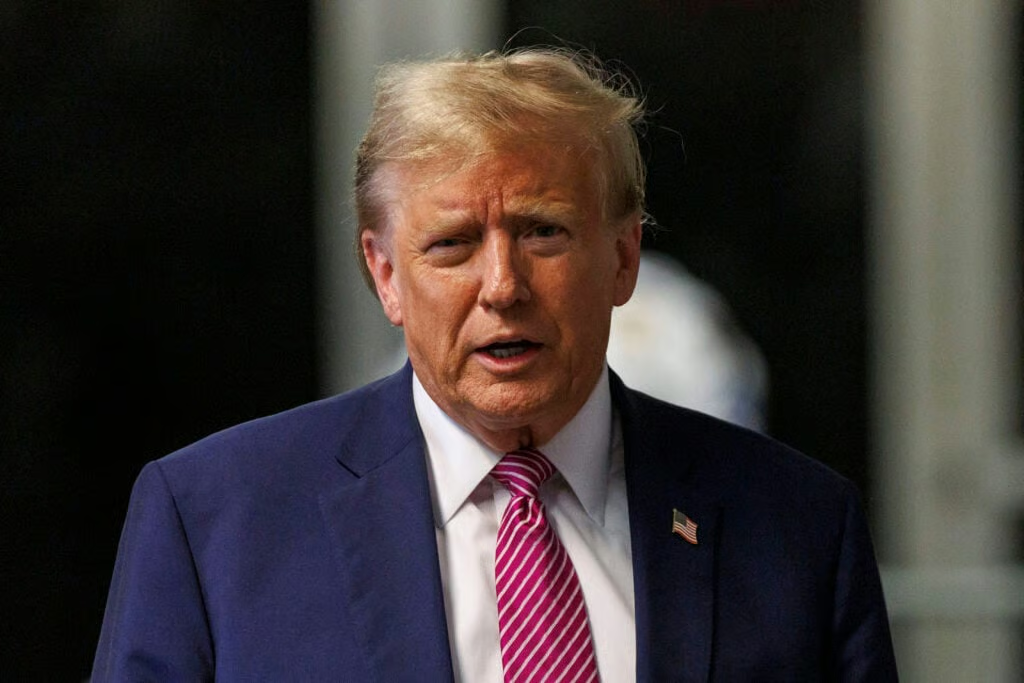
President Donald Trump pardoned three high-profile crypto figures between January and October 2025, triggering allegations that personal financial ties influenced executive clemency decisions.
Ross Ulbricht: The Silk Road Founder
Trump granted a full and unconditional pardon to Ross Ulbricht on Jan. 21, 2025, freeing the creator of the Silk Road marketplace after more than a decade behind bars.
Ulbricht had been serving a double life sentence since 2013 for operating an online marketplace that prosecutors said facilitated roughly $1 billion in illegal transactions involving drugs such as heroin, cocaine, and LSD, largely settled in Bitcoin (CRYPTO: BTC).
Trump announced the pardon on Truth Social, saying he personally called Ulbricht’s mother and credited support from libertarian voters.
He described those involved in Ulbricht’s prosecution as having “weaponized the government.”
Following the pardon, Ulbricht publicly praised Trump as “a man of his word.”
Blockchain analysis later showed wallets linked to Ulbricht still held about 430 BTC, valued at more than $45 million at the time.
BitMEX Co-Founders Receive Clemency
On March 27, 2025, Trump pardoned Arthur Hayes, Benjamin Delo, Samuel Reed, and former BitMEX executive Gregory Dwyer.
The four had pleaded guilty to violating the Bank Secrecy Act for failing to establish anti-money laundering and know-your-customer programs while operating BitMEX.
Prosecutors accused them of operating BitMEX as a “money laundering platform.”
The co-founders were ordered to pay $10 million each in civil fines, while BitMEX itself paid $100 million.
Hayes tweeted “Thank you POTUS” after the announcement while Delo said the decision validated their long-standing claim that the case was excessive.
Hayes has since continued to promote a bullish long-term outlook for Bitcoin, including a $1 million price target tied to global monetary expansion.
Changpeng Zhao’s Pardon Sparks Backlash
Trump pardoned Binance founder Changpeng “CZ” Zhao on October 23, 2025, sparking the most intense backlash of all crypto pardons.
CZ pleaded guilty in November 2023 to enabling money laundering while CEO of Binance, paid a $50 million fine, and served four months in prison.
Binance agreed to a $4.3 billion settlement with regulators.
Trump said he doesn’t know CZ personally but was told by “a lot of people” that CZ was “persecuted” by the Biden administration.
The decision drew immediate criticism from lawmakers, who argued the pardon raised serious ethical concerns.
The Corruption Allegations
Congresswoman Maxine Waters (D-CA) called the pardon a “blatant display of corruption” tied to Trump’s financial interests in digital assets.
Waters claimed Changpeng Zhao “spent months lobbying Trump and his family while funneling billions into Trump’s personal crypto company,” referring to World Liberty Financial (CRYPTO: WLFI).
Reports indicate Binance parked $2 billion in WLFI’s stablecoin, generating about $80-87 million annually.
With a 60% stake, the Trump family could receive $48-52 million in passive income.
Additional disclosures showed Binance spent about $800,000 on lobbying related to clemency efforts and paid $450,000 to a firm run by Charles McDowell, a longtime associate of Donald Trump Jr., to seek executive relief.
Zhao denied any quid pro quo, calling reports of a deal with World Liberty Financial “categorically false.”
Senator Elizabeth Warren (D-Mass.) echoed the criticism, saying Zhao pleaded guilty to money laundering charges, promoted a Trump-linked crypto venture, and then received a presidential pardon.
Read Next:
Image: Shutterstock
