

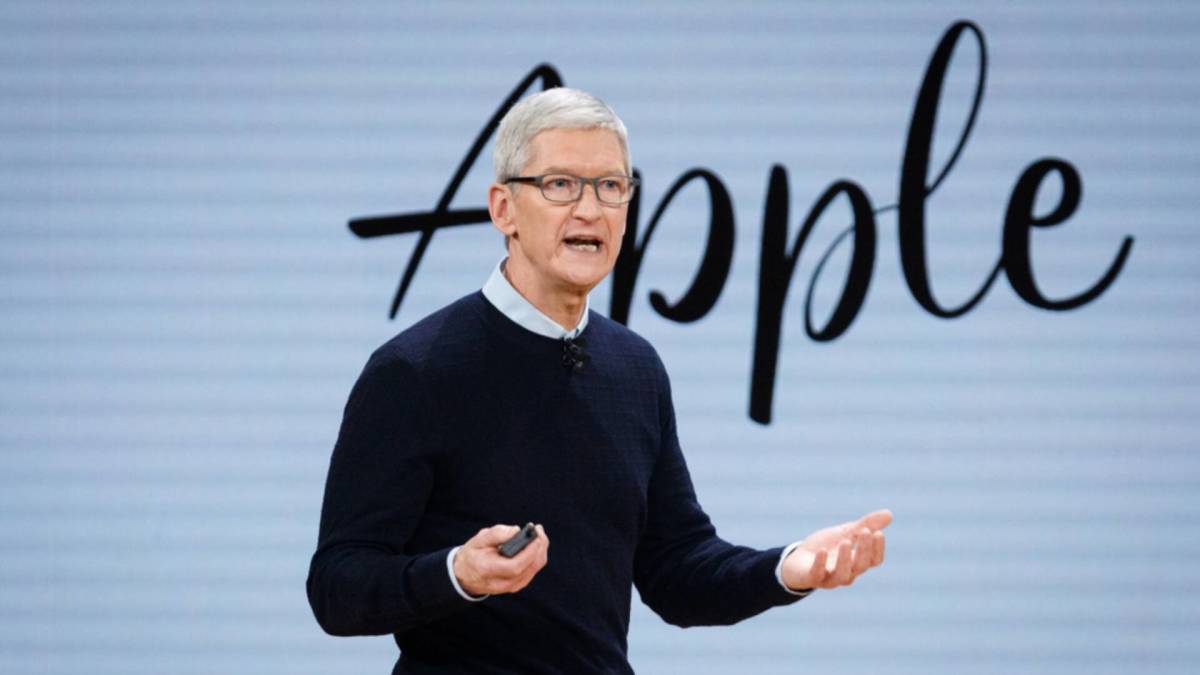
Apple (AAPL) stock investors appear to be fixated on soaring memory costs of late. However, Bernstein’s Mark Newman feels they’re looking in the wrong place and should start focusing on AI.
In doing so, Newman bumped his price target on Apple to $340 from $325. With shares of the Cupertino giant trading near $273, that implies a nearly 24% upside from current levels.
To be fair, though, Apple fans weren’t exactly pulling that idea out of thin air.
In fact, Apple CEO Tim Cook specifically addressed memory after the company posted another blowout quarterly report.
Still, when pressed about pricing being a possible lever for the iPhone 18, Cook wouldn’t go there.
The cautiousness suggests Apple is still weighing its options, and clearly, the math behind the upcoming iPhone lineup still hasn’t been worked out.
However, veteran Apple analyst Ming-Chi Kuo doesn’t expect a major shift in approach, at least for now, as the tech giant is likely to stick with its existing strategy heading into the iPhone 18 debut.
Despite the validity of those concerns, Newman points to a bigger catalyst in Apple Intelligence and Siri 2.0 to drive the stock’s next leg higher.
Newman feels Apple’s hybrid AI architecture could unlock a major new upgrade cycle, which is a bigger story than memory inflation.
Bernstein updated its Apple price target, reshaping the stock’s near-term outlook.
Photo by Justin Sullivan on Getty Images
Apple’s latest Wall Street price targets
- Wedbush:$350 (outperform).
- Goldman Sachs:$330 (buy).
- JPMorgan:$325 (overweight).
- BofA Securities:$325 (buy).
- Morgan Stanley:$315 (overweight).
Sources: Yahoo Finance, Investing.com
Apple’s cost pressures are real, but the growth story is bigger
Despite memory cost inflation being a big deal, it still doesn’t fundamentally impact Apple’s tremendous earnings power, Newman shared in a CNBC interview.
That’s not to say he doesn’t expect iPhone production costs to rise, though.
Heightened component costs could push iPhone prices up by as much as 15%, Newman added, while bumping the overall average selling price by nearly 12% as some customers trade down to cheaper models.
More Tech Stocks:
- Morgan Stanley sets jaw-dropping Micron price target after event
- Nvidia’s China chip problem isn’t what most investors think
- Quantum Computing makes $110 million move nobody saw coming
That increase is substantial, and it comes down to a staggering 237% surge in mobile DRAM contract prices since Q2 2025, along with a 70% jump in NAND.
Despite the pressures, Newman feels that Apple separates itself from the pack through its superb execution.
He says Apple is “managing better than competition,” led by unmatched scale advantages, supplier leverage, product mix, and durable pricing power.
To his point, Apple has evolved into a powerful platform company with a walled-garden ecosystem that locks users in.
That matters a ton when costs spike.
That’s why even with the memory pressures in play, Bernstein’s modeling points to iPhone gross margins dropping by nearly 1.5 percentage points by Q4 2027.
Though that’s meaningful, Newman believes the EPS impact will be substantially offset by higher-margin services revenue, mix shift, and aggressive cost management.
Apple’s AI ambitions outweigh rising costs
Newman’s bullish take on Apple centers around AI.
Instead of AI technology showing up just as a chatbot, Newman says Apple is deploying it as a system-level layer, making its ecosystem stickier.
What makes this possible is a hybrid design that handles as many requests on the device and reroutes the heavier ones (advanced reasoning) through Private Cloud Compute using Google’s Gemini.
Related: Cathie Wood drops $10 million on resurgent tech stock
That robust setup ensures Apple’s privacy positioning remains firmly intact, while delivering cutting-edge responses and features.
Unlike many of its peers, Apple isn’t in the race to win AI benchmarks or translate those gains into tangible financial gains. It just needs those features to change behavior and pave the way for healthier services revenue.
In fact, some of the earlier modeling supports that logic.
Morgan Stanley’s April 2025 survey, as reported by Investing.com, was an early “tell” that Apple’s AI pitch would likely move the needle.
At the time, 51% of iPhone owners said they were “extremely likely” to upgrade in the next 12 months. More importantly, those respondents, compared with those in the previous fall, showed a 12% higher willingness to pay $9.11 per month for Apple Intelligence.
For perspective, the significant Siri 2.0 (the next phase of Apple Intelligence) is reportedly set to launch in spring 2026, according to Mac Rumors.
Ironically, Apple stock was initially blasted for lagging in the AI realm. However, as we’ve gotten deeper into the cycle, Newman argues that investors have actually felt a lot “more comfortable” amid the AI wars.
For more context, Apple stock has gained an impressive 20% over the past six months, while the Roundhill Magnificent 7 ETF is up just 7% during the same period.
Apple vs. S&P 500: returns from YTD to 10-year
- YTD: Apple 0.67% versus S&P 5001.41%
- 1-year: Apple 20.22% versus S&P 500 14.43%
- 3-year: Apple 81.23% versus S&P 500 69.71%
- 5-year: Apple 102.14% versus S&P 500 77.55%
- 10-year: Apple 1,061.26% versus S&P 500 274.86%
Source: Seeking Alpha
Related: Bank of America sends quiet warning to stock market investors
