

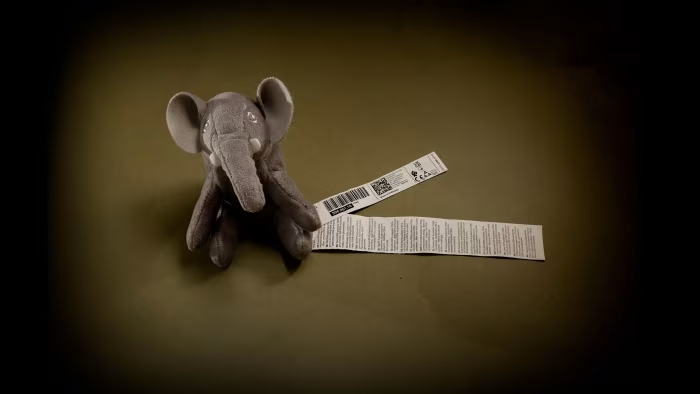
If there is one product that symbolises the absurdities of the EU’s single market in goods, it might be a cuddly elephant.
The Djungelskog toy from Ikea may only be 12cm tall and cost less than €2, but it has a 20cm-long label protruding from its behind.
Environmental rules from France and EU textile legislation account for much of the length. But the elongated label reflects a strategic, even a philosophical, problem for Europe as its companies battle to compete globally.
The single market in goods should be the EU’s crowning achievement. Compared with free movement of people, services or capital, it is the area that has come furthest in more than 30 years since the common market was established.
Yet there remain small, often invisible barriers to trade that, taken together, amount to what the IMF estimates is a drag on Europe’s economy equivalent to a tariff of 44 per cent.
“We entered the EU because of the single market. It is our religion,” said Anna Stellinger, deputy director-general of the Confederation of Swedish Enterprise.
But she added of the single market for goods: “This is where the hurdles are that are the most illogical and uncalled for. It’s technical and it’s detailed, but in our view it’s one of the most crucial things for growth.
“Xi Jinping is not doing it to us, Vladimir Putin is not doing it to us, Donald Trump is not doing it to us. We are talking about a one- or two-digit percentage of growth in Europe.”
As businesses across Europe struggle in the increasingly competitive fight with US and Chinese companies — both of which can draw on huge internal markets — the stubborn problems ensnare everything from falafels and ski poles to paint and toy kitchens.
“It’s a mess for small and medium-sized enterprises. The number one issue is bureaucracy,” said Jacob Wallenberg, a leading Swedish industrialist. “To run a business in Europe is perhaps more cumbersome than we have ever seen.”
The Djungelskog elephant’s labels contain information mandated in other countries but most of the length is occupied by material required by EU nations. Ironically, the first thing many parents do, according to an Ikea executive, is cut off the labels whose contents are designed in part to cut waste — creating more waste.
For a company with Ikea’s scale, such seemingly trivial issues add up. Fully 2.8bn Ikea items are printed with France’s “Triman” environmental logo and explanations in French, despite only 16 per cent of those products actually being sold in France.
Ikea said the 2020 introduction of the mandatory Triman logo alone cost it and its suppliers “thousands of extra working days” as its packaging specialists and production engineers analysed and updated labels. In 2022, the European parliament found that measures to ease regulatory complexity and facilitate trade within the bloc could offer economic benefits of €228bn to €372bn a year.
“The single market is super important for Ikea. One of the reasons why we’re successful is that we can keep low costs without undermining standards and quality by using scale,” said Roberta Dessi, head of EU affairs at Inter Ikea, the part of the sprawling flat-pack furniture empire that owns the brand and concept.
But she added: “You need the harmonisation of how rules are applied and enforced. We are facing big problems when rules are not harmonised.”
Much of the problem springs from individual countries imposing national rules in areas such as environmental labelling. At times companies also blame the European Commission for not enforcing its own rules and trying to stop bureaucracy in its tracks.
The Triman logo is one case in which European authorities have been spurred to act. Brussels referred France to the EU Court of Justice in July, arguing that the requirement presented an obstacle to the free movement of goods. But in the meantime, companies must keep the large logo on their products.
And France is not the only culprit.
Retailers print labels that conform to rules in multiple countries because they want to keep costs down and allow flexibility in their supply chain. They could produce packaging just for France, say, but if a given item proves more popular in Spain, they would not be able to divert it for sale there without Spanish labelling.
The problems can go deeper. Dessi said that at one stage French legislation stipulated that packaging must not include the common “Green Dot” recycling label, while in Spain the label was mandatory. That particular squeeze was avoided when a French court ruled the provision was illegal.
Ikea is far from the only company affected. H&M’s cute stuffed toy shaped like a marshmallow boasts no fewer than eight small labels. Many favourites are there: France’s Triman logo and its explanation get a label, while materials are explained in up to 35 languages. Some countries, such as France, also have their own care symbols.
H&M’s Marshmallow soft toy — with no fewer than eight labels protruding from it © Charlie Bibby/FT
H&M said it “works to sell safe and compliant products in all our markets. In addition to that, we need to keep flexibility to be able to move products from one selling market to another — hence the need to label our products with a global mindset.”
Prolific labelling only works for certain products. Dutch paint producer AkzoNobel has to include France’s Triman logo, Spain’s Punto Verde and Italy’s alphanumeric material code — but space is so tight on its one-litre cans that it now holds separate stocks for France, Spain and Italy. On multilingual packs AkzoNobel sometimes even has to include contradictory information on how waste should be handled, further confusing the consumer.
AkzoNobel, which makes Dulux paint, now holds separate stock for different markets © AkzoNobel
Companies are careful not to fault the intentions behind the national rules. But the problem comes when countries apply different standards. AkzoNobel faces a similar problem over indoor air quality: lacking common European rules, many countries have introduced their own standards for volatile organic compound emissions from paints.
This means different criteria in each country — including in neighbours such as Germany, Belgium and France — leading not only to different labels but also to different administrative procedures to get a paint tested, approved and scored.
Individual EU countries may also produce odd outcomes, and companies can face sudden blocks on selling particular products, even when they spend significant sums on trying to meet all the regulations.
Ikea’s Duktig toy kitchen, sold across Europe, is a classic for many families. But Inter Ikea said one EU country suddenly classified it as a “functional toy”.
This category is intended for toys that are exactly the same as their grown-up version — in this case, suggesting that you could boil water for pasta or wash up dishes. The Duktig is not, in fact, designed to connect to actual plumbing or power sources.
The Ikea Duktig kitchen © Ikea
Ikea had to stop selling the product; it said it appealed against the decision in the national courts, but lost, then took it up with the European Commission. The commission agreed the complaint was well-grounded, but declined to take legal action as the problem had only reared its head once.
Ikea declined to identify the country concerned, but its national websites show the Duktig kitchen is for sale in every EU country apart from Romania.
Myriad other small issues add up to huge complexity. Extended producer responsibility schemes levy fees on companies to help fund waste collection and treatment at the end of a product’s life. But the rules across a slew of materials are a mishmash of regulations imposed at EU, national and local levels.
Companies “that are producing the same product across the EU receive very conflicting messages, and will end up being sanctioned or rewarded for the same product in the 27 member states”, Dessi said.
All this means time and money wasted. Sevan, a family-owned Swedish food company, ran into a bizarre problem when creating falafels for a private label for the Nordic region.
Just before the product was finalised, the company discovered that the normal baking powder used in the falafel — made from bicarbonate of soda and acid — was approved in Denmark as a food additive but not for use in the category that includes falafels. Sevan was forced to switch to using bicarbonate and acid separately, triggering a fresh regulatory approval process, said chief executive Elin Ingves Pyk.
Keeping track of such local differences proves a constant challenge, she said. “We still don’t understand why, if baking powder is OK to use in falafel in Sweden, it is considered dangerous in Denmark.”
Swedish food company Sevan had to change the recipe for its falafels… © Sevan…in order to be compliant in all Nordic markets
Kang, a Swedish maker of hipster-approved sustainable ski poles, discovered EU bureaucracy when it wanted to start exporting within the bloc. Carl Norinder, chief executive, said it was forced to register with a recycling programme in Germany even though it has so little packaging that it only had to pay the scheme €20 a year.
“We spent several hours finding information on how to register and finding a supplier, so we felt that the opportunity cost was disproportionately high,” he said. Worse, several other European countries required a similar process.
Europe is slowly eliminating some issues. Lift manufacturers have long complained about different national standards; Kone, the Finnish lift maker, told regulators how Denmark required a high level of lighting for the location where lift equipment is installed, while the Czech Republic wanted special wiring for controllers in evacuation routes and France needed specific fire ratings for decorations inside lifts. But Kone said its concerns were allayed by new EU standards due to take effect early next year.
Who killed Europe’s single market dream?
This is the second piece in an FT series examining what went wrong with Europe’s flagship economic project — and why it is so difficult to revive the single market as a growth engine
The EU is also working to harmonise certain instructions on waste, promising some relief for companies such as Ikea. But Dessi said a single European recycling symbol, rather than multiple national ones, would be even more helpful.
Most of the barriers are far from fatal in themselves for European companies, but together they create a huge competitive disadvantage, executives said.
“It’s just making things more complicated than they need to be,” said Vincent Clerc, chief executive of AP Møller-Maersk, the world’s second-largest container shipping company and a bellwether for global trade.
“It is a self-inflicted injury,” said Clerc. “It is not any individual country. It’s all of ourselves.” The industrialist, who is active in both trade and EU discussions, said there was a long way to go with the EU single market: “The devil is in the detail.”
Part of the problem may be that the detail has become highly technical. Stellinger of the Confederation of Swedish Enterprise said the conversation about the single market was both “abstract [and] particularly boring”.
But she added: “It’s the most successful free trade agreement in the world. We need to do the nitty-gritty things. That will give us extra growth.”
Dessi contemplated a stuffed panda in her office with a label as long as the elephant’s. She said of the single market in goods: “Why don’t we see that this is what makes Europe strong? Why are we struggling so much to put it at the centre of the agenda?”
Design and development by Sam Learner and Irene de la Torre Arenas
